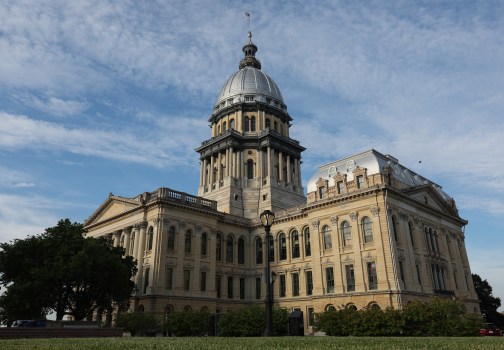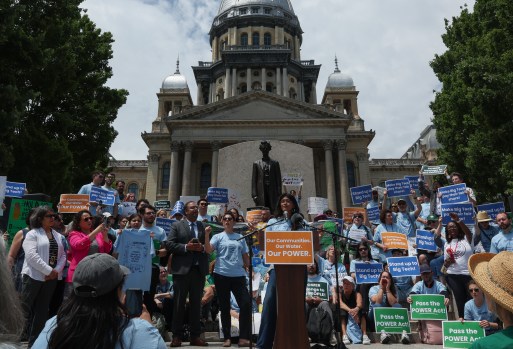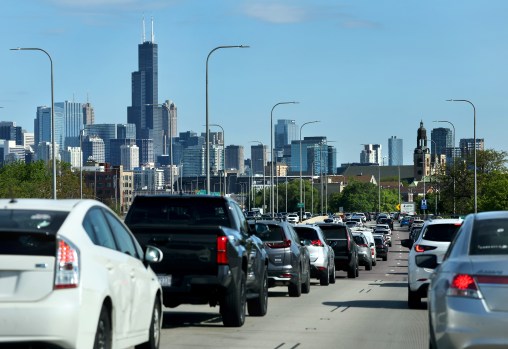
The naysayers have had their say. Concern over a bold tower, characterizable as brooding. Worries about neighborhood gentrification, implying a new tourist destination is all downside. The amplifying of complaining subcontractors, always easy to find. And an absurd prejudgment that a museum celebrating a presidency could not coexist with an institution also focused on offering art, basketball and a plethora of gathering spaces to a community that has suffered from disinvestment for decades.
Even without the political baggage — all presidential libraries, now centers, are of most interest to those who believed in and miss the celebrant — a project as massive as the Obama Presidential Center (OPC), set to officially open Friday in the Chicago neighborhood of Woodlawn, would attract a variety of opinions. We’ve consumed many of them. You’ve likely done the same.
Bold architecture is supposed to spark debate and there can be no question that the OPC struggles to reconcile its desire for Apollonian, granite-clad gravitas, as befits the presidency of the United States, with grills, jump-shots and sledding hills. Inevitably so, in our view. The same baked-in contradiction can be found in the honoree. Maybe in all presidents in their different ways.
But here at Barack Obama’s hometown newspaper, where a historic and unexpected endorsement put wind in his sails on his way to the White House, we’re focusing on different things in this, our main editorial judgment on this new entity in our city.
Our starting place is a number: $850 million.
That’s the amount of private investment being made through this center in Chicago’s South Side, which has suffered from neglect for 100 years or more. Valerie Jarrett, the head of the Obama Foundation and thus this entire operation, asked us at an editorial board meeting held at the center on Monday whether we could think of a comparable private investment in something located south of the South Loop.
We could not. Can you?
The OPC’s admission fees and rentals won’t cover the projected annual running cost of $75 million, John Roberson, the center’s executive vice president told us. That means there will need to be continued private investment in this same community. We don’t doubt it will occur.
This leads us to our next point: This will be a major new tourist attraction for Chicago, not unlike Millennium Park, a massive success, but drawing people to a part of the city they likely would not have otherwise visited.
A city is not an amusement park, but it must learn from the likes of Disney or Universal that people always need reasons to return.

When there is a new marquee attraction, it sparks fresh visits and that means more business for existing destinations, not to mention hotels, restaurants and retail operations throughout the city.
We’ve written innumerable editorials lamenting what Chicago has turned down or lost: World Cup matches, a Bears stadium in city limits (or so it appears), the Lucas Museum of Narrative Art. We’re still mad about that last named entity, slated to open in Los Angeles in September, even though the globally famous George Lucas and Mellody Hobson wanted their populist attraction here and were willing to fund it entirely themselves.
Lucas did not prove to be a skilled ring-kisser. The shrewd, long-serving Obama hands Jarrett and Tina Tchen coached this project through all the minefields Chicago inevitably put in its way. They executed at the highest level. No mean feat.
Their efforts will pay off for some valued Chicago institutions in ways still underappreciated.
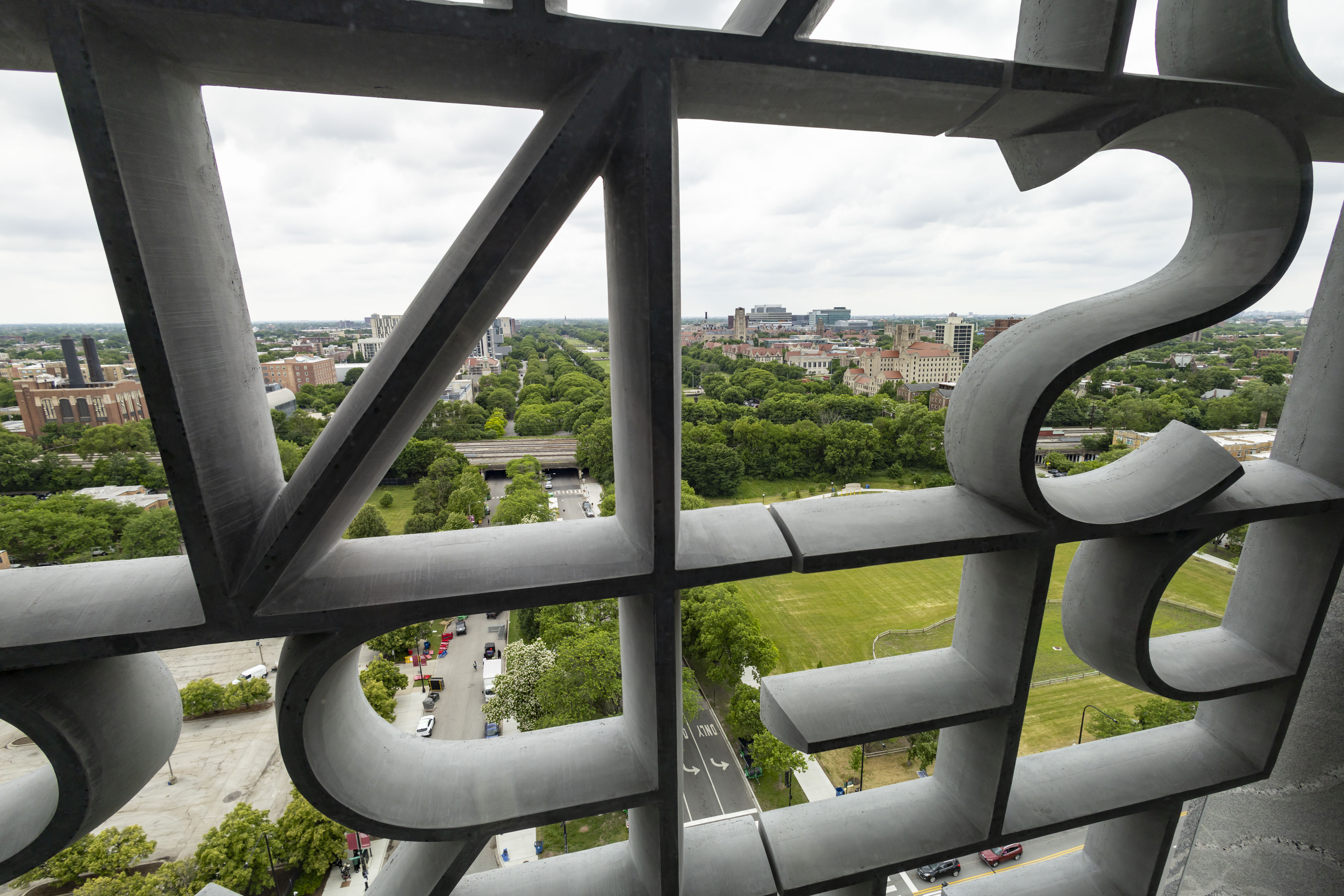
Take, for example, the University of Chicago, which not only will enjoy the prestige of the center but now has something new to show off to prospective students and their parents, often deciding between the U. of C. and the Ivy League. Vistas from the Obama tower now showcase the Hyde Park campus in all of its collegiate Gothic glory. Recruits will be knocked out. And University of Chicago institutions like the Institute of Politics will have a new TV-friendly, state-of-the-art venue for talks and debates, far superior to that at the Kennedy School of Government at Harvard.
Take for another example the Griffin Museum of Science and Industry (GMSI), the grand south side of which can now be viewed spectacularly from the top floor of the OPC, rendering it almost like a shadow White House staring down on the newcomer on the block. Thanks to the newly beautified Women’s Garden, a callback to the 1893 World’s Columbian Exposition, Jarrett’s argument to us that there will now effectively be two museum campuses in Chicago, one downtown and one on the South Side, strikes us as accurate. New express bus service, Roberson noted, will serve both the GMSI and the OPC from the Loop. What an educational day that will be for many families.
Unsurprisingly, the Obama Presidential Center trumpets the achievements of President Barack Obama and does not focus on what he did not get done, nor, indeed, what got rolled back by subsequent administrations, which is a great deal. That said, we admire the efforts made at the museum to avoid abject hagiography by focusing on the viewer, especially the future life of the young visitor interested both in American democracy and in public service. Those who lived through the Obama era will find little to be surprising here; to our minds, the museum is most useful for the young.
This is, after all, a presidential center, not a library, a decision made in light of Obama being the first president of a truly digital age. The documents a researcher might crave are online or, if a scholar really wants to hold the hard copies, in Maryland under the care of the National Archives. A cynic might say this development makes the OPC a redundancy or merely a partisan theme park. But we see plenty of value in what is being presented here. Digitization too often brings the devaluation of place and time. A presidency should remain tactile.
Jarrett told us without ambivalence that the OPC intends to be welcoming to Republicans and to those who disagreed, and continue to disagree, with Obama’s point of view. Tchen said the same of the programs she will oversee. Jarrett, Tchen and Executive Vice President Robbin Cohen also said that they do not see this place as somewhere that will take stands on “issues of the day,” as Jarrett put it. This may prove a lot harder than they now think, but it reflects Obama’s relative centrism, by today’s standards, within the Democratic Party and it is the right way to go.
Some of our enthusiasm for the center flows from our Chicago partisanship, to which we freely confess.

Obama put Chicago at the center of the national conversation; he began his political career here and ended it here with his goodbye speech at McCormick Place, which some of us attended. His first transition into office was managed from the Loop. We’ve been disappointed to see so little of him, frankly, even in the run-up to the opening of this center. But in a city that has to compete nationally with New York, Washington and Los Angeles for young talent, that advance from being merely a regional capital meant something here. Chicago has felt that loss of prestige since then. And while this museum won’t return all of that to us, it still is a step in the right direction. It is a far more meaningful post-presidency achievement than another Netflix documentary.
Chicago now also has another world-class contemporary art museum, replete with large-scale pieces, some of which will be temporary installations and sculptures. Some will come here to see a replica of the Oval Office or watch the ample video footage or see the first lady’s dresses; many Chicagoans will leave talking about the extraordinary quality and scale of the art. Meanwhile, many in the neighborhood will see this as a beautiful place to take a contemplative stroll or sit and read a book in the sun or sled in the snow. On a prior visit, we spoke to a family that had spent an entire day there, kids happily playing in the park.
We’re hardly strangers to tall buildings in Chicago. But there simply is no other place on the South Side where the public can ascend and see the city from the southern point of view, adding to visitors’ awareness of the city’s geography as the omnipresent lake shimmers in a lesser-photographed spot. And perhaps more remarkably, the aerial view of the South Side’s proud neighborhoods is a revelation, a public opportunity afforded nowhere else in the city.
During our meeting, the OPC executives said they were confident Chicagoans would cherish and look after this place; after all, once the bigwigs exit at the weekend, the fences will come down and anyone and everyone will be able to visit the library and roam everywhere except the ticketed museum. The grounds will be open, seven days a week, from 6 in the morning to 9 at night.
Time will tell, of course. But on a visit with many others, we most certainly saw people making an effort to be their best selves, kind to fellow attendees, especially of different races, and elevated of conversation. To some degree, all grand city museums prod us to be our better selves.
But this one is here and it is new and it is grand and it is ours.
Submit a letter, of no more than 400 words, to the editor here or email letters@chicagotribune.com.