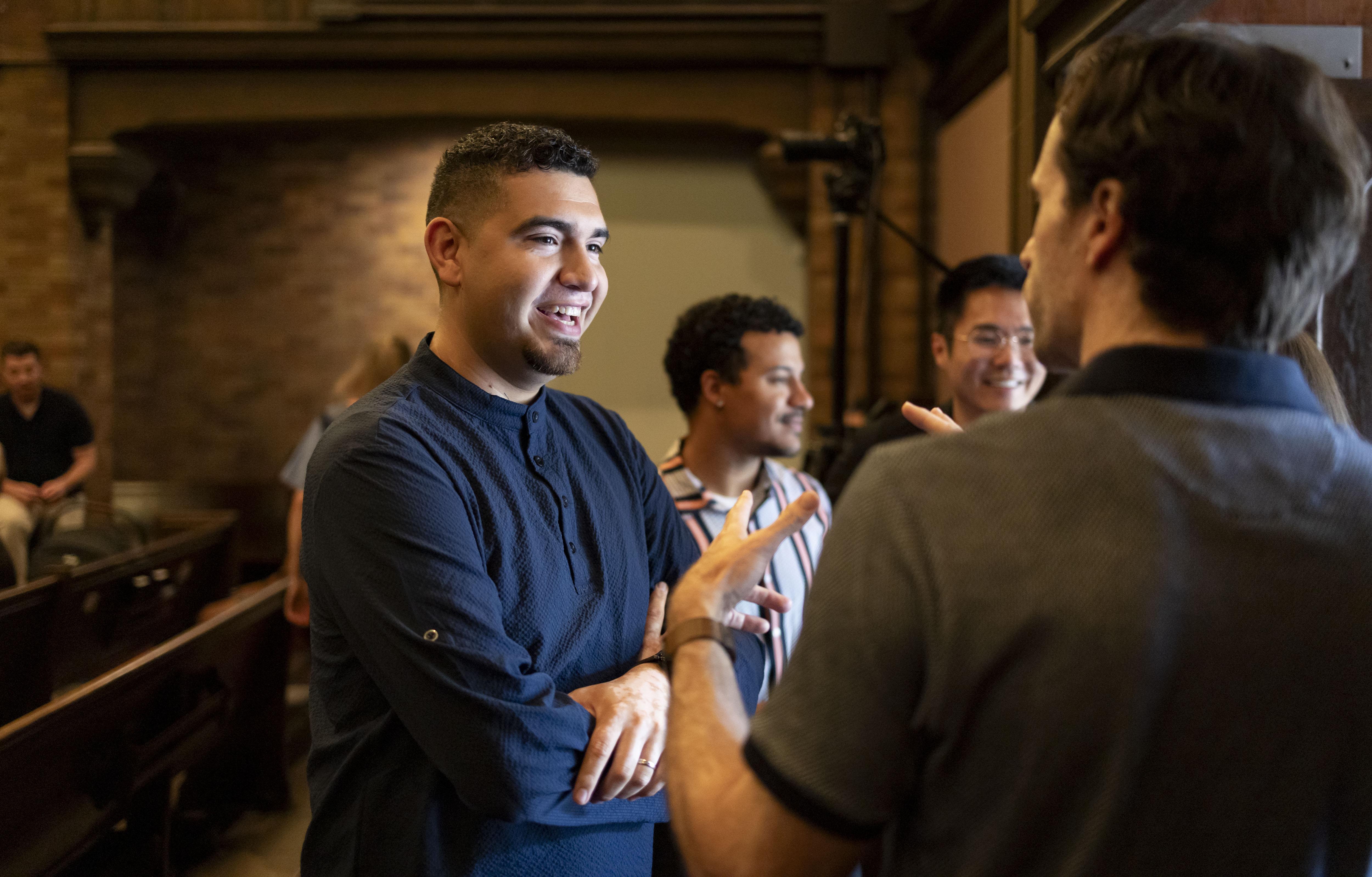
For much of his life, the pastor considered his immigration status akin to a legal purgatory.
At the age of 6, his undocumented mother and father brought him from his birthplace of Guadalajara to the Southeast Side of Chicago in search of a better life for their family in the United States.
The Rev. Edgar Torres has few memories of growing up in Mexico but vivid ones of singing “The Star-Spangled Banner” alongside his classmates as a little boy.
“At a young age, you don’t know if you’re undocumented or documented. You’re just a child,” he recalled. “I thought I was a proud American because I didn’t even know I was a citizen of Mexico. Because I always found the U.S. to be my country.”
Despite this strong sense of belonging and patriotism, he was essentially living on the margins, first without legal authorization as a child and later as a Deferred Action for Childhood Arrivals recipient for roughly a decade during adulthood.
Yet a quarter century after his immigration, Torres was finally able to become a citizen and formally take the oath of allegiance to the nation he had long known and loved during his naturalization ceremony in October at the Dirksen U.S. Courthouse in Chicago.
Surrounded by his wife, baby daughter, parents — who by then held green cards — and dozens of other candidates for citizenship from all over the world, Torres pledged to support and defend the Constitution and laws of the United States. To renounce and abjure fidelity to any foreign power. To bear true faith and allegiance to this country.
“For me, that was such a beautiful, powerful moment,” Torres recalled. “You just saw my mom completely bawling as she’s seeing her son taking an oath to this country.”
Torres is among the tens of millions of immigrants who have made the United States their home since its founding on July 4, 1776. The narratives of these new arrivals have been deeply woven in the fabric of the nation’s history, economic prowess, diverse culture and politics since its inception.
Some come seeking an education, work and economic mobility. Some are fleeing authoritarian regimes, war or natural disasters. Others reunite with family members and loved ones, often after months or years of separation by oceans and continents.
As the 250th anniversary of the United States approaches, several of the nation’s newest citizens in the Chicago area shared with the Tribune some of the joys and struggles of their journeys to the U.S. as well as their reflections on their adopted homeland as it reaches this milestone birthday.
A Naperville man from India called the United States “the greatest country in the world,” though he longs for a return to a climate of more civility and less polarization, reminding Americans that despite divisions there is much to be grateful for here.
A woman born in Russia recounted her pride in casting a ballot for the first time during the March primary; she served as an election judge at her local polling place because, she said, “citizenship is not only about rights, it is also about participation and responsibility.”
A United Kingdom emigrant marveled at the uniqueness of the American experiment — a fairly young nation intentionally designing its system of governance largely from scratch — from the Declaration of Independence’s ideals of “life, liberty, and the pursuit of happiness” to a written Constitution outlining the rights of the people and the government’s structure.
And Torres, the pastor born in Mexico, often speaks from the pulpit of the Biblical command to care for the stranger, telling his own story to evoke support for immigrants. He advocates for more protections and a pathway to citizenship for so-called “Dreamers,” undocumented residents brought to the U.S. as children, and helps raise funds for programs for refugees and other new arrivals.

Torres lamented that the nation’s landmark semiquincentennial comes amid a fever pitch of anti-immigrant sentiment in the United States, marked by a rise in xenophobia and an onslaught of attempts to restrict newcomers here and abroad.
Fear spurred by the Trump administration’s immigration crackdown has reverberated across the Chicago area and other major cities nationwide.
Refugee resettlements have been capped at an all-time low this fiscal year. In January, the State Department indefinitely paused immigrant visas to applicants from 75 countries deemed at a high risk of “public benefits reliance,” to ensure they don’t “unlawfully utilize welfare in the United States or become a public charge,” according to an agency statement.
On the first day of his second term, President Donald Trump issued an executive order attempting to end automatic birthright citizenship for many babies born in the U.S., though the measure has been blocked by the courts as the nation awaits a landmark Supreme Court ruling on the matter expected this summer.
“I believe this 250th celebration should focus on those who built this country too,” said Torres, 32, who works as a church mobilizer for the nonprofit World Relief Chicagoland and serves as the president of the Latino Association of the Evangelical Covenant Church. “And that would mean some of our immigrant communities.”
In the face of so much recent backlash against new arrivals, various groups around the country have made a point of championing the contributions of immigrants as a part of their 250th anniversary festivities.
The U.S. Conference of Catholic Bishops earlier this month released a prayer service recognizing immigrants and refugees, to be used for semiquincentennial observances across the country.
The text includes a moment of silence “in solidarity with the millions of migrants who, each day, risk their lives in search of a place of safety and belonging — whether to reunite with loved ones, to seek new opportunities, or to secure the means to support families who remain in their countries of origin.”
The website of Illinois America 250, the state’s official yearlong anniversary commemoration, acknowledges that “millions of people have emigrated from and immigrated to Illinois, or sought refuge in our state, bringing with them their culture, lifeways, knowledge, and labor, which has shaped Illinois into one of the nation’s most diverse states.”
Historians note that anti-immigration fervor tends to peak during eras marked by widespread feelings of economic uncertainty, political turmoil and societal change.
Yet DePaul University professor Martha Gardner offers an alternative perspective, one where the experiences of immigrants can offer society comfort, cohesion and a sense of hope in their nation during times of apprehension.
“They can tell us what America means by reflecting on why they wanted to come and join us and be here. It’s a shame that we don’t allow those voices to be louder,” said Gardner, author of the book “The Qualities of a Citizen.” “Because if we are having this sense of anxiety about a society that is changing — an economy that is being transformed, a politics that seems deeply fractured, a sense that we’re living in a modern period that for some people feels deeply frightening and maybe unrecognizable — we could take great comfort in the stories and narratives that immigrants tell us about why they believe so much in the United States.”
‘Undercurrent of tension’
The father longed for his son to one day live the American dream.
Aditya Rao traveled from his home in southern India to a university in New Hampshire at 27 to pursue a master’s degree in information systems in 2015. Both his parents supported him making the roughly 8,000-mile journey around the world, his dad in particular.
During school, Rao worked in a warehouse and at a calendar kiosk at a local mall to help pay his rent.
Performing these common jobs was remarkably refreshing for the young immigrant, who noted that back in India there was still a deep cultural stigma against taking work deemed to be beneath one’s social status or education level.
“One thing I really loved about America was the dignity of labor,” he said. “Unfortunately, that kind of discrimination still exists in that part of the world. You’re seen as less because of the kind of work that you do.”

In 2017, Rao’s father became ill, but the son was afraid to fly home to be by his side due to severe travel restrictions and heightened vetting of student visa holders during the first Trump administration.
International students risked being detained and questioned at ports of entry; Rao recalled that some of his friends who were also here on student visas were grilled by federal authorities when they tried to reenter the country.
“There was this undercurrent of tension that they might stop you just because you’re an immigrant,” he said. “Not many international students wanted to take that chance and throw everything in the water.”
His father died before he could travel back home to say goodbye.
“I couldn’t be there when he passed,” Rao recalled, his voice breaking up a little. “That is the kind of sacrifice that you make sometimes when you move. But he had always dreamed that I would come to the U.S. and live a good life.”
As a green card holder in 2022, Rao was able to travel with much greater ease back home to visit India.
At the shore of the Ganges River, waters considered sacred in his Hindu faith, he immersed some of his father’s cremated remains to perform the funeral ritual Asthi Visarjan, which is believed to help the soul transition to salvation and liberation.
After completing his education in the United States, Rao’s work took him to Dallas, where he met his wife, a physician and cancer researcher who was also an immigrant from southern India. His mother made the trip from India to watch them wed in Texas.
Just before the outdoor ceremony, a brief unexpected rain misted an otherwise sunny day. The groom believes the trickle of a shower was his father’s presence, offering his blessing.
The couple later moved to Naperville. His wife gave birth to their daughter in late 2023, the first U.S.-born citizen in their family.

“She gets to have a good education and have a childhood that we probably couldn’t have had,” Rao said. “She’s American from every angle you can look at it.”
As an immigrant, Rao said he has been pained watching the Trump administration’s local mass deportation campaign, dubbed Operation Midway Blitz, which has roiled much of the Chicago area in trepidation and anxiety.
“Everybody comes here for a better life,” Rao said. “As long as he’s an honest, hardworking immigrant, I don’t think you should discriminate against him.”
After a decade-long immigration journey, Rao became a naturalized citizen in October. He was moved by the words of the immigration officer, who announced to the court that the candidates were found to be of good moral character.
Rao thought of his father.
“I felt like he was my angel,” the son said. “I wish he was here. But I know he is watching over me.”
That moment was eclipsed only by his wife’s naturalization ceremony three weeks later, when she too became a citizen.
“Because of the contributions she did for this country in terms of research, in terms of medical research and the sacrifices. … To be honest, I was more proud of her becoming a U.S. citizen,” he added.
As the nation hits its quarter-millennium marker, Rao urges a return to a more civil, kind era of American politics, rhetoric and culture.
“The U.S. I came in was not like this,” he added. “I hope to see the nation going back to the old days where there was not such polarization of left, right.”
Precious rights and freedoms
The teen left her hometown in Siberia on a student visa more than a decade ago and has not returned to Russia since.
Daria Rum came alone to the United States at 19 to study accounting at Oakton Community College in Des Plaines in 2015.
Even certain little things here were so different. She recalled going to Walmart for the first time, with its vast rows and aisles of so many products, and recalled that “it was like a museum.”
“You see so many brands of ice cream. And I was like, whoa,” she said, laughing.
Then in February 2022, the news that Russian missiles rained down on Ukraine came as a shock to Rum, who called the invasion “heartbreaking.”
“It was so surreal,” said Rum. “My (Ukrainian) friends who are here, their families back in Ukraine, they have to go to war. I know people who lost their brothers in the war. … These politics are very wrong.”
Due to travel restrictions amid the war, the only child has not been able to visit her parents in Russia and they have not been able to come to the United States.
“There are moments when I wish they could see my life here firsthand,” Rum said of her mother and father. “I wish they could visit my home, meet more of the people who have become part of my life, and experience the country that has given me so many opportunities.”
The State Department maintains a Level 4 “Do Not Travel” warning for Russia. All U.S. consulates there have suspended operations, according to a December agency statement.
The advisory goes on to offer a glimpse at the stark contrast between the freedoms and protections of the U.S. compared with life under the authoritarian regime of Russia’s President Vladimir Putin.
Authorities there have detained and arrested those suspected of “acting against Russia’s interests;” people can be punished for criticizing the government or military, according to the advisory.
In late 2022, the Kremlin declared martial law in several areas along the border of Ukraine, which allows the government to seize property, restrict movement, limit public gatherings, detain foreigners and forcibly relocate residents, according to the State Department.
“In Russia, peaceful assembly and freedom of speech are not protected rights,” the warning added. “Russians and U.S. citizens have been detained for posts on social media.”
Rum went on to finish her education and recently began a new job with the Justice Department. She met her husband, a Polish immigrant, in the Chicago area through mutual friends.
They wed aboard a helicopter hovering over the lit up Las Vegas skyline in March 2024, him in a tuxedo and her in an ivory dress and heels.
Afterward, the newlyweds arranged for an extended family vacation in Turkey, where both sets of in-laws met for the first time to celebrate the marriage, blending multiple ethnicities and cultures through their union.
Roughly a decade after her arrival in the United States, Rum became a citizen in June 2025 at Midway International Airport during the first naturalization ceremony ever held at a Chicago airport.
“As we approach our nation’s Independence Day, your journey and story inspires and reminds us that our nation’s strength and vibrance is in its diversity,” U.S. District Chief Judge Virginia Kendall told Rum and 27 other newly sworn-in citizens from a half-dozen countries.

At the age of 30, Rum was elated to vote for the first time during the March 17 primary election. The southwest suburban Bridgeview resident proudly served as an election judge, working from 5 a.m. until late in the evening “to help facilitate the democratic process.”
“For many Americans, voting is something they have always been able to do,” she said. “For me, it was something I waited years to experience.”
As America nears its 250th anniversary, Rum said she feels grateful to be part of its story.
“My hope is that America continues to be a place where people from different backgrounds can build meaningful lives through hard work, determination and opportunity,” she added.
A tougher test
They found one another nearly a decade ago at the University of Oxford.
He was an undergraduate from northeast England studying mathematics. She was an international student from South Bend, Indiana, getting her master’s degree in theology.
Matthew Speirs met his future wife during a campus theater production of “Guys and Dolls,” where he sang in the chorus and she did hair and makeup.
They reconnected a few months later in spring 2017 while attending a cast party reunion at the Turf Tavern, a venue with a little quirky American lore: The historic English pub claims to be the site where President Bill Clinton was accused of smoking marijuana while attending Oxford as a Rhodes Scholar but famously insisted he “did not inhale.”
The couple wed in 2022 beneath the stunning gilded domed ceiling of Worcester College Chapel in Oxford. More than 140 family members and friends filled the 18th century Victorian house of worship’s wooden pews, iconic for featuring ornate animals carved into their ends.
The newlyweds believed they’d have more opportunities if they began their life together in the United States; his wife had already found a job in South Bend, near her family.
“Something we talked about earlier in our relationship was that we wanted to reside in a country together without thinking about visas,” he added.
For about six months, she lived and worked in Indiana while he remained in the United Kingdom, maintaining their relationship through phone calls at odd hours of the early morning and late night due to the time difference.
“It wasn’t that long in the end. … But it was still awful,” Speirs recounted.
His five-year journey to become a U.S. citizen was an incredibly “nervy” process, he recalled.
“There’s always things changing with immigration,” he added. “I applied for my green card to be renewed when there was a different administration. There’s always sort of memos coming out with new directives.”
Shortly before Speirs was scheduled to take the naturalization oral civics test, U.S. Citizenship and Immigration Services announced changes in late fall that would make the exam more difficult for future applicants, among a slew of recent immigration restrictions that have made it increasingly challenging to gain citizenship here.
The pool of possible questions was expanded from 100 to 128; and new applicants now have to answer twice as many correctly to pass.
Although Speirs was among the last naturalization candidates to take the old version of the civics test, he said he felt compelled to memorize the answers to the new pool of questions just in case. The software project manager even created an app to help him study.
“It’s scary because it’s such a big deal,” he said. “It’s citizenship. It’s not a menial thing.”
The immigration agency had already implemented heightened vetting of candidates and stricter reviews of disability exceptions to the English and civics requirements earlier in 2025.
“By ensuring only those aliens who meet all eligibility requirements, including the ability to read, write, and speak English and understand U.S. government and civics, are able to naturalize, the American people can be assured that those joining us as fellow citizens are fully assimilated and will contribute to America’s greatness,” said an agency statement in September. “These critical changes are the first of many.”
The agency also altered its method of assessing the moral character of candidates for citizenship by “looking for positive contributions to American society instead of a mere absence of bad behavior” and began “resuming neighborhood investigations to ensure that aliens meet statutory requirements and are worthy of U.S. citizenship,” the statement added.
Earlier this month, dressed in a sweater decorated with an American flag, Speirs was sworn in as a U.S. citizen at the federal courthouse in Hammond.
He recalled feeling a deep sense of pride during the ceremony.
“Pride in my new country,” he said. “And relief that the immigration process is now over.”
After taking the oath, he and the three other newly minted citizens were gifted small American flags.
Speirs had his flag framed and it now hangs in his South Bend home.
He noted that not many nations have a history of forming their government anew so recently. He expressed particular respect for the Constitution and Declaration of Independence — despite the slight irony of an Englishman essentially celebrating the overthrow of rule of his home country.
“It’s something that makes … the U.S. special,” he said. “For all the things that are happening in the U.S. — whether the people agree with everything or not — it’s still a fantastic country. And being able to be part of it is a huge honor.”