
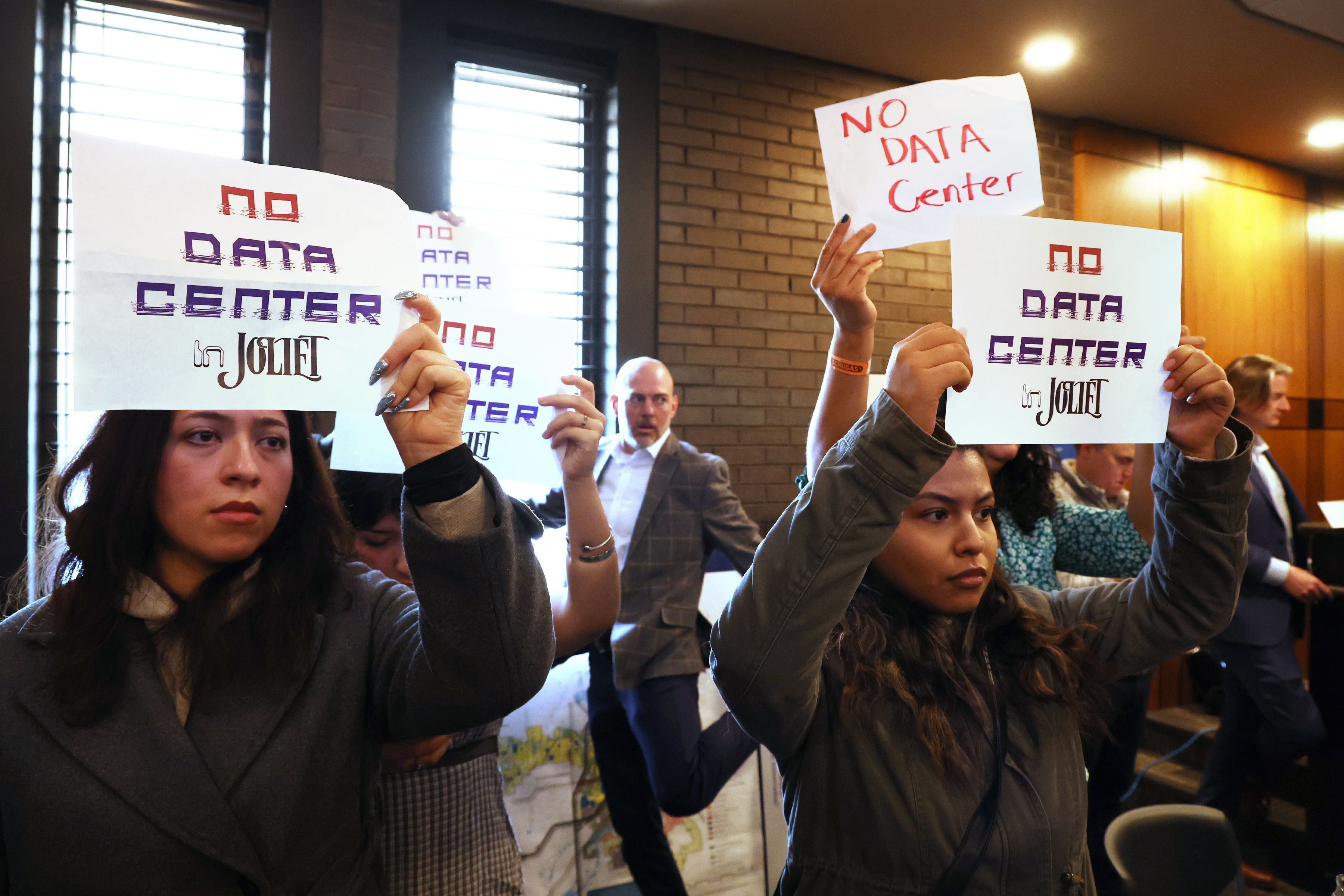

One hundred and twenty-three. That’s the number of new data centers planned for construction in Illinois, a staggering figure that would nearly double the current total.
As these power-hungry facilities multiply, our communities and ratepayers need stronger safeguards and greater transparency. Passing the Protecting Our Water, Energy, and Ratepayers Act (SB4016/HB5513) is an essential first step.
The POWER Act, introduced in February by state Sen. Ram Villivalam and state Rep. Robyn Gabel, would regulate energy and water use for hyperscale data centers and mandate public transparency measures. Notable guardrails include water-use reporting, community benefit agreements with local towns and a requirement that data centers pay for their own renewable-sourced energy.
These guardrails matter because the costs of unchecked data center growth are well documented. Their enormous power demand will keep natural gas and coal-fired power plants online, disincentivizing renewable energy investments and worsening air pollution, a primary driver of climate change. Additionally, their intensive cooling systems require vast amounts of water and produce constant noise and light pollution.
And these burdens aren’t shared equally. Data center development sites are disproportionately located near communities of color and under-resourced populations, compounding the public health risks these residents already face, such as respiratory illness and water contamination.
As president of the LinkMind Foundation, a student-run nonprofit dedicated to public health and sustainability, I have seen the toll data centers can take on communal well-being. One of our current projects is a nationwide survey examining the correlation between data center proximity and environmental risk. The results: Low-income residents are more likely to live near these facilities and experience pollution concerns.
Yet the POWER Act bill missed the General Assembly’s May 31 deadline. Meanwhile, Illinois has already handed out an estimated $983 million in lifetime tax breaks to at least 27 data centers. It was only on June 5 that Gov. JB Pritzker suspended new tax incentives, and it is still not enough.
Springfield needs to act this fall. Robust evidence supports it. And waiting only means that communities will have to pay the price.
— Renee Ma, president, LinkMind Foundation
Solution for abandoned wells
Thank you for the story “Abandoned oil, gas wells burden state” (June 22). While the article does a fine job outlining the safety and water pollution threats these leaking wells present, it doesn’t mention that methane is, in the short run, a greenhouse gas that is 80 times more powerful than carbon dioxide. Indeed, reducing methane emissions is an essential goal in reducing the growing threat of climate change.
Illinois is now the leading state for tornadoes, which is a direct result of a changing climate. We need to do more to reduce methane emissions, and plugging abandoned gas wells is one important step we can take now.
The article also does a fine job showing how the state is slowly catching up to owners, but that process can take many years, if not decades, time we do not have to waste.
One solution to this slow cat-and-mouse game might be to incentivize investors to cap the wells, even if they were never involved with them in the past. There is a large and growing voluntary carbon credit market, in which companies can claim credit for emission reductions and sell these credits to companies that are hoping to offset their own emissions. New data centers that are fueled by burning natural gas seem to be a likely candidate to buy these credits.
Capping abandoned wells while offsetting new data center emissions looks to be a win-win solution.
— Jonathan Berman, Elmhurst
Bad actors are still hurting us
I have been really enjoying the investigative team’s reporting on abandoned wells in Illinois. My career actually focuses on bonding and preventing taxpayers from being on the hook for the failures of bankrupt and corrupt companies. It’s been so interesting to hear about plugging and abandonment issues from a different perspective.
Other states where oil and gas are larger industries tend to have much stricter requirements to protect the environment and to keep taxpayers from being saddled with the bill. It’s a shame that in Illinois, we didn’t have the right safeguards in place.
People are still being hurt today by bad actors from decades ago.
— Katie Kahl, Chicago
Harmful effects of plastics
Thank you to the Tribune for choosing to conduct a series in the coming weeks on the problem of plastic waste (“Hazards of plastics becoming more clear,” June 21). We have long understood and have seen the environmental impacts of plastic production and plastic waste in Chicago, Illinois and our country as well as around the world, even where humans have no regular footprint. You only need go to your local grocery store, coffee shop, bar or fast-food restaurant to bear witness to the extraordinary amount of plastic waste that is suffocating our environment.
Now we know as well, thanks to scientific research, that plastics in micro and nano forms are invading our bodies and causing human health problems including infertility, possibly dementia, “heart and brain diseases and other ailments … from toxic chemicals leaching out of the particles,” as the recent report reveals.
Plastics are in our bodies from the placenta until the grave. We need to create plastic-free environments now to preserve our health.
Industry, like tobacco companies, turns a blind eye to the problem, continues its mass production to achieve maximum profit and blames the consumer for bad choices. We cannot individual-choice our way out of this problem; we cannot recycle our way out of this problem. The only possible solution is to turn off the spigot, particularly regarding single-use plastics that are everywhere. It is well past time to legislate solutions to this problem.
Organizing for Plastic Alternatives is working with other organizations and networks in Chicago and Illinois to develop and support legislation to limit highly toxic plastic products. Their use may last seconds, but the plastic and its toxins live well beyond us.
While the plastic is here, it is doing an extraordinary amount of damage to our environment and us.
— Jon Schmidt, Chicago
ID requirement for voting
It is difficult to understand the position of many Democrats on voter identification. They argue that requiring a photo ID to vote places an unfair burden on citizens. A photo ID verifies that the person casting the ballot is the individual registered to vote.
Yet is there any objection to requiring a photo ID for an Illinois resident to receive discounted admission to the Obama Presidential Center? Apparently, proving your identity to save money on a ticket is acceptable, but proving your identity when participating in our democracy is considered too much to ask.
If asking for identification is reasonable for a reduced admission price, why is it unreasonable when protecting the integrity of our elections?
— Al Zvinakis, Lemont
Note to readers
Bike lanes in Chicago inspire a lot of passion. We’d like to hear your thoughts. Do you support bike lanes? Or are you opposed? Whether you’re for or against, do you have advice for the city on its approach? Send a letter of no more than 400 words to letters@chicagotribune.com by Wednesday, July 1. Include your full name and city/town.
Submit a letter, of no more than 400 words, to the editor here or email letters@chicagotribune.com.


