For months, the expectant mother in Chicago has feared the possibility her daughter could be born here without the typical rights and protections of an American citizen.
The pregnant mother of four — who is due in a few weeks — described intense anxiety as the matter of birthright citizenship loomed before the Supreme Court.
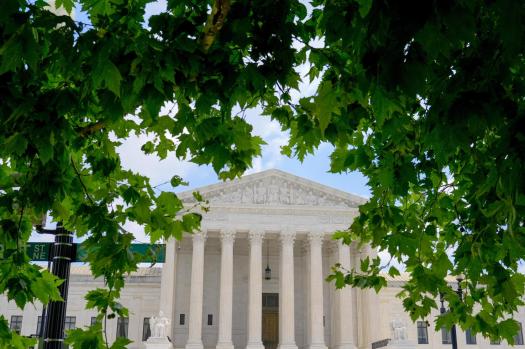
Yet the 42-year-old undocumented woman expressed relief and gratitude Tuesday when the high court affirmed the nation’s long-standing practice of birthright citizenship, rejecting President Donald Trump’s executive order that declared children born to parents who are in the United States illegally or temporarily are not citizens.
“It’s like a weight lifted off my shoulders,” said the woman, who was brought here from Mexico as a baby and asked to remain anonymous due to the tenuous nature of her immigration status. “I’m excited that (my baby) won’t be stripped of her rights.”
Many Illinois immigrants and local leaders celebrated the 6-3 Supreme Court decision preserving birthright citizenship protections, which dealt a major blow to Trump’s anti-immigration agenda.
In the case Trump v. Barbara, the high court confirmed that the Constitution’s 14th Amendment broadly guarantees citizenship to those born on U.S. soil regardless of parental immigration status, with narrow exceptions for children of a foreign occupying force or international diplomats.
On the first day of Trump’s second term, he signed an executive order ending automatic birthright citizenship, which upended more than a century of legal understanding of the 14th Amendment’s Citizenship Clause.
Locals with birthright citizenship hope the practice prevails as Supreme Court to weigh in
However the measure, which would have applied to births on or after Feb. 19, 2025, had been blocked nationwide by lower courts. Immigration experts have estimated that Trump’s order could have impacted more than a quarter of a million babies born in the United States each year.
Gov. JB Pritzker, an ardent Trump critic, called Tuesday’s ruling an “important victory,” adding that “today the Supreme Court sided with the Constitution.”
Yet the governor warned that the president “keeps trying to circumvent the rule of law through illegal executive actions” and will continue to do so if Americans don’t remain vigilant.
“Trump’s racism made him unable to understand that birthright citizenship helps make America great,” Pritzker said in a statement. “He went after the 14th Amendment because making our country smaller was the only way he could make himself feel bigger.”
Challenging birthright citizenship was a central campaign pledge of Trump’s, who has disparaged the practice as “a magnet for illegal immigration.”
The executive order was among a litany of restrictions on immigrants and other new arrivals during Trump’s second term, from a record cap on refugee resettlements to a mass deportation campaign that has targeted the Chicago area and other major cities nationwide, spurring widespread terror among immigrant communities.
Preserving birthright citizenship was a highly personal and emotional matter for some Illinois politicians.
State Rep. Barbara Hernandez, a Democrat from Aurora, wept when she learned the Supreme Court rebuffed Trump’s executive order.
Her mother came to the United States from Mexico while six months pregnant with Hernandez, who was born here as a de facto citizen.
“Hate lost today because this executive order was done by hate,” said Hernandez, who has served in the Illinois House since 2019. “It was done because the president unfortunately hates certain populations, is scared of the unknown … and the power that community members and immigrant families have.”

U.S. Rep. Delia Ramirez invoked the immigration journey of her mother, who came to the United States from Guatemala while pregnant with her.
“And regardless of what some of my colleagues might call me, I am a citizen by birthright and an AMERICAN!” the Illinois Democrat said in a written statement.
Joining roughly 20 other states, Attorney General Kwame Raoul had sued to block the Trump administration’s order in January 2025.
“As a birthright citizen myself, born to an immigrant mother not yet naturalized at the time, the fight to preserve birthright citizenship is a personal one,” Raoul said in a statement earlier this year.
But not all Illinois leaders rejoiced at the news.
Illinois Republican U.S. Rep. Mary Miller, of central Illinois, lamented on the social media site X that the high court “made the disappointing decision to leave one of the greatest abuses of our immigration system untouched.”
Trump said the decision was “too bad for our Country” and wrongly suggested that Congress could “easily” address it with legislation. The majority decision rests on constitutional grounds; it would take an amendment to overcome the decision.
Reaction to the decision on social media was mixed.
“The bogus argument is that the 14th Amendment was ratified for the purpose of giving anchor babies automatic citizenship,” one Facebook user posted.
Another argued that the Supreme Court ruling provided “more reason for a strong border and mass deportation.”
But others called the ruling “common sense,” with one Facebook user celebrating “another loss not just for Trump” but also for the president’s broader Make America Great Again movement and its followers.
Local immigration advocates championed the ruling and perseverance of birthright citizenship.
During a news conference Tuesday, Fred Tsao, senior policy counsel with the Illinois Coalition for Immigrant and Refugee Rights, called the decision “a resounding reaffirmation of the long-standing principle that people born in the USA are U.S. citizens.”
He noted that the Supreme Court cited extensive legal precedent in its ruling, including the landmark 1898 Supreme Court decision United States v. Wong Kim Ark.
In that case, the plaintiff Wong had been born in San Francisco to Chinese immigrant parents.

After a visit to China, Wong had been denied reentry to the United States under the Chinese Exclusion Act of 1882, which heavily restricted immigration from China and barred Chinese immigrants from becoming U.S. citizens.
But citing the 14th Amendment, a majority of justices sided with Wong and affirmed that everyone born in the United States — regardless of the citizenship or nationality of their parents — are automatic citizens, with rare and narrow exemptions.
Tsao felt a close connection to that historic case.
“Wong Kim Ark, like me, is the son of two Chinese immigrants,” Tsao said.
The American Civil Liberties Union of Illinois called Tuesday’s decision a reaffirmation of the Constitution while cautioning that legal challenges over birthright citizenship are far from over.
“This is not a moment to relax,” said ACLU of Illinois spokesperson Ed Yohnka. “This is a moment to engage. … We cannot give in to the idea that a president can tell us what our Constitution means and what it does not.”
He was also deeply critical of the Supreme Court justices who dissented.
“It is remarkable that somehow three justices of this court could not read the plain text of the 14th Amendment,” which states that “all persons born or naturalized in the United States, and subject to the jurisdiction thereof, are citizens of the United States,” Yohnka added.
Jason Mazzone, professor of law at the University of Illinois Urbana-Champaign, praised the Supreme Court for conferring “a broad protection for birthright citizenship that cannot be undone by a president’s executive order or even by Congress.”
He noted that the decision came down shortly before July 4, when the United States will celebrate its landmark semiquincentennial.
“With the nation’s 250th anniversary days away, the Court’s ruling is a powerful reminder of the nation’s commitment to the fundamental principle of birthright equality,” added Mazzone, director of the Illinois Program in Constitutional Theory, History, and Law.
The Associated Press contributed.