
If you remember 1976, you remember the Bicentennial.
Oh, the bunting.
The pie-eating competitions. The air shows. The fire hydrants painted red, white and blue. Bicentennial placemats at neighborhood diners. Bicentennial cereal boxes. Bicentennial toilet paper. Bicentennial quarters. United Airlines offered “Bicentennial fares.” At the Gerald Ford Presidential Library and Museum in Grand Rapids, Michigan, you can view a novelty can of “Bicentennial Air,” via Indiana — “Give to a friend who can’t make it to Indiana this year!”
Saturday mornings, I revisited the Bicentennial with “Schoolhouse Rock!,” which launched in 1973 and within a year was delivering animated history lessons. That’s how endless the Bicentennial was — it went on for years. CBS’s nightly “Bicentennial Minutes” lasted for two-and-a-half years. This newspaper published a column headlined “Red, White and Blue Nausea” — in 1974.
Bicentennial mania was so ever-present, Yale University still maintains a “Bicentennial Schlock Collection,” with 13 archival boxes of Bicentennial beer cans, Pez dispensers, egg cartons …
That’s why it wasn’t hard to flash back recently on ye olde days of Bicentennial Dixie Cups and 7-Up bottles when I visited a President Donald Trump-backed “Freedom Truck” in Hillsdale College in Michigan and met the AI-generated ghost of George Washington. “My friends and fellow citizens, welcome,” he said, as casually ingratiating as a Red Lobster waiter. “My name is George Washington, and you may have heard about me.”
He was tall and digital and his vertical screen was framed in faux gold.
A child pushed ahead of me and tried tapping and swiping at George, and when George only went on talking, lacking in interaction, the boy turned to his mother and cried out, “Mommy, it’s Harry Potter!”
Actually, son, George is less magical.
He looks like one of those old-timey portraits that people animate with artificial intelligence today, because that’s exactly what he is. He’s also the first thing you see as you enter the White House’s new, $14 million traveling U.S. History 101 class, created for our nation’s Semiquincentennial. The Freedom Truck mobile museum program, rolling nationwide through December, visiting schools and county fairs and amusement parks and church parking lots, amounts to six semi-trucks of Semiquincentennial pride. It’s the most accessible product of Trump’s Freedom 250 task force — the others including a car race through Washington, D.C., ultimate fighting on the White House lawn in June and a Great American State Fair on the National Mall with Fourth of July fireworks, all in honor of the 250th anniversary of the Declaration of Independence.
Yes, the nation doesn’t seem quite so gripped in Semiquincentennial Fever the way it was all-in for the Bicentennial days of 1976. And yet Freedom 250 is far from alone this summer in offering reflections on the Declaration of Independence and the nascent days of the country.
The Newberry Library has “Free and Independent: The Declaration of Independence and the Words That Made the United States” (though July 18); the American Writers Museum is offering “Declarations: 250 Years of Writing Toward Independence” (though Sept. 7); and the Chicago History Museum created “US at 250: Civic Action in Chicago,” a year-long initiative that includes the July 4 reopening of its “Facing Freedoms” exhibit, which considers how Chicagoans have taken on the ideals outlined by the Declaration of Independence. In Springfield, the Abraham Lincoln Presidential Library and Museum recently opened “Second American Revolution,” about the promise of Reconstruction and the ultimate failure of the country to live up to the founding documents; and the Peoria Riverfront Museum has “The Promise of Liberty” (though Jan. 7, 2027, curated by Ken Burns), offering a range of historic documents touching on democracy and freedom, from an early printing of the Constitution to Franklin D. Roosevelt’s “Four Freedoms” speech.
If you have a ticket to the Obama Presidential Center museum, the very first artifact is a Declaration of Independence, with historical context.

I started celebrating in April, with the Freedom Truck in Michigan.
Though six Freedom Trucks have fanned out nationwide, and a truck visited Rockford back in May, there are no plans for a Freedom Truck to stop within an hour of Chicago. The closest will be Holland, Michigan, in September, and the only Illinois visit to come is in tiny Altamont in August, about four hours southeast.
In fact, since going out in January, Freedom Trucks have visited California once, and though you’d assume New England is a natural destination, considering its Revolutionary past, there are just four stops in the region (besides the two canceled due to complaints that the history depicted was whitewashed and simplistic). Freedom Trucks are mostly visiting communities with voters ideologically aligned with the White House.
Which is disappointing, because Matthew Spalding, the vice president of Hillsdale College’s Washington campus and dean of its graduate school of government, the historian responsible for the narrative on the Freedom Trucks, told me their inspiration had started with the Freedom Trains, the mobile classrooms that ran coast to coast in the 1940s and 1976, visiting 48 continental states, including 19 Illinois towns. (An attempt to revive one of the Freedom Trains on a similar journey was shelved in spring, due to reported financial concerns and a lack of agreement between railroads.)

That’s too bad because there are some compelling things about the Freedom Trucks — all of which, incidentally, are identical, slick and require 140 feet of available parking.
One exhibit asks you to decode a note sent between colonial spies (George Washington was “711”), thoughtfully illustrating the cloak-and-dagger reality of a war often presented as frontlines of soldiers firing into each other. Considering the origin of the Freedom Trucks — a co-creation of Hillsdale College, a famously conservative university, and PragerU, an Oklahoma-based educational nonprofit known for books and videos “upholding Judeo-Christian” worldviews — you’d be naive not to look askance at its displays that ask you to take a U.S. citizenship test, or the interactive quiz that presents you with colonial-era scenarios then evaluates where your loyalty lies, with King George or the revolutionaries. But it’s a clever way to lure you in, and frankly, pretty fun watching people sweat as they respond. The citizenship test reminds us that only 36% of Americans can pass its test (according to the Institute for Citizens & Scholars). It’s such a carny-like come-on, you kind of wish they gave you a goldfish if you actually do pass.
But before you get the idea that Freedom Trucks offer a fresh, engaging history lesson, understand that despite promising the story of the nation, the narrative you find — which traces roughly the founding of the Jamestown colony to the Declaration of Independence — is an often dusty and prosaic tale, especially if you remember anything from a U.S. history class. It’s also centered on the religious faith of the colonists, showing an early Bible and, in the first room, wall text that plainly states: “The foundational principles of America are rooted in the Western and Judeo-Christian traditions.”
As in, end of conversation, let’s move on.
However earnest, the rest — the timelines, the maps, its portraits of everyday colonists you might not have heard of — comes wrapped in a presentation that resembles, to quote a Hillsdale student I overheard, “total AI slop.” That said, simple, uncomplicated and often-taught history was the point.
“There were a lot of ways to go (with U.S. history),” Spalding said. “But there is only one narrative. There really is only one history.” He said they wanted to avoid the usual interpretative conflicts that erupt around how and what to teach when it comes to U.S. history. “We’re not trying to get into anything post-modern or deconstructive. I wanted to avoid those debates, and the consensus way to avoid it is to let the narrative tell its own story. I also didn’t want to erase or ignore facts. I know history debates are important debates — that fact that we debate American history itself is important. The Declaration of Independence was controversial (in 1776) as well. We have always debated history.”

But one of the problems with teaching history today, he said, is that it’s so focused on periods or themes, “you don’t see the narrative — especially younger visitors, or people who have forgotten the story.” He wanted to remind them of that “very clear narrative.”
While we talked outside the truck, a Frederick Douglass interpreter, in period costume, spoke to visitors. The real Douglass, a runaway slave who became the country’s most vital abolitionist voice, twice visited Hillsdale, founded in 1844 as an abolitionist college. I wondered what Douglass would have thought of the history in a Freedom Truck. Not even a century removed from the revolution, he lectured that celebrating the Declaration of Independence felt like a “hollow mockery,” and that the nation was “false to the past.”
A century later, in Chicago, in the midst of the Bicentennial, Ebony magazine dedicated an entire issue to the anniversary, though not as a celebration but rather “an assessment of 200 years of Black history,” and whether Blacks should celebrate at all.
Beverly Gage, the Yale historian whose 2023 biography of J. Edgar Hoover won the Pulitzer Prize for history, recently wrote “This Land is Your Land: A Road Trip Through U.S. History,” an account of two years she spent traveling, noting the endless ways U.S. history is told, from Chicago’s Pullman neighborhood and Thomas Jefferson’s Monticello in Virginia, to Disneyland and Los Alamos.
She chuckled at the idea of a common American narrative.
History, she said, “is a fact-based discipline, and an interpretive art. Any assemblage of facts is an interpretation. I do think there are certain facts everyone ought to know, and how those facts were situated in the past. We have a thing called ‘presentism,’ where people think of history only through how they feel now. Which doesn’t make for very good history. But there are also those who use history to make political points. To think you can remove interpretation — well, that’s just a timeline. Even with a timeline, you would be selecting what you choose and do not choose to include on it.”
♦♦
Here’s one smart example.
The American Writers Museum’s “Declarations: 250 Years of Writing Toward Independence,” which is about a fraction of the size of the Freedom Truck exhibit. It’s a pop-up, somewhat hastily assembled, but cleverly curated by Nate King, the museum’s content and exhibits manager. It’s a charming reminder of how a new vantage can illuminate old material. The whole exhibit centers on a single idea, that the Declaration of Independence was a bit of persuasive writing — an essay, basically — for three audiences: the colonists, the king and the world.
The museum didn’t aim for a larger story.
“We were just trying to figure out a way to be a part of the (Semiquincentennial) activity,” said Cary Cranston, president of the museum, “and we decided to lean into the point that it’s a country founded on the written word — which had to go to a typesetter, which had to be sent out to colonies, and a king in England. And so what does that look like?”
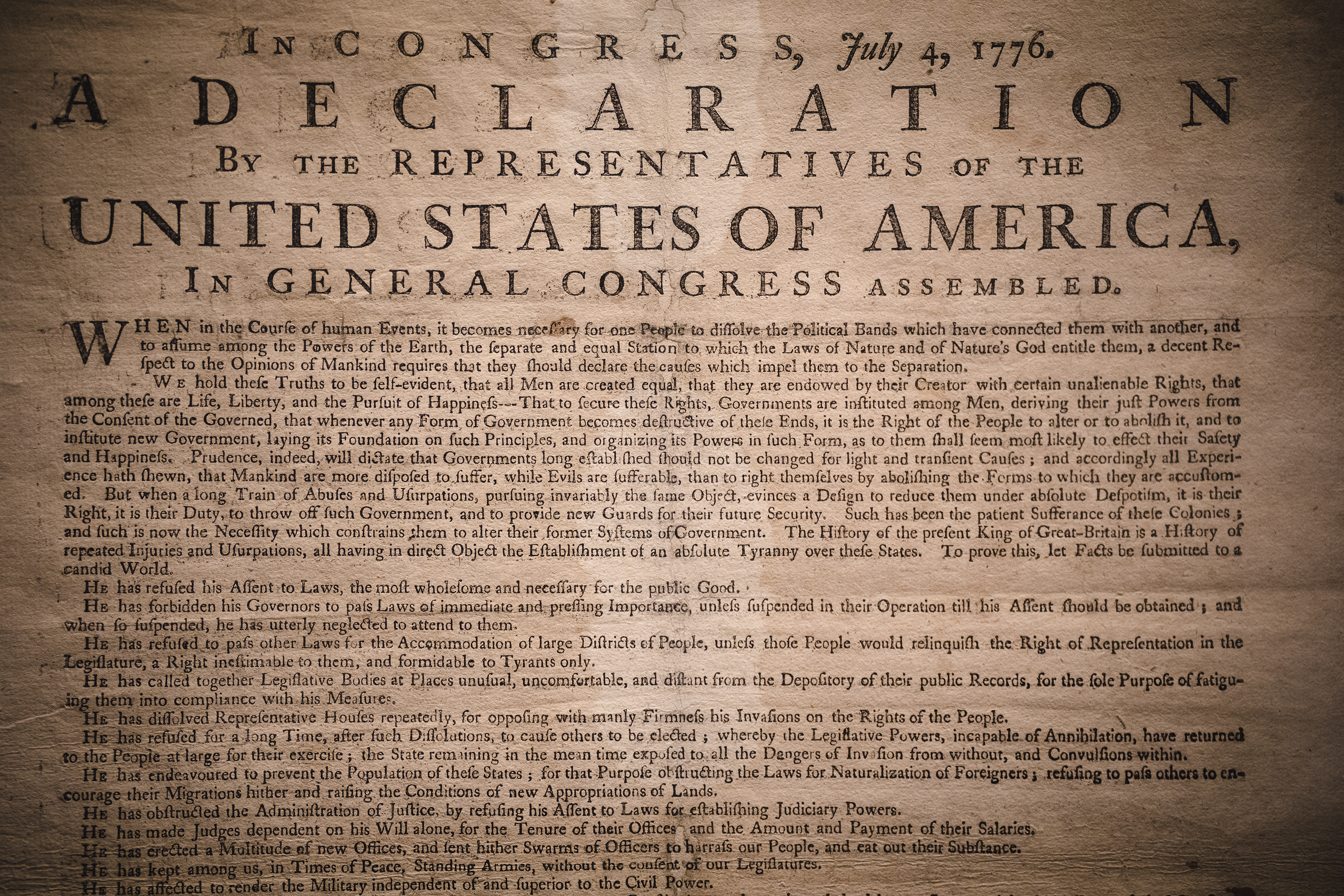
The centerpiece is a copy of the Declaration of Independence, a facsimile printed off the etching made by William Stone in 1823, a three-year process done at the urging of John Quincy Adams, who was concerned the original document was already fading. Beside it are several documents from Declaration signers. A land promise by Ben Franklin (fixed with an adorable starred seal), an appointment by Jefferson to a New York bankruptcy commission — everyday papers, illustrating that the signers, once the essay was written and the nation founded, kept day jobs. They were not always signing landmark parchments.
And they might have done things differently.
Across from the Declaration is a stack of photocopied Declarations with black markers, inviting you to imagine the Declaration as erasure poetry. Black out words you don’t want and settle on the Declaration you’d prefer. Hanging nearby are examples that visitors left — some left the paper nearly as is, some trimmed its 1,320 words to a dozen.
♦♦
Eric Slauter, deputy dean of the humanities division at the University of Chicago, and an associate professor of English and literature who teaches a course on the Declaration of Independence, thinks of the nation’s founding document as more of a provocative press release, full of language intended to poke England and announce intentions. He curated Newberry’s fascinating “Free and Independent,” which, though crammed into a narrow, dimly-lit gallery not much smaller than an 18-wheeler, brings an even more clever angle.


Slauter paired artifacts (all from Newberry archives, including a copy of the Declaration made in the summer of 1776) with phrases from the Declaration, illustrating why specific words were used and how they were received in the 18th century. “In the course of human events,” for example: Those choices of words get placed alongside a large, chaotic-looking chart from 1769, dedicated to Benjamin Franklin, an attempt at fitting all of human history onto a single page of parchment. The author, Joseph Priestly, an English scientist and minister, wanted to show “what makes the course of human events leads to revolutions, empires break up, then new nations formed,” Slauter said.
“Pursuit of happiness” — that’s joined with a prayer book from 1790, once owned by George Washington, underlining how the phrase could be linked with religious liberties.
“A tyrant” — that’s paired with a copy of Thomas Paine’s galvanizing “Common Sense,” which did not shy from using the word “tyrant,” despite its use being a nod to King George III. In England, a printer could be prosecuted for libel for using the word “tyrant,” so copies of the Declaration there generally left a space where “tyrant” would be found. “Like 18th-century Mad Libs,” Slauter said.

Several of the works in the exhibition contradict the choice of words, questioning “what ‘equal’ really meant to a slaveholder, and if these men were hypocrites at times. None of which are ‘woke’ contemporary questions. They were being asked 250 years ago, too.”
“Liberty” is placed alongside a petition filed in 1773 by five slaves in Massachusetts; they argued that liberty and freedom were not just civil and divine rights but “natural.”
“I have been to so many celebratory events where the Declaration of Independence comes up and people talk about how nobody had the ideas in it before it was written — we even got a little of that from Obama the other day when he opened (the Obama Presidential Center). There’s always this sense that everything was oppressive, and then the United States showed up, and that would have made the committee who drafted the Declaration howl with laughter. Jefferson, late in his life, even said the point was not to say anything new. The philosophy was not new. The point was to express the American mind on a common subject, and what made it revolutionary was that ordinary people — farmers, merchants, enslaved people — they all decided to talk about it, too.”
♦♦
To be fair to the White House and its Freedom 250 events, John Adams once wrote that he hoped future Americans would celebrate the Declaration of Independence “with Pomp and Parade, with Shews, Games, Sports, Guns, Bells, Bonfire and Illuminations.”
He also asked for the holiday to bring “solemn Acts of Devotion to God Almighty.”
And so, prayer, extreme fighting, state fairs — none of it seems that out of place.
Adams, though, might have expected his government to pony up a few artifacts from his era. Not one of the Freedom Trucks roving the nation right now displays a single artifact, not a beige scroll of parchment or a tiny prayer book or Paul Revere’s lantern. There is a digital Declaration of Independence that allows you to sign your name at the bottom with your finger, with all the gravity of buying a six-pack at the grocery store. Instead, there are PHOTOS of George Washington’s spectacles and Paul Revere’s lantern and a Wells Fargo shotgun, among others, with corresponding QR codes that bring you to a “PragerU virtual vault” — in other words, you could see pictures of this stuff anywhere.
Indeed, the centerpiece of the Freedom Trucks is not even about the nation’s early years. It’s the “Wall of American Heroes” you pass as you’re leaving, images of 51 historic figures — 52, if you count Trump, seen in a video welcoming you to the wall — suggesting a mid-20th-century view of American history. Robert Frost represents poetry, and Norman Rockwell is the only painter. Eighteen of the 51 Americans work in arts and entertainment, including P.T. Barnum and Walt Disney. Every athlete is Black, and every faith leader is Christian. There’s room for innovators (George Washington Carver, Henry Ford) and tycoons, but the only post-1960s American is Steve Jobs. Two hundred and fifty years of American history, 51 slots, and though there are no presidents on the wall, there is space for the Soviet agent-turned-anti-communist Whittaker Chambers.

Spalding said “the Wall of American Heroes” is something of an early version of Trump’s proposed sculpture park for Washington, D.C, the National Garden of American Heroes. But it’s also, however inadvertently, an extravagant reminder of how the story of history is always a series of choices. And that history is everyday people, and that perhaps government isn’t always the best steward of its own narrative. If you’ve been confused by the difference between America 250 and Freedom 250 — the former is a bipartisan Congressional initiative created a decade ago for events that would span the entire country, and the latter was created last year by the White House — know that the government’s handling of the Bicentennial didn’t go smoothly either.
Bicentennial Fever was a product of grassroots pride.
It swelled somewhat organically from a recognition that, as Beverly Gage writes, history is outside everyone’s windows, “in street names and family stories, shopping malls and local accents — in who lives where and why.” She told me, “I don’t think history is as easy to suppress as the administration might think it is. When it gets pushed out in one place, it always finds a way to pop up in another.”
cborrelli@chicagotribune.com