

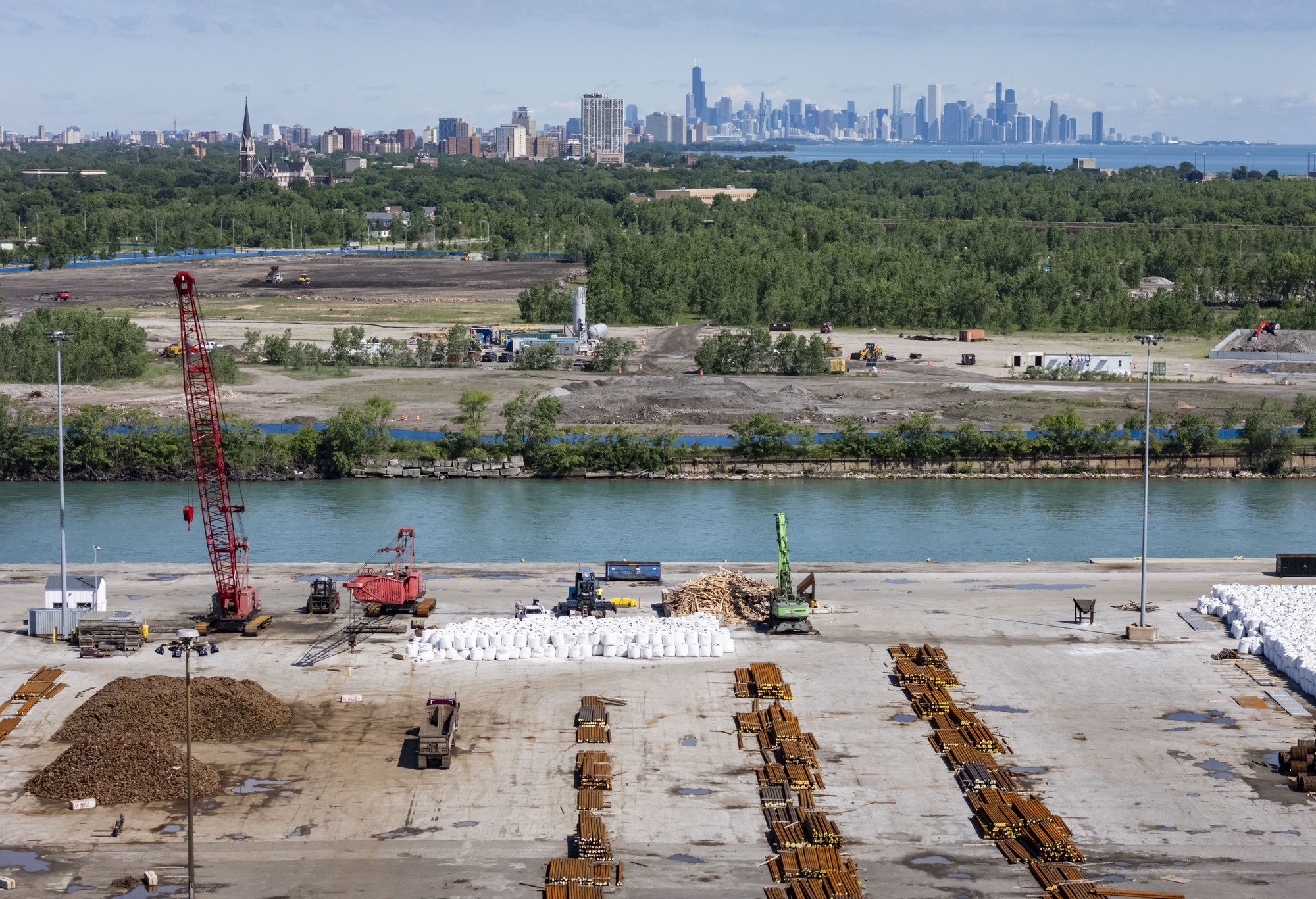
At the mouth of the Calumet River on Chicago’s industrial Southeast Side, workers load steel, sugar and lumber off and onto ships.
The port is the center of Chicago’s maritime economy. But labor strife here is spilling off of the docks and into City Hall, with political implications for Chicago Mayor Brandon Johnson, himself a former labor organizer who is expected to run for reelection in less than a year.
Two unions are fighting over who should represent the dozens of stevedores who work for QSL America, a private company that operates at the publicly owned port.
For more than a year, some QSL workers have been on strike with the International Union of Operating Engineers Local 150. But others are still at work, laboring under a new collective bargaining agreement with another labor organization, the International Longshoremen’s Association. QSL agreed to recognize the ILA as the dockworkers’ union representative last year, after the Operating Engineers’ strike began, setting off a battle between the labor groups that is under review by federal regulators at the National Labor Relations Board.
In early June, Johnson met with workers who support the ILA and took a photo with them. The episode prompted accusations of hypocrisy from Local 150, which views the ILA-affiliated workers as strikebreakers and accused Johnson of taking sides.
Johnson is no political ally of the Operating Engineers, who backed Paul Vallas against him in the 2023 mayoral runoff. Local 150’s president chairs political committees that have poured money into the campaign of Illinois Secretary of State Alexi Giannoulias, a likely 2027 mayoral challenger.
“Mayor Johnson built his public image on the language of solidarity and worker justice, but when working people at Chicago’s ports needed that solidarity most, he chose to take a meeting with the very people undermining them and then posed smiling in a photo with longshoremen and workers crossing the picket line,” Local 150 spokesperson Kristine Kavanagh said in a statement in June.
The ILA denies that the workers who support them are scabs, saying they are longtime port workers who chose the ILA to represent them. In response to the dispute, Local 150 has posted an inflatable Scabby the Rat in front of City Hall for months now.

Johnson released a statement through his press office saying the ILA workers who met with the mayor are members of the team that bargained their new contract, ratified this spring.
“Over the past year, these workers organized their coworkers, successfully formed a union, and negotiated a contract that delivers higher wages and strengthened health and safety protections for all workers at the facility,” spokesperson Griffin Krueger said, adding that Johnson “remains committed to supporting all working people and stands in firm solidarity with all those who are fighting to unionize.”
Krueger said the mayor’s office had been in communication with Local 150 about the dispute and added that Johnson had taken the ILA meeting “as part of the administration’s ongoing effort to engage all parties.”
Fifteen miles southeast, however, striking dockworkers start picketing the port at 5 a.m. each morning, carrying weathered-looking signs.
The Operating Engineers Local 150 argues QSL made a backroom deal to recognize the ILA in order to get rid of Local 150.
The ILA and the company, however, say that a majority of dockworkers chose to be represented by the ILA. The Longshoremen say their union helped workers bargain a contract with hourly raises of $10 to $15 an hour, improved health insurance and safety protections.
“We’re ironing it out at the table instead of setting up a picket line and doing it that way,” said Rusty White, president of a Portage, Indiana-based ILA local and the vice president of the international union’s Great Lakes District Council.
The Chicago Federation of Labor backs the strikers. “Workers deserve the right to organize free from employer interference, intimidation, or backroom deals — and elected leaders should stand with workers fighting for that right,” the CFL said in a statement.
Local 150 says regulators have found merit to two charges they filed against the company and the ILA, including allegations that the company “unlawfully assist(ed)” the ILA. A finding of merit is not a final determination, and the NLRB has not issued any complaints against the ILA or QSL, which operates as the North America Stevedoring Co., or NASCO.
NLRB spokesperson Sylvester Giustino would not comment on the pending case and would not confirm whether officials had found merit to the charges referenced by Local 150.
ILA representatives said they were confident they would ultimately prevail in the labor board proceedings, and QSL said it denied the charges filed against it by the Operating Engineers.
Political committees associated with the Operating Engineers have spent about $2.5 million this year supporting Giannoulias, who has not yet officially entered the mayoral race.
The ongoing dispute offers a look into the broad political spectrum within Chicago’s organized labor movement. While Johnson cut his teeth as an organizer for the stridently progressive Chicago Teachers Union, the Operating Engineers’ deep-pocketed political organization has historically skewed to candidates farther to the right.It’s a conflict that will be increasingly important as a broad swath of candidates enter the race for mayor in 2027 and seek money and support to power their campaigns.
“This has nothing to do with politics,” said Kavanagh, of Local 150. “It has everything to do with striking workers.
A yearlong dispute
The dispute between the two unions is legally complex. Both unions argue they started organizing the port workers first, and each union has argued the other has ulterior and nefarious motives.
Safety has emerged as a key issue in the Operating Engineers strike. Picketers told the Tribune they had worked with faulty equipment, and they characterized QSL’s training for new workers as insufficient.
QSL spokesperson Marie Deschamps said the company considers health and safety “to be of the utmost importance,” and said employee concerns “are thoroughly and timely investigated and addressed as required.”
Leo Lopez, 25, said he walked off the job with the Operating Engineers when he realized the conditions he was working in were “not something normal.”
Lopez, who lives in Cicero, said he had worked with machines that lacked horns, brakes or lights. When it rained, he said, the warehouse would leak and rainwater would mix with the sugar stored inside, making a syrupy texture on the ground that was unsafe to operate machinery over.
“We want to make sure we’re going to make it home every single day with 10 fingers, 10 toes,” said striker Alex Muñoz, a Little Village resident who said he’d worked at the port for 15 years.
Last year, the Occupational Safety and Health Administration cited NASCO for a number of safety violations. The company reached an informal settlement in the case, fixed issues identified by OSHA and paid just under $53,000 in penalties, according to the federal agency.
“In April 2026, OSHA officially closed its investigation, thereby confirming its satisfaction with the abatements provided by NASCO on such citations,” Deschamps said.
The ILA, meanwhile, argues that is has won safety protections for workers in their new contract, including the creation of a safety committee and a labor management committee that conducts semiannual safety audits.

Andre Christian of Flossmoor, who said he’d worked at NASCO for about 20 years, described working for the company as “a great experience.”
“With QSL and ILA combining together as one, and coming together as a family,” he said. “… I think it’s going to be a great experience as far as in working together as a team.”
Marvin Sanders, of northwest Indiana, said he’d worked at NASCO since 2017.
“We’re a big family,” Sanders said. “QSL, the guys that’s been working here, we’re like family here. I like how the ILA came in and helped us protect what we love to do,” he said, citing gains the union said it has made in wages and healthcare.
“The (Operating Engineers) never once approached us, came in and talked to us,” Sanders said. “They only talked to a certain few.”
Local 150 says 28 workers are on strike. ILA lawyer Daniel Wolff said about 35 workers were currently at work under the ILA’s contract, although he said the numbers fluctuate.

When the Operating Engineers first went on strike over unfair labor practice charges in May 2025, the union had not yet filed a petition that would trigger a union election with the NLRB, and that June it sent a letter to the company saying it had no interest in doing so “at this time.”
“Local 150 has no intention of organizing your company or requiring it to sign a collective bargaining agreement,” the letter read in part.
The Operating Engineers say the local sent the disclaimer because it didn’t believe it had sufficient signed union cards to file a petition with the NLRB at the time. Kavanagh said Local 150 proceeded with an election petition “when we learned that QSL was bringing in the ILA” because it believed that it had gained the support of the majority of workers at that point.
Unions can file for an election with the NLRB when they have the support of at least 30% of workers in a proposed bargaining unit. That petition then typically triggers an election. If a simple majority of the workers vote to unionize, the union is then certified.
But unions can bypass the election process by requesting voluntary recognition from a company if they have the support of a majority of the workers. If an employer chooses to grant recognition, no election takes place, and the parties begin bargaining a contract that sets standards for wages, working conditions and benefits.
QSL workers never voted in a union election.
Deschamps, the QSL spokesperson, said a neutral third party had verified a majority of employees supported the ILA.
QSL “respect(s) the freedom of association of all employees, ensuring their right to choose representation without interference,” she said.
Bob Bruno, director of the labor studies program at the University of Illinois, said the sequence of events struck him as reminiscent of “the worst kind of labor agreement” — one that’s top-down, not bottom-up.
“It’s our right for us to be able to choose a union that we want to get represented by, not one that the company is bringing into it,” said Lopez, one of the strikers.
The ILA, which unlike the Operating Engineers is unaffiliated with the AFL-CIO, denies the implication that it is a so-called “company union,” a derogatory term within the labor movement that implies a union is too deferential to the employer.
“Operating Engineers is a great union,” said Joseph Perez III, special representative for the ILA’s Great Lakes council. “But this is not their lane. This is longshoremen work.”
ILA representatives accused the Operating Engineers of only getting interested in organizing the port workers when they got into a disagreement with the company over the operation of cranes at the property, which Local 150 denies.
The Illinois International Port District, the municipal corporation that owns the port, appears to be trying to stay out of it all, though Local 150 has pushed for the termination of QSL’s lease at the port.
In a statement, Erik Varela, the executive director of the port, said it remains “committed to maintaining an open dialogue with all parties” and “fully recognizes and supports the rights of workers to organize and their right to choose their collective bargaining representative.”
Meanwhile, an uncertain future is on the horizon for the workers who load cargo where the lake and river meet.
Fewer than 6% of private sector workers in the U.S. belong to unions, according to the Bureau of Labor Statistics.
Within that context, said Bruno, the labor studies professor, the fight over the port workers is “absolutely wasteful.”
“It’s bad for the movement,” he said.


