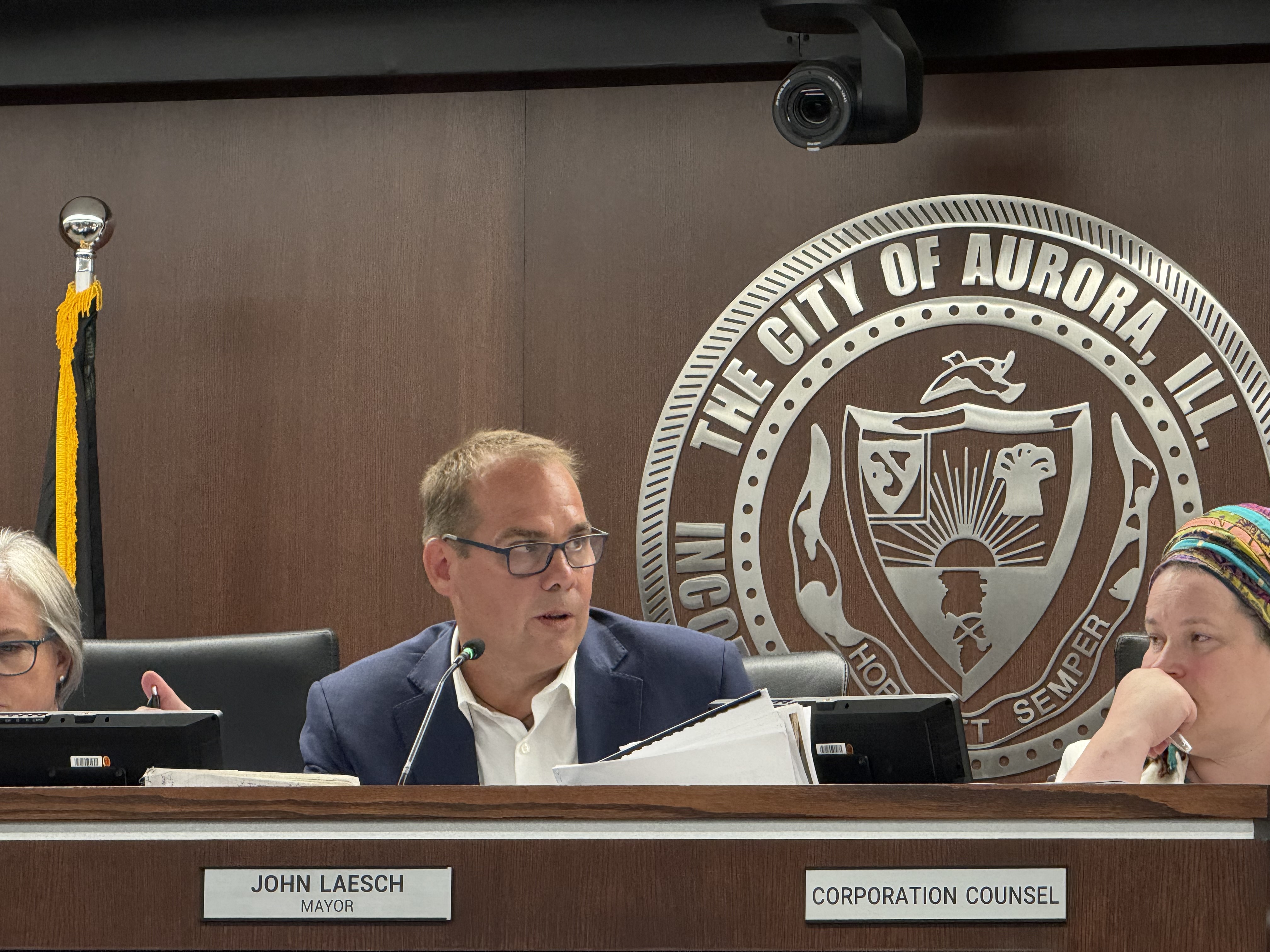

The Aurora City Council spent over two hours workshopping Mayor John Laesch’s long-discussed campaign finance ethics reform package Tuesday night, with some aldermen at odds with the mayor over regulating political action committees.
Council members at the Committee of the Whole meeting also debated the definition of doing business with the city and other requirements on disclosures that some aldermen said they felt treated them as “criminals” for running for office.
Despite some disagreement, the council overall reached a consensus over several language changes in the ethics proposal, such as eliminating disclosure requirements for loans and services.
The council plans to debate the package again at the City Council meeting Tuesday, July 14. Laesch said his goal is to have an updated draft of the proposal with the language changes at the council by then, with the understanding that more amendments could still be added.
“Tonight, there was some positive movement and encouraging collaboration regarding the city’s proposed ethics ordinance, with compromises being made,” Laesch said Tuesday.
The reform package, first proposed by Laesch last October, has faced delay after delay in recent months. It has been debated at a number of different committee meetings, and when it went before the City Council in March, was sent back to a committee for further review.
One major discussion point during the Committee of the Whole meeting Tuesday was over an amendment proposed by Ald. Patty Smith, 8th Ward, and Ald. Mike Saville, 6th Ward, that would eliminate disclosure requirements for contributions from political action committees.
Smith said regulations on political action committees would be hard to track, and she warned against regulations creating a “got you” moment where a candidate is exposed for something they were unaware of.
She said such regulations are for races featuring much more money than usually spent on Aurora aldermanic contests.
“This is just one way to simplify a very complicated ordinance that we are putting in place,” Smith said.
But Laesch said that eliminating the section would defeat the entire purpose of the ethics package. Ald. Will White, at-large, Ald. Keith Larson, at-large, and Ald. Edward Bugg, 9th Ward, also disagreed with Smith and Saville’s proposed amendment.
The mayor said that without the section, the ordinance would allow what he called “shadow PACs” to collect funds from corporations that do business with the city of Aurora, and then spend those funds on campaigns to elect aldermanic and mayoral candidates.
Smith and Saville’s proposed amendment also included other changes that would loosen some requirements for candidates running for City Council, such as reducing some time constraints.
“Citizens want to do their civic duty, and that’s why they run for office,” Saville said. “We don’t want to make a criminal out of somebody just wanting to run for office and represent their area and do good things for the city.”

The proposed ethics reform package would prevent anyone who has done business with the city in the last four years, or who is seeking to do business with the city, from making over $1,500 in donations during a single year to any candidate for city office or to a city elected official.
It would place the same restrictions on donations to any city official or employee who is a candidate for another office.
Under the proposal, “doing business” with the city means any sales, purchases, leases or contracts that are collectively over $5,000 within 12 months.
At Tuesday’s meeting, Ald. Shweta Baid, 10th Ward, proposed raising that bar from $5,000 to $50,000.
A majority of the council informally agreed with Baid’s proposal, but White, Larson, Bugg and Ald. Daniel Barreiro, 1st Ward, wanted a lower amount than $50,000.
“Just to me, $50,000 is a lot of money, and to say that someone who makes $49,000 isn’t doing business with the city just doesn’t seem accurate to me,” White said.
Yordana Wysocki, legal counsel for Aurora, said she and other city staff were concerned with some broad language in the package, specifically in the section outlining when elected officials, candidates and certain city employees are required to publicly disclose business or income interests and gifts to the city.
The council agreed to her proposed adjustments that narrowed the language defining when people are required to to publicly disclose business or income interests to the city.
“The concern is really, we want to make sure that employees, that there’s no harassment and that they’re not disclosing information that would otherwise not be subject to disclosure,” she said.
City Council members also reached a general consensus on eliminating disclosure requirements for loans and services that cost over $150.
Wysocki said including this could require people to disclose haircuts, dentist visits and other services costing over $150, which she said could effect local businesses.
“We don’t want people to be discouraged from using businesses here in Aurora because they’d have to keep a list all year,” she said.
Under the proposed package, elected officials, candidates and certain city employees would be required to publicly disclose a list of all real estate the person owns, what business entities located within Aurora they own, any city-funded or affiliated organizations they are involved with and any gifts they’ve received from those doing business with the city.
It would also expand existing economic interest disclosures, so that candidates and city officials would need to disclose if their employer is doing business with the city or has received financial assistance from the city. Similar disclosures would also be required of anyone living within a candidate’s or city official’s household, except for minors.
The proposed ethics ordinance is a compromise from Laesch’s original vision, which was for a full ban on campaign donations from those doing business with the city.
awright@chicagotribune.com