

Lucia Vasquez-Gonzalez thought she was doing the right thing when she went to court in March.
Vasquez-Gonzalez migrated to the U.S. in search of a better life but did not have legal permission to live here. In January, she was charged with one count of misdemeanor domestic battery in a confrontation with her roommate, according to court records, but she appeared before a judge hoping to take care of the matter responsibly — despite the risk posed by continuing immigration activity around Cook County courthouses.
After leaving court, though, Vasquez-Gonzalez said she was stopped by immigration agents a couple of blocks from the building and pulled out of her car.
“I was in complete shock because I didn’t know what was happening,” Vasquez-Gonzalez told the Tribune in Spanish. “I was like, ‘Why are they arresting me if I didn’t do anything bad? … And then they said, ‘No, it is because you missed the first rule of immigration, which was don’t get into any problems.’
“I said: ‘But this is the problem that I am fixing.’”
In December, Gov. JB Pritzker signed into law a ban on federal agents making certain arrests near courthouses and easing a path for individuals to sue if they think their rights were violated during civil immigration arrests.
The Court Access, Safety and Participation Act, which is being challenged by the Trump administration, followed an order issued by Cook County’s chief judge at the time, Tim Evans, similarly barring civil immigration enforcement around county courthouses.
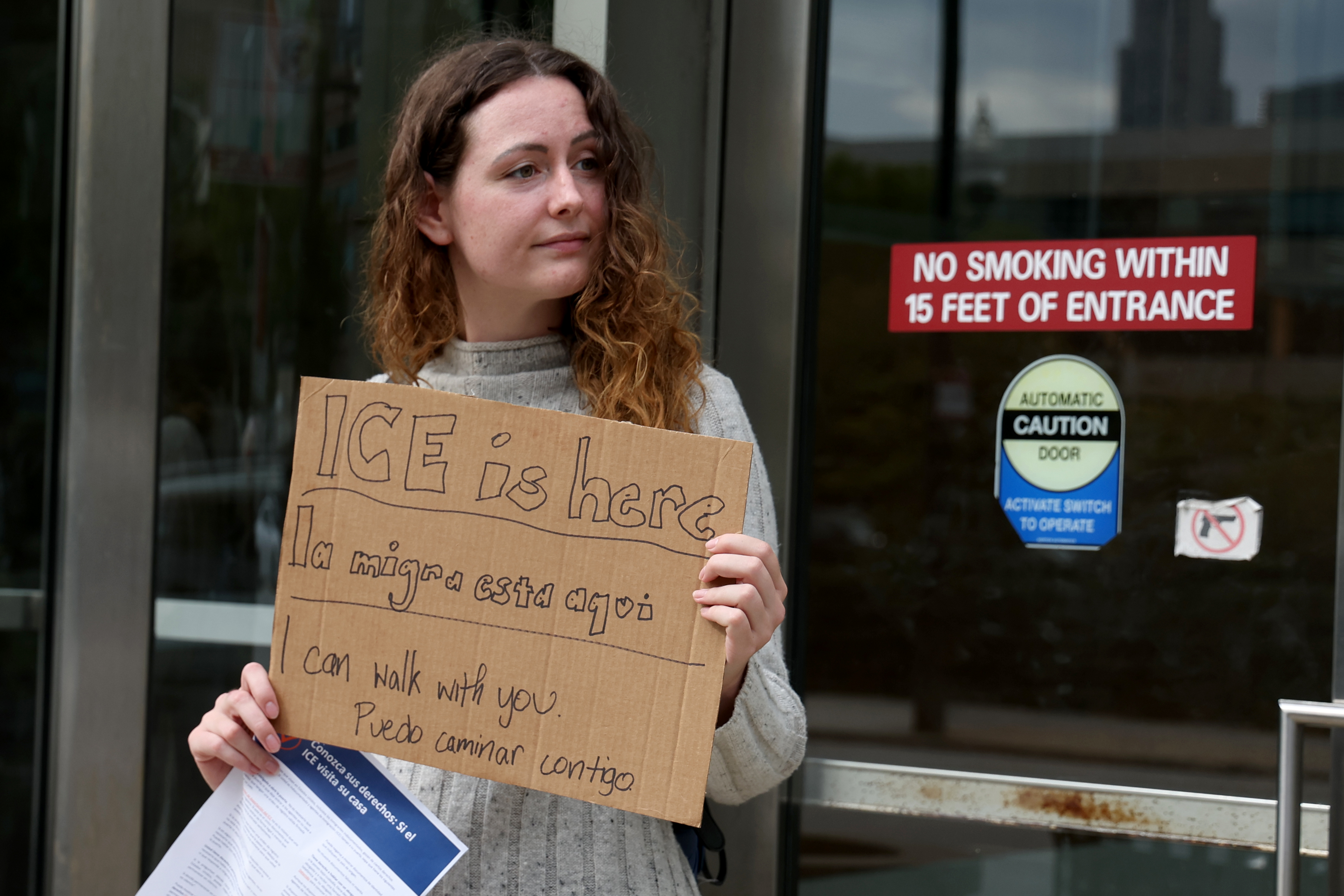
Despite the measures, though, the presence of immigration agents around Cook County courthouses is stubbornly persistent, according to a Tribune review of a tracker maintained by the Cook County public defender’s office.
Since the beginning of the year, immigration agents have been in or around county courthouses at least 50 times through June 9 — a rate of more than twice per week.
“What they are doing is interfering with the operation of state courts,” said Jonathan Manes, senior counsel for the MacArthur Justice Center’s Illinois office. “They are making it very difficult for people to access justice here in Illinois.”
In a statement to the Tribune, a Department of Homeland Security spokesperson said immigration enforcement near courthouses is “common sense.”
“It conserves valuable law enforcement resources because they already know where a target will be,” the statement said. “It is also safer for our officers and the community.”
In Cook County, agents have sometimes made arrests or entered the buildings, while other times just been spotted nearby. But their mere presence has a chilling effect on the county’s court system, stakeholders say. It has united factions of the criminal justice system that are often in opposition, as they condemn the behavior of federal agents and argue it makes people less safe when victims and defendants are afraid to participate in the court process.

It puts people like Vasquez-Gonzalez in an impossible position, they say, as undocumented immigrants must choose between complying with their mandate to come to court, or risk being detained. Court records show that Vasquez-Gonzalez’s misdemeanor charge was dropped after she was taken into custody by Immigration and Customs Enforcement.
“I cry about this, and feel so upset because I think ‘how many people are there robbing, killing, doing bad things?’” she said, speaking by phone from Venezuela, where she had been deported. “And I was only there as a single mother who was searching for a future for my daughter.”
‘Made their jobs impossible’
Staff members for the Cook County state’s attorney’s office’s victim services bureau were recently working with a mother and her children facing one of the most difficult types of cases the office prosecutes.
The victim specialists — who work with crime survivors as well as the prosecutors handling their cases —were preparing a sexual assault case involving minor victims. The children’s mother, though, was afraid to bring them to court to meet to prepare testimony because of the chance of encountering immigration agents, said Kayla Johnson, chief of the victim services bureau.
In that case, the victim specialists arranged to do some of the prep virtually so the family could avoid the risk of court. But while practical in that instance, it’s not an ideal solution, Johnson said.
“People who have obviously experienced that level of trauma really benefit from the support of in person engagement and building rapport … so that is something we are navigating alongside people,” Johnson said.
Setting up virtual sessions to replace in-person contact with victims is a method the bureau has increasingly had to rely on due to immigration presence around court, as court workers across the system say they’ve had to modify operations in a number of ways to keep things functional.
“The response when these arrests picked up under the first Trump administration was so broad and brought together aspects of the justice system who are usually not in agreement with each other,” said Douglas Keith, deputy director in the Brennan Center for Justice’s judiciary program, which has tracked how similar courthouse-focused immigration enforcement unfolded in New York during President Donald Trump’s first term. “This was public defenders, hand in hand with prosecutors and judges, talking about how this has made their jobs impossible and their communities less safe.”

In response, lawmakers in New York passed the Protect Our Courts Act in 2020.
According to the tracker kept by the public defender’s office, immigration agents were sometimes seen outside courthouses or in the vicinity, but they entered court buildings at least 27 times since the beginning of the year.
In the same time frame, agents have been reported in or near the domestic violence courthouse at 555 W. Harrison St. at least 22 times. Immigration enforcement around that building has raised particular concern because people seek help there in the form of orders of protection or other services.
The log was compiled based on reports from the county’s building services department as well as the office’s clients, community responders and other sources. Officials described it as a likely undercount based on incidents they feel they have confidently verified.

In at least some cases, the presence of immigration agents has led to tumultuous clashes in or near the court buildings. In November, agents made an arrest outside the Leighton Criminal Court Building on the Southwest Side, knocking over a fence and leaving a trail of blood on the sidewalk.
“There are actual incidents of violence in courthouse hallways that make courthouses appear unsafe with ICE officers chasing down their targets in hallways,” Keith said.
Courthouse security
In June at a branch courthouse in Bridgeview, a chaotic scene unfolded, caught on video and widely circulated online.
Immigration agents were inside the suburban court building, struggling with a man on the ground while onlookers yelled, asking if they had a warrant.
Moments later, outside the building, a person in a Cook County sheriff’s office uniform is seen greeting an immigration agent while they placed the detained man into a vehicle.
That day, agents took two adults and a child into custody when the adults appeared in court on misdemeanor retail theft cases.
The dramatic video spurred condemnation of the agents’ actions, as well as letters from state and local lawmakers to Cook County Sheriff Tom Dart, whose office provides courthouse security, seeking answers and referencing the state law barring warrantless immigration arrests.
“In spite of these laws, video evidence depicts multiple CCSO officers in uniform standing by and watching ICE agents flout our laws,” the letter from state lawmakers said.
But in response, Dart, in a letter obtained by the Tribune through a public records request, said his office “shares your concern” about the conduct of federal agents, but contended that parts of the letter, signed by 15 lawmakers including Rep. Kelly Cassidy and Rep. Abdelnasser Rashid, “require factual correction.”
In the “fast moving and evolving situation,” deputies manning a security entrance sought to maintain the security screening area during an “active and chaotic” situation and stop members of the public from entering through an exit lane, Dart said in the letter. Deputies had no advance notice of any law enforcement action when agents chased a man who ran inside the screening area.
“Maintaining the integrity of the screening area during a rapidly evolving incident is required to ensure the safety of all people in the building,” Dart said in the letter.
The letter also notes that the Court Access, Safety and Participation Act offers civil remedies but does not empower local law enforcement to arrest federal agents who violate the law.
Deputies have received training, the letter said, and the office of professional review is investigating the conduct of deputies during the Bridgeview incident.
Asked for comment, a spokesperson for Cassidy said that “Illinois, Cook County, and the City of Chicago have all taken steps to address the harms caused by ICE enforcement activities at our courthouses because access to the justice system impacts the safety of everyone in our community.”
A spokesman for Dart referred to the office’s written responses to lawmakers.
The Bridgeview arrests led immigration advocates to call on Dart’s office as well as Chief Judge Charles Beach to do more to prevent the enforcement activity, while Dart’s letter argued that there are limits to what they can do in response to the federal government’s actions.
Though noting the law and court order can be difficult to enforce when agents follow people from court, some have questioned why law enforcement agents have been able to access the interior of buildings so often, and whether options for remote court could be expanded. In a statement to the Tribune, Cassidy said the sheriff’s office should “provide actionable policy steps and enforcement mechanisms to ensure these harms are addressed so that people feel safe utilizing our court system.”
Beach’s office, in response to a request for comment, pointed to information it has released about virtual court options.
“It’s a difficult situation. I understand what I think to be at least some of Sheriff Dart’s stated concerns,” said Daniel Schneider, of counsel at Legal Action Chicago. “At this point I think … the chief judge and the sheriff both have an obligation to ensure that the spirit and letter of state laws are followed.”
‘We don’t have anything’
Meanwhile, fear in the county’s immigrant communities is constant.
Organized Communities Against Deportation, an immigrant rights group, has received hotline calls and requests for support from families who need court services or must attend court dates, said Antonio Gutierrez, strategic coordinator for the group.
“We’ve been documenting as much as we can,” Gutierrez said. “Letting them know of their rights and the necessity of still showing up for hearing. Letting them know the possibility of doing a virtual hearing.”
Still, remote court isn’t a perfect solution, experts say. Not all courtrooms offer it, and most judges would not consider it for major hearings where someone’s life may be impacted significantly, like a sentencing or trial.
Even as officials try to call for better local solutions, county stakeholders called on the Trump administration to stop enforcement around courthouses in alignment with longstanding practice meant to protect court operations.
“It’s up to ICE to stop the practice of targeting people,” Manes said.
Now, Vasquez-Gonzalez no longer faces any active criminal charges in Cook County, but she has been deported to Venezuela, where she said she and her daughter are struggling to make ends meet. She wishes she could return so her daughter could receive a better education.
According to the Department of Homeland Security, Vasquez-Gonzalez accepted voluntary departure and was removed from the country.
“She was given full due process,” the agency said in a statement.
Now, Vasquez-Gonzalez and her daughter are trying their best to start over.
“We don’t have any clothes. We have to bathe and wash our undergarments at the same time,” she said. “We don’t have anything.”