
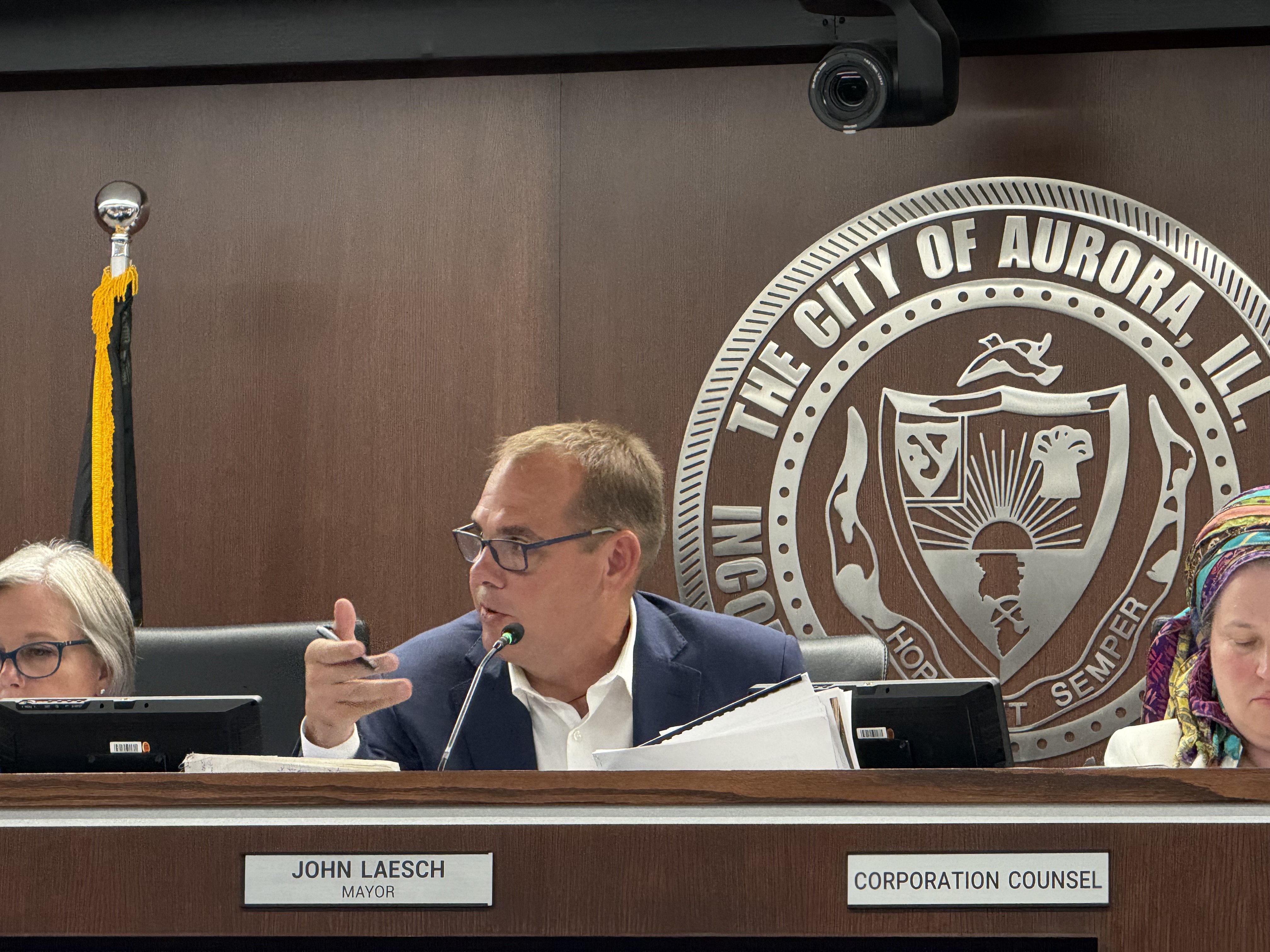

The Aurora City Council passed Mayor John Laesch’s campaign finance ethics reform package Tuesday night after more than nine months of discussion, partially fulfilling one of Laesch’s 2025 campaign promises.
In the final hours before passage, the council approved amendments loosening restrictions on political action committees and economic interest disclosure requirements, which Laesch and a few aldermen criticized.
The final ordinance, which built upon a 2019 city ordinance, was far from Laesch’s original version that proposed a full ban on campaign donations from those doing business with the city, but he called it a win.
“Its a big win to make this marginal change,” Laesch told The Beacon-News just after the approval. “We’ve taken a step to limit the influence from city contractors on the competitive bidding process.”
Laesch focused much of his mayoral campaign last year around a number of ethics reforms aimed at campaigns for city elected office. He claimed former mayor Richard Irvin prioritized government contracts or incentives to those who donated to his campaign, which Irvin consistently denied.
The final ordinance approved Tuesday enacts a $1,500 limit on campaign donations in local elections from businesses with city contracts.
It also requires candidates to disclose economic interests with the city, which the measure defines as outside employment, political committee affiliation, real estate assets, entity ownership, city-funded organization membership and gifts over $150.
Public officials, city employees and lobbyists are also prohibited from soliciting or accepting campaign contributions on city property with the exception of city parks, as long as candidates pay the same park fees as the general public, according to the ordinance.
A few aldermen worried these restrictions could make running for office more complicated and discourage candidates who want to run for local office for the first time.
“We just want to make it easy for them to run for election and not get into complicated things where anybody can come and say ‘got you’ for not understanding what mistake they made,” said Ald. Shweta Baid, 10th Ward.
Baid and Ald. Patty Smith, 8th Ward, cited these concerns when justifying their proposed amendments to the reform package Tuesday night. Both amendments were approved by a majority of the council.
Smith’s amendment, also backed by Ald. Michael Saville, 6th Ward, eliminated disclosure requirements for contributions from political action committees.
This section of the reform package would have required candidates to disclose if they received any large PAC donations that represented more than a third of the PAC’s total contributions to all candidates.
Smith said such regulations are for races featuring much more money than usually spent on Aurora aldermanic contests. She also said local candidates already follow similar contribution limits set by the state. Additional requirements, she said, made her feel treated like a criminal just for running for office.
“This makes me feel like I’m being treated like a crook,” she said of the PAC ordinance section. “You want to talk about complication, wait until you start going through this at the end of your campaign.”

But Laesch said that without the section, the ordinance would allow what he called “shadow PACs” to collect funds from corporations that do business with the city of Aurora, and then spend those funds on campaigns to elect aldermanic and mayoral candidates.
He said last week that eliminating the section would defeat the entire purpose of the ethics package. Tuesday, he told The Beacon-News he planned to continue working to ban “shadow PACs” in Aurora, partially through increasing public awareness on the matter.
“In the next election cycle, I’m pretty sure that some of the people who lost their influence in City Hall want to regain that influence through setting up some sort of shadow PAC,” he said.
The council also approved an ordinance proposed by Baid that loosened the definition of doing business with the city.
As approved Tuesday, the package limits people who have done business with the city from donating over $1,500 to candidates for city office or to a city elected official during a single year. Before Baid’s changes, doing business meant any sales, purchases, leases or contracts that are collectively over $5,000 within 12 months.
Baid’s amendment changed that maximum amount from $5,000 to $50,000, and a majority of the council agreed.

Laesch, along with Ald. Will White, at large; Ald. Keith Larson, at-large; Ald. Javier Banuelos, 7th Ward; and Ald. Edward Bugg, 9th Ward, disagreed with the amendment and wanted a lower amount than $50,000.
“The last-minute effort to water this down and redefine what the term doing business is as somebody with $50,000 or more in contracting is a concern, and it’ll be an issue that I continue to work to change,” Laesch said.
Ald. Carl Franco, 5th Ward, pushed back against the entire ordinance Tuesday night, claiming it did not level the political playing field, but just added additional regulations to businesses while not regulating contributions from political parties and religious institutions.
The reform package had been delayed several times since it was first proposed by Laesch last October. The proposal was sent back to committee for further review when it went before the City Council in March. It was delayed again in June, with the council opting to hold a special meeting to debate it further.
The new rules and regulations will apply to the next local election in April 2027.
awright@chicagotribune.com