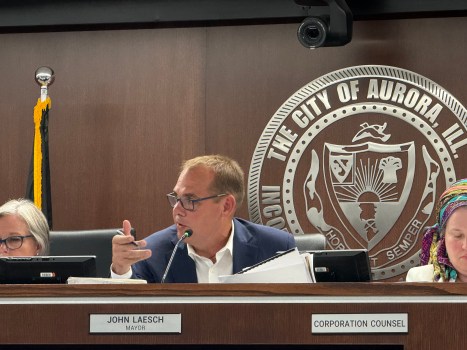


After over a year of testing water using requirements heightened in 2024, Aurora officials said Tuesday they once again found high levels of lead in the drinking water of some homes.
More than 10% of 100 water samples collected from area homes by the city between January and June exceeded the Environmental Protection Agency’s action level for lead in water, officials said.
This marks the third time the city has found high levels of lead in drinking water in some homes since new water testing standards were enacted in 2024 by the Illinois Environmental Protection Agency. High levels of lead were also found in some homes in July 2025 and January 2026.
Exceeding the action level means that the EPA requires the city to take actions such as replacing lead service lines, adjusting water treatment practices and implementing public education programs, according to the EPA’s website.
The action level is not a standard for establishing a safe level of lead in a home, according to the EPA website.
City officials said water coming from Aurora’s Water Treatment Plant does not include lead, but that some of the pipes that connect houses to city water mains do.
Lead can enter from these pipes and affect household drinking water, officials said. When that lead is consumed, the human body can mistake it for calcium, accumulating it in bones and organs.
Public health officials have said minor exposure to lead can have long-term consequences and can even permanently damage the developing brains of children and contribute to heart disease, kidney failure and other health problems later in life.
The recent Aurora results do not mean that all drinking water in Aurora contains lead, officials said.
Rather, lead service lines are clustered in certain city areas, according to a city map of water service lines.
Wards 2, 3, 4 and 6 show a high number of water pipes that contain lead, while Wards 8, 9 and 10 show relatively few lead service lines, according to the map.
Lead service lines are also concentrated in the 5th Ward, mostly up until Orchard Road, and in the 7th Ward up until the Oakhurst Forest Preserve, according to the map.
The 1st Ward contains some lead lines but mostly in clusters, with the largest group of lead pipes in an area bound by Aurora Avenue, David Hoffman Drive and Ohio Street, according to the map. Lead lines have also been found around Indian Creek Park, along Squire Drive and along Trask Street, the map shows.
The city advised residents in a news release Tuesday to use water filters certified to remove lead, to clean their water faucet’s aerator and use cold water and running water for a short time before using it to clear what sat in pipes.
Aurora officials said the city will replace lead service lines at no cost when disturbances such as maintenance activities or underground infrastructure improvements occur, as well as when a test reveals a service line has a lead concentration above the action level.
Aurora officials also said customers can, at their own cost, replace the service line from the meter on the inside of their property out to the curb stop, and the city will provide a filtration device prior to that work being done. Once that work is done, the city will schedule the replacement of the remainder of the service line from the curb stop to the water main at no cost to the customer within 30 days, officials said.
Aurora has been working to remove lead and galvanized water lines for years. Since 2018, the city has replaced 3,425 lead service lines, with more set to be replaced in the coming years, the recent news release from the city said.
The city also implemented new corrosion control treatments in March, which include the use of orthophosphate. This chemical can reduce the amount of lead leaching into drinking water, lowering potential exposure to lead when the water comes in contact with a lead service line, officials said.
City, state and even federal officials have long pushed to remove lead lines in Illinois, as the state has more lead service lines than any other state, with 677,000 known lead service lines and another 820,000 suspected lines as of May 2026.
In 2024, pressure to remove lead lines heightened after a package of more stringent federal regulations was passed under the Biden administration. That package included a mandate for communities to identify and remove every toxic lead pipe within a decade, with exceptions.
Aurora officials said the new sampling and monitoring requirements under these regulations have contributed to certain homes in the city now exceeding the action level for lead.
Officials said before 2024, they would only measure the first liter of water that came out of a faucet in a residential unit. Now, both the first and fifth liters of water must be sampled, officials said.
Despite state and federal grant programs, progress in replacing lead lines has been slow in Illinois, as the task can be costly. Replacing a single lead line can cost about $10,000.
The state is set to receive $295 million in federal money to address lead in drinking water as part of a $921 million regional investment, the federal government said in May. It remains unclear how much of that funding is promised to Aurora.
Aurora residents can learn what material their service line is made out of by going to lead-service-cityofaurora.hub.arcgis.com. Those who wish to have their water tested can email the Aurora Water Production Division for help: leadtesting@aurora.il.us.
awright@chicagotribune.com