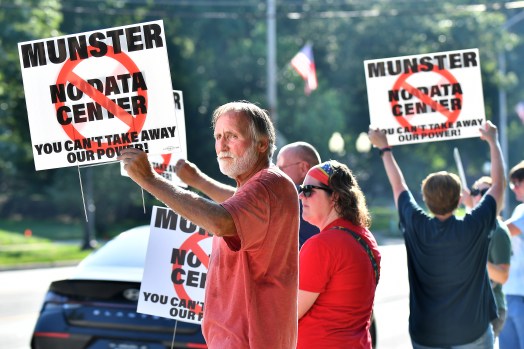
Three Gary council members brought the Citizens Action Coalition to the city Wednesday night to talk about residents’ continued concerns with high utility bills and data centers.
Councilman Darren Washington, D-at large, encouraged other Northwest Indiana cities to do the same.
“We are challenging every common or town council in the entire state to allow these people to come and do presentations,” Washington said. “We must be prepared for the 2027 legislative session because a lot is going on, and utility costs and rates cannot be hidden in everything that’s going on.”
Council members Lori Latham, D-1st, and Dwight Williams, D-6th, also joined the meeting. Wednesday’s forum explained why utility bills have been high statewide, actions at the statehouse that lead to higher bills, and the impact that data centers have.
The Citizens Action Coalition was founded in 1974 and watches utilities statewide and advocates for residential ratepayers and the environment. Kelly Hamman, the organization’s director of development, said that since its beginning, the Citizens Action Coalition has saved residential ratepayers about $10 billion in excess utility costs.
Kerwin Olson, the organization’s executive director, said he advocates for ratepayers during each state legislative session. The group also monitors the Indiana Utility Regulatory Commission’s actions and intervenes in cases on behalf of consumers.
“Utilities should be affordable for all households,” Olson said. “We’re in the midst of what we believe is a significant energy and utility affordability crisis.”
In a July 2025 report, the Citizens Action Coalition found that electric utility bills have increased more than $28 per month statewide, or 17.5%. NIPSCO residential customers were hit hardest, with about a $50 per month, or 26.7% increase, in one year.
Olson said Wednesday that the organization does not yet know what those numbers look like a year later.
He added that actions taken by the Indiana General Assembly have led to higher bills statewide, including allowing trackers or add-on fees to bills, which allows utilities to raise rates or charge customers for things outside of a general rate case proceeding.
“The Indiana General Assembly has been passing those things ad nauseum for the last 20 years,” Olson said.
Olson also claimed that legislators have eroded the discretion, flexibility and authority of regulators through some of its actions, and it’s led to affordability issues.
“We created these regulatory commissions as a surrogate to competition, to keep these monopolies in check,” Olson said. “The more the legislation passes bills that reduce that discretion, reduce that flexibility … the less ability the commission has to do their job in playing that role.”
Ben Inskeep, the Citizens Action Coalition’s program director, said NIPSCO customers have watched their bills skyrocket in the past two years while wages have not increased at the same speed. Laws that erode customer rights, costs to keep coal plants open, and the utility’s deals with large operators have led to increases, Inskeep said.
As data centers come to the region, they’ll have concerning impacts for customers, Inskeep said, which include large water and energy consumption. Data center operators also receive “heavy subsidies” at the state and local level, which Inskeep said can be detrimental to local governments who need money.
“In fact, no other facility on the grid today uses as much electricity as an (artificial intelligence) data center,” Inskeep said. “With that large energy consumptions comes a lot of negative impacts to communities, especially when they’re fueled by fossil fuel generation.”
Inskeep encouraged community members to pressure their elected officials to take several actions against high utility bills, including eliminating sales tax for residential customers, eliminating fees, having shareholders chip in for costs and giving customers more options.
In a statement Thursday morning, a NIPSCO spokesperson said the utility was not invited or asked to provide information about Gary’s meeting. The utility statement said NIPSCO has heard directly from customers about rising household costs, and customer support and affordability is a key focus.
Washington said Wednesday that the decision to not invite NIPSCO was made on purpose.
“I’ve been to many forums where NIPSCO is there, and every time you speak to NIPSCO, there’s always something we’re not doing,” Washington said. “It’s always something, like, ‘You don’t have your thermostat at a certain level.’ It’s always something with us.”
For the summer, NIPSCO launched a $1.5 million shareholder-funded CARE Electric Cooling Program, which will help those eligible for the Low Income Home Energy Assistance Program manage summer electricity costs, eliminate deposits for income-qualified gas and electric customers, and waive certain electric reconnection charges.
Through new agreements to provide data center customers with service, NIPSCO also expects to return $1.4 billion in bill credits to electric customers over 15 years, according to its statement.
NIPSCO also said in its statement that its rates are reviewed and approved by the IURC, and the process allowed for public participation and evaluated necessary investments and costs.
“The outcome of that process enables NIPSCO to make critical investments in the infrastructure needed to serve customers today and into the future,” the utility’s statement said. “These investments support a more balanced generation portfolio, modernization of the electric grid and replacement of critical infrastructure necessary to provide safe and reliable service for decades to come. In addition, NIPSCO remains focused on delivering customer value through measures, such as returning 100% of revenues from excess power sales back to customers.
“Investments to modernize and strengthen the electric system are helping improve reliability, lessen the impact of outages and restore power more quickly when interruptions occur, including during severe weather. The value of these investments can be seen in a variety of ways, including during significant severe weather events such as those experienced across northern Indiana in 2026. While no electric system can completely prevent outages during severe weather events, NIPSCO’s investments in grid modernization, reliability and resiliency have strengthened the system’s ability to perform under challenging conditions, helping reduce outage impacts and support restoration efforts.”
On Wednesday, the IURC also announced findings from its investigation into energy affordability statewide. The commission launched formal investigations into return on equity and trackers to “best evaluate the impacts of performance-based ratemaking on utility profits, risk and affordability,” according to a news release.
“We applaud the IURC for taking a deep dive into issues that we believe are key drivers that led to the affordability crisis facing Hoosier ratepayers today,” Olson said in a statement following the IURC announcement. “We have long been critical of tracking mechanisms which allow monopolies to increase bills outside of a rate case and which reduce the discretion and flexibility of regulators. There’s no question that the returns on equity of the Indiana utilities are unjustly high and disproportionate to the risk that investors face.”
Other actions they will take include developing future performance incentive mechanisms; guiding transmission, distribution and storage system improvement charge implementation standards; double customer assistance programs; evaluate energy efficiency programs; meet local development needs; improve customer care; and communicate ratepayer relief.
The IURC also recommends the Indiana General Assembly look at several energy issues, including evaluating the sales tax on utility bills and allowing the commission to have more oversight on utility ownership.
State Rep. Alex Burton, D-Evansville, said in a news release Wednesday that Hoosiers cannot wait until legislative to get utility relief, and he called on Gov. Mike Braun’s administration to take action.
“We’re in a moment that must be met with more than words, plans or promises,” Burton said. “For nearly a year, Hoosiers have been consistently vocal in advocating for energy relief, but very little has been done to put ratepayers first. This time around, Hoosiers are refusing to be lullabied and distracted away from addressing our energy cost burden. This inequity has festered long enough.”