Authorities are investigating the death of a 5-year-old boy Sunday who had been staying inside a warehouse on the Lower West Side housing several thousand migrants.
The parents of Jean Carlos Martinez Rivero are devastated, said Matt DeMateo, executive director and pastor at New Life Centers, who is consoling the family and mediating their communication with city officials as the investigation of their son’s death continues.
DeMateo has been by the family’s side since the boy was taken to the hospital Sunday, “and I’m still here,” he told the Tribune.
For migrant advocates, the boy’s death marked the tipping point of the city’s shelter system overflowing with demand. More than 26,000 migrants have come to Chicago over the past 16 months, and advocates say they have been worried about something like this happening for weeks.
Health care specialists have questioned both the conditions and coordination of care not only in the warehouse at 2241 S. Halsted St., but in the entire 27-shelter system.
“Malnutrition on top of crowded conditions in the winter when there are all kinds of respiratory conditions can lead to really bad outcomes,” said Minal Giri, chair of the Refugee Immigrant Child Health Initiative for the Illinois chapter at the American Academy of Pediatrics.

She said the city’s health care system in shelters is disorganized and decentralized.
Jean Carlos had been sick for a couple of days prior to his death, his parents told police. The family had been outside begging for money earlier on Sunday, but came home after the 5-year-old had vomited.
At the shelter, his lips turned purple, his parents told police. The boy’s family members told police that staff had said the discoloration was “probably because of the cold.”
But after the boy complained that his stomach hurt and his eyes rolled to the back of his head, staff began performing chest compressions on him and called for an ambulance.
The boy was pronounced dead at Comer Children’s Hospital and the cause of death is under investigation, authorities said. The Chicago Department of Public Health will continue to evaluate the situation, according to a statement Tuesday from Mayor Brandon Johnson’s press office, which continued to place blame for the migrant crisis on Republican Texas Gov. Greg Abbott, who has been busing migrants to Chicago and other liberal cities since August 2022.

“Many new arrivals survive brutal and dangerous journeys to border states and are promptly and inhumanely transported with little to no triage. Border states do not take appropriate measures to ensure the safety of individuals they load onto buses,” according to the mayor’s office statement. “As a result, interior cities like Chicago are receiving new arrivals with more severe medical needs, since many asylum-seekers are spending the night outdoors without access to sanitation, drinking water or food immediately prior to their journeys.”
According to the city, the Martinez Rivero family arrived in Chicago on Nov. 30, and had been staying at the warehouse ever since.
A vigil for Jean Carlos is planned for 6 p.m. Wednesday near the shelter. Volunteers are requesting those attending bring medicine to share.
Sara Izquierdo, co-founder and director of the Mobile Migrant Health Team, a group of medical students that went to police stations to provide medical care when migrants were staying there, performed a site assessment at the shelter Monday with city officials and shelter employees.
She called the conditions inside “very, very concerning.”
When she was providing care to migrants at police stations, she said she would promise them better resources once they got into the city’s shelter system.
“Now I feel almost as if I lied to them,” she said.

City officials say that the city’s public health department supports shelter-based care through its partners, including on-site screenings, infection prevention and vaccinations.
“Strike teams from UI Health and Rush have been deployed to shelters on an as-needed basis to address outbreak responses, and currently visit the Halsted shelter twice a week to provide additional testing and vaccinations,” the mayor’s statement said.
On Monday, after the child’s death, fire officials transported five people with fevers to hospitals from the shelter, which houses 2,414 migrants. The ill people included children ages 1, 4, 8 and 9, Fire Department spokesperson Larry Langford said.
“The cases do not appear related other than having originated in the same shelter, and symptoms are consistent with ongoing seasonal respiratory trends. We will continue to provide updates as more information becomes available,” Johnson’s statement said.
The ambulance call is not an isolated incident, and since the boy’s death, EMS calls haven’t stopped.
Langford said Tuesday there had been two EMS calls for migrants late Monday — a 7-year-old with an ear infection and a 3-year-old who was vomiting. Both were brought to the emergency room at the University of Illinois Hospital.
A woman in her 40s was brought to the hospital early Tuesday for “chest discomfort,” Langford said.
Tuesday afternoon, the Tribune watched two ambulances pull up to the shelter in the course of three hours.
Langford said he has only seen an increase in emergency calls from the shelter on Halsted Street, despite 26 other locations housing nearly 11,500 migrants around the city.
“I don’t know why, but that one’s been getting a run,” he said.

Migrants who gathered outside the shelter Tuesday afternoon said it feels like they are sleeping in a refrigerator. Euglimar Ramos, 30, from Punto Fijo, Venezuela, said she was in the same section of the shelter as the little boy who died.
“It’s so sad,” she said, looking at her 11-year-old son Lenin. “I saw him die. He shouldn’t have died that young.”
Giri said she has heard and seen concerning reports of conditions inside the Halsted shelter. But her biggest concern, she said, is the lack of transparency from the city’s biggest contractor to handle the migrant crisis, Favorite Healthcare Staffing.
“Favorite shut the door so that no one could really see what’s happening in these shelters. … And it’s horrific,” she said.
“Does Favorite have a protocol for dealing with sick children? Do they have anyone in house who has any kind of pediatric background? Do they have regular access to sick visits?” she asked.
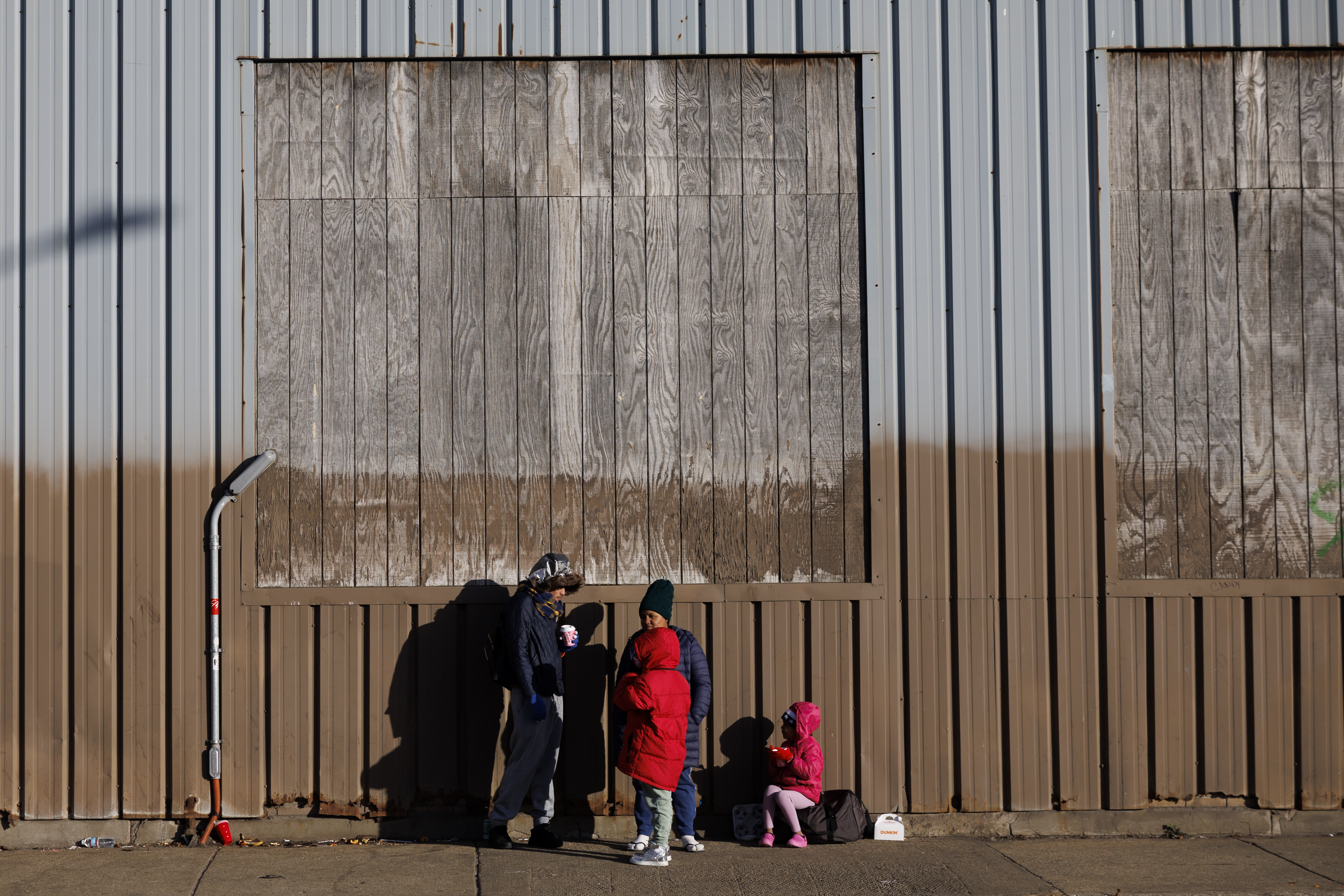
Migrants told the Tribune on Tuesday there is a general atmosphere of fear in the shelters. They are worried about what will happen when their time in shelters runs out and they are put out onto the street.
Tuesday afternoon, dozens of migrants got off a CTA bus and walked into the shelter. Mothers held children swathed in blankets. They wrapped their arms around themselves to stay warm.
At 4:30 p.m. a school bus dropping off migrants pulled up to the shelter at the same time as an ambulance. The sirens flashed red onto the fluorescently lit windows of the large brick industrial building.
Lupe Guadalupe Rivera, a teacher who volunteered helping migrants at the Gresham District (6th) police station went to the shelter on the Lower West Side Saturday to hand out Christmas gifts to children staying there. Over 1,000 gifts were needed, she said.
She said the migrant children she gave gifts to were wearing flip-flops and didn’t have coats. Their health needs are extensive.
“I’m sure as the weather is getting worse, the families are getting sicker,” she said. “They have a lot of allergies. They need a lot of stomach medications. … And it can be hard to keep up with that.”
The volume of migrants she saw Saturday solidified to her the city’s challenges providing care to everyone.
“I feel like the city has been trying to do as best as they can with the resources that they have, but there’s so many people there that it’s just difficult to handle,” she said.