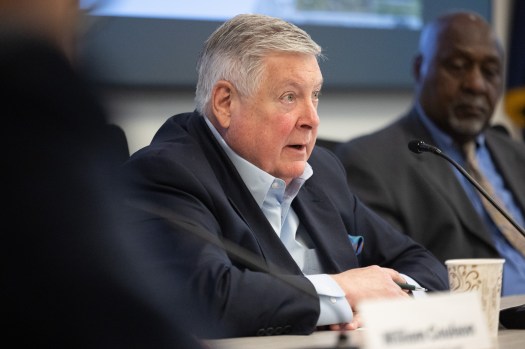
Howard Dean doesn’t mince words about Dean Foods Co.’s new television advertisements for its trendy Milk Chugs line. “I don’t like them myself,” huffs the normally low-key chairman and chief executive.
The ads feature a hip, animated youth named Chazz, with tall, purple hair and sunglasses, who struts around chugging a pint of milk out of a plastic bottle.
They are a little too slick for Dean’s conservative tastes. But the 63-year-old executive, grandson of the company’s founder, grudgingly accepts them because he can’t argue with success.
Although they are off-putting to Dean, the ads for the Franklin Park-based dairy food processor have wowed on-the-go teens and twentysomethings who no longer thought milk was cool. In the three years since the line was introduced, Milk Chugs has grown to a more than $200 million business, one of the most successful product launches in the company’s 75-year history.
“Chugs have been a home run,” said David Nelson, an analyst at Credit Suisse First Boston.
That’s an encouraging sign for a company better known for its manufacturing heritage than marketing know-how. Dean is building on that momentum as well, by investing more in product innovation and in the company’s existing national brands, such as Chugs, Land O’ Lakes dairy products, Marie’s salad dressings and Dean’s dips.
Dean Foods has to move aggressively because it’s not likely to keep up its hectic pace of acquisitions–26 in the past five fiscal years–that historically have fueled growth.
Moreover, investor patience is running as thin as non-fat milk. Choppy earnings in the past few years– mostly because of problems absorbing dairy purchases–have taken a bite of the company’s stock price. Shares are off nearly 30 percent from their 52-week high of $46.56.
“They’ve got to make these branding initiatives work,” Nelson said.
The company has concentrated in the past on being a low-cost, high-volume producer. When the dairy industry started consolidating about five years ago, Dean decided to grow rather than be a target. The company bought more than a dozen smaller dairies to become one of the nation’s two largest dairy processors, with operations in more than 20 states.
The dealmaking helped the company double sales to $4.1 billion in fiscal 2000, which ended in May, from $2 billion in 1990.
While the company was on an acquisition binge, it also had to confront a scary reality: Milk consumption was steadily declining. With consumers eating at home less often, they no longer had time for a bowl of cereal at breakfast or a glass of milk at dinner.
For the first time, Dean Foods had to think about milk as a product to be packaged and marketed to meet consumers’ changing needs. It was quite a departure for a company with a few brand names and a much bigger portfolio of private-label offerings.
Dean never had spent exorbitant sums on star pitchmen or splashy ad campaigns. After all, how many consumers look at the label before buying a gallon of milk?
In late 1996, Dean hired Philip Marineau, a marketing expert who had been with Quaker Oats Co. As president, Marineau also was viewed as the heir apparent to Dean.
He brought with him sophisticated marketing, such as brainstorming sessions on new products and advanced consumer research, something that food companies such as Quaker and Kraft Foods had been doing for years.
“We put a brand group together, which was very different in Dean,” said Jenny Carpenter, vice president of brand management, who has been with the company for 33 years.
At the time, the company was testing a single-serve package of milk that was portable and could fit in car cupholders. But Marineau left for PepsiCo Inc. before the regional rollout of Milk Chugs in November 1997.
The original ads featuring Chazz, created by Chicago’s Euro RSCG Tatham, seized on the Chugs’ contemporary packaging and portability to excite kids and moms about milk again. Though Dean was wringing his hands over the ads, they struck a chord with consumers, whose only exposure to milk advertising was the “Got Milk” and milk mustache campaigns from the dairy industry.
“We weren’t going to win by talking about the properties of milk,” said Gary Epstein, president and chief executive of Euro RSCG Tatham. “Sure, it’s refreshing and cold, but that’s been-there, done-that marketing.”
Dean Foods is taking Chugs national after refining a manufacturing technology that extends the shelf life of milk to 45 days from 25. With the rollout, the marketing of the product has evolved. The label features a more prominent “Milk Chug” graphic, de-emphasizing the regional dairy companies that distribute the product.
The company became a sponsor of U.S. Youth Soccer to broaden Chugs appeal with teens and kids ages 9 to 12, known as tweens. Milk Chugs also signed two mini-celebrities as spokespeople: professional soccer player Carlos Valderrama and Shannon MacMillan, a member of the women’s national team that won the World Cup.
Now, Dean Foods is counting on Chugs’ success to breed other winners. The company is living up to its promise to invest more in its national brands: In the new fiscal year that began in June, Dean Foods boosted its ad budget by about 30 percent.
The company is increasing its spending on marketing while keeping a close eye on other expenses. It recently canceled a retreat in Florida for 220 managers and their spouses.
In the first quarter, the company spent $6 million advertising Chugs, Marie’s pourable dressings and Dips-for-One, single-serve snack dips that were introduced in April.
Initial consumer studies have found the individual dips are popular with females, who don’t like finding crumbled chips in the 16-ounce tubs favored by males, Carpenter said.
Outside the dairy case, the company has expanded into nutritional drinks and is testing a cheese pouch, named Poucheze, for chip-dipping. Dean said the company is talking to a leading fast-food chain that is interested in selling a version of the pouch to customers who like cheese with their fries.
And the product pipeline is richer than it ever has been in the company’s history. For instance, the company is studying juice, yogurt and coffee drinks in the same handy containers that Chugs come in, Dean said.
“You have to give consumers what they want,” he said.
Indeed, with that in mind, the company reorganized its business units last month, creating a division just for its national dairy and related brands and putting a former Kraft whiz, Lou Nieto, in charge. President Richard Bailey, another Kraft alum and Marineau’s successor, also plans to fully implement brand management, a system made famous by Procter & Gamble Co. that is intended to establish and build relationships between brands and consumers.
“I think Dean Foods is changing for the better,” said John McMillin, an analyst at Prudential Securities.
Bailey, who joined the company in 1998, personally has a lot riding on the success of the branding initiatives. He is in line to become CEO, but Dean says the promotion is not guaranteed. Dean, who has been with the company since 1965, the last 13 years as CEO, is looking forward to retiring by July 1, 2002, when he turns 65.
But Dean would like to go out on a high note. Although he is proud the company has so far survived the consolidation of the dairy industry, he is well aware that investors are not happy with the stock’s recent performance.
If a shareholder invested $100 in Dean Foods’ stock on June 1, 1995, those shares were worth about $125 at the end of May. By comparison, the same investment in the S&P MidCap 400 Index was worth more than $250 over the same time frame.
Dean had to greet shareholders earlier this month at the annual meeting with hat in hand. “One figure I don’t want to talk about, but I will, is the stock price over the past five years,” he told them.
So he has a sense of urgency: “We’ve got to keep growing.”