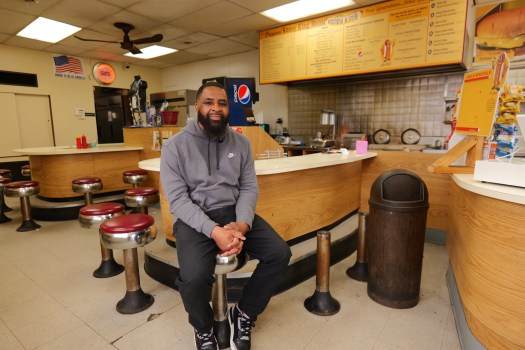
When Omar Minaya agreed to run the Montreal Expos for Major League Baseball, he took over an organization that had only six people remaining. Everybody else had gone to the Florida Marlins with owner Jeffrey Loria.
But Minaya does have a volunteer assistant. He’s the same guy who helped Andy MacPhail land Moises Alou last December–the well-known dealmaker, Sammy Sosa.
Sosa was one of the first people who called Minaya when he was named the Expos’ general manager, becoming the first Hispanic GM in the big leagues.
“Sammy was excited, very excited,” Minaya said. “He was thinking about coming here before he left for camp. He wasn’t sure he could get here but he said he wanted to come by to shake my hand.”
Minaya and Sosa have both come a long way since their first handshake. It came on the day of a tryout in 1985.
Minaya, who had spent the previous season playing in Italy, was in his first year as a scout for the Texas Rangers. Scouting director Sandy Johnson, his mentor, had just hired him for an annual salary of $11,000. That doesn’t sound like much, but it is more than three times what it took Minaya to sign Sosa.
“If I told you I knew he would hit 60 homers in three seasons I would be lying to you,” Minaya said. “I thought he had a little bit of baseball ability, but I’m not that smart. He’s not the kid we signed. He was 5-foot-10, slim, little. He had the desire. When you have his work ethic, you have a chance.”
Minaya remembers Sosa stepping off a bus after a six-hour ride to the tryout and being as wide-eyed as anyone on the field. When he introduced himself to Minaya, he told him, “I’m going to be a major-leaguer.” He sealed the vow with a handshake beyond his years.
“He’s got large hands,” Minaya said. “He did then. I remember how strongly he shook my hand.”
When Minaya brought Johnson to the Dominican Republic to sign Sosa, they found him shining shoes. “Sammy was a worker,” Minaya said. “He still is a worker.”
While Sosa was playing his way to the big leagues, then piling up 450 career homers, Minaya was making a reputation of his own. He became an assistant to Texas general manager Doug Melvin, then moved to his native New York in 1997 as an assistant to Mets GM Steve Phillips.
Minaya added to his reputation as a tireless scout by becoming an early expert on international players. He traveled the world for the Mets, returning with players such as Masato Yoshii, Timo Perez and Tsuyoshi Shinjo.
It seemed only a matter of time before somebody gave him his own team to run. He made all the right lists and had all the right contacts. He got lots of job interviews but he couldn’t land a general manager’s job.
Minaya was told he was the second choice when Seattle hired Pat Gillick to replace Woody Woodward in 1999. It was the same story when Dean Taylor was hired to run the Milwaukee Brewers. Minaya also interviewed for GM jobs with Los Angeles, Pittsburgh and Colorado.
He became discouraged. His worst moment came last winter when a search firm working for Texas owner Tom Hicks contacted him, then never got back after asking an impersonal battery of questions. He had expected better treatment from the franchise where he had played a major role in the acquisition of perennial All-Stars Ivan Rodriquez and Juan Gonzalez, among others.
While African-Americans and Hispanics were becoming more visible in managing and coaching jobs, there were no minority GMs in the major leagues between the Yankees’ firing of Bob Watson in 1997 and the White Sox’s promotion of Ken Williams in October 2000. Minaya began to wonder if he was getting job interviews only to fulfill the requirements of Commissioner Bud Selig.
“Sometimes that crossed my mind,” Minaya said. “At some point in time you say to yourself, `What do they want?’ It got to a point where I started asking [organizations], `What are you looking for? If you’re looking for an administrative type, I’m not it. If you’re looking for a baseball guy, a guy who has a lot of experience, then let’s talk.”‘
Minaya has no idea where the chance to run the lame-duck Expos will lead. He knows he will have a job beyond 2002 but doesn’t know if it will be running this franchise in a new market, most likely Washington, D.C., or if it will be in an undetermined capacity with Selig’s office.
It was hard for him to leave his hometown Mets, who have a chance of going to the World Series, and uprooting his wife and two children. But in the end there was no way he could pass up a chance to be a general manager.
“You do get frustrated,” Minaya said. “But I believe in myself.”
Frank Robinson says Minaya’s hiring made it easier for him to accept a one-year deal to manage the Expos. “I believe we’ll have a good relationship, be on the same page,” Robinson said. “I’ve known Omar. We’ve sat and talked about baseball a lot … The only way I can help him is winning ballgames. I’m going to try to make him look real good.”
Minaya says he has “full authority” to run the Expos as he would any other team. But MLB’s ownership of the team creates a strange situation, especially for player movement.
Won’t rival teams complain if Minaya trades productive players such as Vladimir Guerrero and Jose Vidro to contenders? Those deals aren’t likely to happen, however, as reliever Graeme Lloyd is the most prominent Expo eligible for free agency after this season.
Minaya is looking to improve Montreal’s team, not break it up. He would consider trading veterans like ace Javier Vazquez only in multiplayer deals where he gets proven players in return. He says his first priority is to acquire a closer with experience to lessen the load on Scott Strickland.
“You know what?” Minaya said. “I like to win. I was with the Rangers when we won, and with the Mets when we won. Those were different budgets but I’m going to do my best to win games. My goal is to improve this team from what it was last year.”