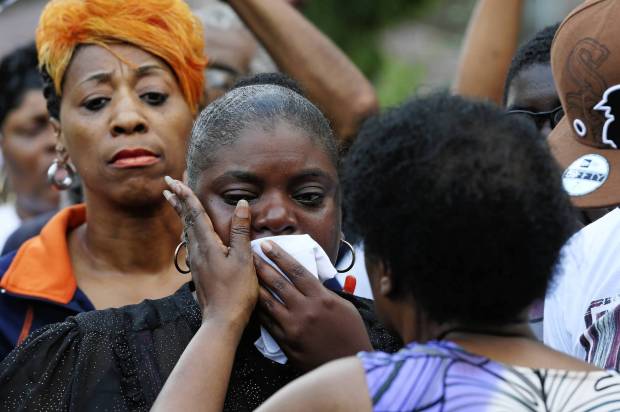


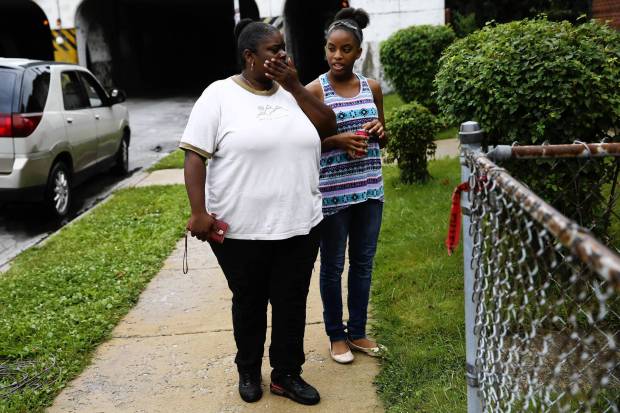



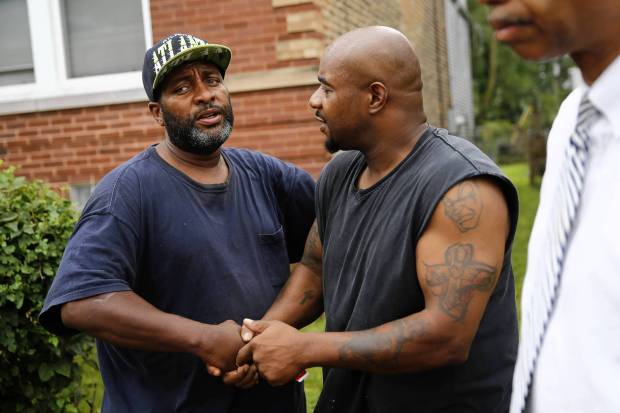
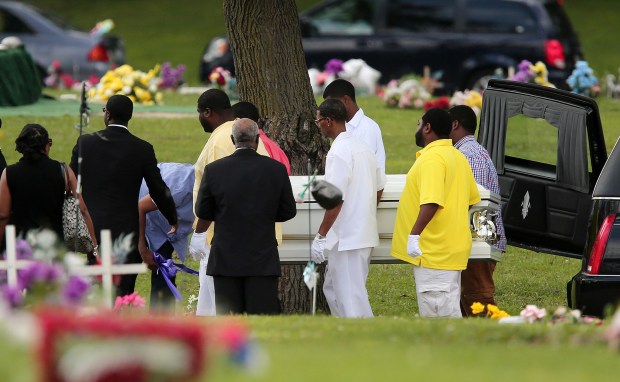


Affectionately called Fat Baby and Hamburger, Antonio loved to make other people laugh, his family members said. … The fourth-grader was on the honor roll at Hinton Elementary School and was so smart he could “sell water to a whale,” according to an obituary written by Antonio’s family and distributed at the funeral, held at the church where he was baptized and sang in choir. His framed Washington Park peewee football No. 84 jersey stood to the left of his small white casket.
— Chicago Tribune, Sept. 20, 2014.
At a bond hearing Saturday for four male defendants, Cook County prosecutors alleged that a gun crime parolee had pumped bullets into 9-year-old Antonio Smith. They said the shooter urinated on his own hands to cleanse them of gunpowder residue, then changed his shirt and returned home to comply with his electronic monitoring requirements.
The prosecutors also documented six “gunshot wounds of entrance” in Antonio’s right chest, right outside forearm, center back, right lower chest, right shoulder and left hand — plus “two additional graze wounds to the left hand.”
More than enough to explain the small white casket. More than enough to mark this particular crime — who repeatedly shoots anyone, let alone a 9-year-old? — as heinous, maddening, incomprehensible.
But the death of Chicago’s youngest victim of gun violence this year merits at least one other adjective:
It’s inconvenient — for Illinois legislators who don’t want to lengthen the prison terms of people convicted of gun crimes. The bulk of this opposition comes from lawmakers who say longer sentences would warehouse more minority youths. The observation that longer sentences also would keep alive more minority youths such as Antonio has, at least until now, been a loser.
If the rest of us allow the killing of Antonio Smith to be little more than inconvenient — to lawmakers but also to our distractible selves — we won’t even be as useful as whoever shoveled dirt atop the peewee player’s small white casket.
The alleged shooter in this case, 19-year-old Derrick Allmon, has a not atypical background for a Chicago murder defendant. In November 2012, at age 17, he was charged with aggravated unlawful use of a weapon by a gang member. Police responding to a call of shots fired had arrested Allmon with a fully loaded .22-caliber revolver plus 14 more live rounds. He acknowledged his gang involvement and directed officers to 7532 S. Jeffery Blvd., where he said he had shot the gun five times and then reloaded.
In March 2013, a judge sentenced Allmon to 42 months in prison. Under Illinois law, Allmon had to serve only about half of that time, or 21 months. Given that his time in Cook County Jail awaiting trial counted toward that sentence, the Illinois Department of Corrections released Allmon on Aug. 1. On Aug. 20, he allegedly shot Antonio.
Prosecutors say Allmon and his fellow defendants had driven to the location of the murder to shoot members of a rival gang faction. While traversing backyards to get a good shot, Allmon allegedly encountered Antonio, who said, “Hey.” Police Supt. Garry McCarthy says Allmon shot Antonio because he thought Antonio “was yelling a warning to (Allmon’s) intended victims.” Authorities found the gun, which testing has established as the murder weapon, after Allmon allegedly told them where he had thrown it into a sewer.
But why was Allmon on the streets after a mere 21 months for his 2012 gun crime?
Illinois lawmakers often hide behind the widespread belief that they’ve enacted truth-in-sentencing laws: If the judge sentences you to X, you’ll serve most of X.
It’s true that convicted murderers must serve 100 percent of their sentences — typically a minimum of 20 years. A cluster of other violent crimes — the list includes attempted murder, homicide of an unborn child, rape, shooting someone, aggravated kidnapping and home invasion — requires that convicts serve 85 percent of their sentences. But other crimes, including common yet dangerous gun crimes such as Allmon’s 2012 offense, require only 50 percent time.
Cook County State’s Attorney Anita Alvarez, whose subordinates walked us through the law’s sentencing protocols, last month urged a legislative panel to toughen Illinois’ light penalties for repeat felony gun offenders, gun offenders who carry firearms while on parole or supervised release, and “known and admitted street gang members” who possess firearms. From Alvarez’s testimony:
“When a felon is convicted for carrying a firearm in public, the average time that he or she ends up serving in jail or prison is 15 months. When a violent street gang member is caught carrying a firearm in public, the average sentence served is 12 months. Studies show us that 63 percent of these offenders will re-offend within 12 months of release, and that they are four times as likely to commit a homicide.”
In practice: Bad enough that Allmon exited prison after 21 months. Had he not been a gang member, his 2013 sentence likely would have been a year or so. He’d have walked free in … about six months.
We often disagree with gun rights groups on policy questions. We do, though, subscribe to one belief these groups often espouse: Lawmakers should set, and courts should enforce, serious penalties for firearms crimes.
That isn’t what’s happened in Illinois. Every time a weak Illinois sentence returns a gun criminal to the streets relatively soon, lawmakers who resist tougher punishments risk having some victim’s blood on their hands.
We’ll all learn, as this case proceeds, whether one of those weak sentences cost 9-year-old Antonio Smith his future.
Join in the discussion on the Chicago Tribune Editorial Board’s Facebook page or on Twitter by following @Trib_Ed_Board.