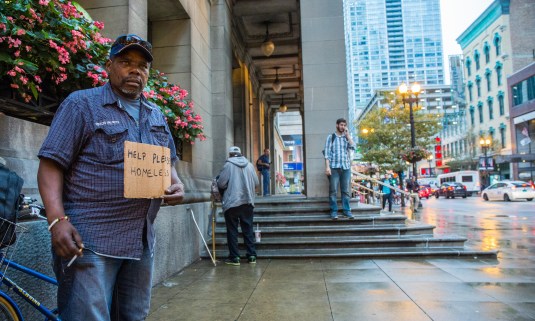

Recently I wrote about panhandlers in the suburbs. Readers didn’t take long to react.
Initial responses disagreed with my compassion theory. New Orleans reader Philip Chin wrote, “First, if government and private (or) religious organizations pay for all (or part) of the homeless’ food and shelter, why should homeless change their addictive behavior? Second, by making food, toiletries, clothing and shelter (mainly) free, the homeless can now spend 100 percent, or a significant amount, of their time and effort to obtain drugs and beer. Third, these ‘homeless, no questions asked’ jobs pay out in cash and ‘street papers’ are sold for cash and are then easily used to purchase drugs and beer to feed addictions as all of their food and shelter is given to them free anyway.”
Philip included links to materials discussing whether some kinds of help for homeless are actually counterproductive and enabling rather than supportive. I’ll admit some of his statements had merit.
A local reader shared his story, referencing the panhandler I have seen locally. He not only knew who I was talking about, but had an interaction with him, “I know the young man you are referring to . . . I’ve talked with him, then confirmed with Mariano’s they were hiring, returned to inform him of that fact and he had several excuses as to why not to apply. Then one day when he was done panhandling he went to his Honda CRV, very nice one. Perhaps I have spent a lot more time in the city than you, but what you are doing is enabling. There are several categories of homeless, some are worthy — disabled, PTSD, mentally ill or addicted. However, there’s a category called homeless by choice. Google it. The young men you see in the LV area are in that category, when you give them money you are taking the incentive away from filling out an app at Mariano’s.”
Support finally came from reader Phyllis, who wrote, “I was shopping at Kohls on Willow Road. I saw a man holding a sign ‘lost my job, need help feeding my family’. With him was a woman and two (preteen) children. They were standing by a stop sign, as I stopped I had a strong urge to do something. I too have been scammed by roadside panhandlers and have read about ‘Fagin-type’ handlers to whom they pay most of what they collected. I drove on but couldn’t get this family out of my mind, so I turned around. I told myself that even if they were scammers, whatever I did for them would have no effect on my life, and if they really needed help I had to step up. I decided I would buy them a meal . . . I asked if the children had eaten that day. The answer was no, so I bought Steak and Shake and asked a few questions. He told me he was from Romania and had lost his job as a landscaper. I hope it reminded this family that people care about them.”
There truly are two sides to every story.
Pat Lenhoff is a freelance columnist for Pioneer Press and can be reached at viewfromvh@yahoo.com.