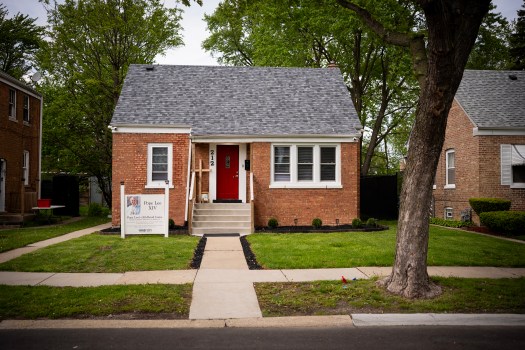


On a good day, the living room of Kathy Rogers’ Palos Park home is piled high with packages of disposable diapers.
It’s the result of a successful diaper drive, with the diapers going to local social service agencies, which will get them into the hands of needy parents.
When the room is empty, that means maybe somewhere in the south or southwest suburbs a baby is going to spend a day, or perhaps longer, in a dirty diaper.
In the two years since SouthWest Area Diaper Depository for Little Ends, or SWADDLE, was founded, the nonprofit has collected 130,000 disposable diapers — relying on diaper drives and fundraisers — for agencies such as Respond Now in Chicago Heights and Together We Cope in Tinley Park.
The diaper bank got its start a few years ago when Tinley Park resident Kay Keating read an article about how many families struggle to cover the cost of diaper wipes, which are not allowable purchases for families relying on government aid programs. Keating went to the National Diaper Bank Network website to find out more.
Friends with Rogers through church, Keating called her suggesting they work together to organize a diaper drive. Keating said she knew she wanted to, beyond a one-off drive, create something that could bring a steady supply of diapers and wipes for families in need. Rogers is SWADDLE’s chairman and Keating vice chairman — part of a seven-member board.
Keating said she and other board members have heard how access, or lack of access, to diapers can impact children and their families. Babies don’t get changed as often as needed, and families will try to clean and reuse disposable diapers, she and Rogers said.
“Health problems are a big issue,” Keating said, with babies suffering severe diaper rash or urinary tract infections from being in a wet diaper for prolonged periods.
Beyond that, there are potential development issues for babies, Rogers said.
“They’re not exploring their world, they’re not exploring their fingers and toes because they’re so uncomfortable,” she said.
Diapers can cost $70 to $80 a month, and families that don’t have broadband internet access can miss out on online diaper deals. Rogers said families might not live near a big box retailer or warehouse club, where they can get a better price on diapers and wipes, instead having to purchase them, at a premium, at a corner grocery or convenience store.
Earlier this year the White House noted that that the poorest families with infants use 14 percent of their income for diapers alone — an average $936 per child each year. By contrast, many higher income families pay less than half that amount.
The Obama administration earlier this year challenged online retailers, diaper makers and nonprofits to come up with solutions to address the diaper gap. In response, online site Jet.com said it would offer to diaper banks packages of diapers at a reduced cost and ship orders for free. SWADDLE just got its account with Jet set up, and Rogers said it will go a long way toward stretching the cash donations the nonprofit gets.
“That’s going to make a huge difference,” she said.
Regular diaper drives can bring in thousands of diaper donations for SWADDLE, which end up taking temporary residence in Rogers’ home until they can be distributed to local agencies. The nonprofit hopes to be able to use space at the Bridgeview business where she works as the new diaper depository.
St. Elizabeth Seton parish in Orland Hills has hosted a number of diaper drives, with one last fall bringing in more than 10,000, and St. Lawrence O’Toole parish in Matteson last fall collected 4,000 diapers and more than 1,200 wipes.
As part of homecoming activities at St. Xavier University in Chicago, SWADDLE was able to collect nearly 11,000 diapers. Rogers and board members Candace Ramirez and Carol Bradtke are SXU alumni, and Bradtke is vice president of the university’s national alumni association.
St. Rita of Cascia High School students and Queen of Martyrs junior high students collected about $1,300 to help purchase diapers, and SXU faculty and staff also made diaper donations, Rogers and Bradtke said.
SWADDLE board members and volunteers will break down diapers collected at the drives into packs of ten, which are wrapped in plastic and labeled to indicate the size. Sizes four, five and six are the ones most requested from the agencies the nonprofit works with.
Those diapers collected at St. Xavier were quickly out the door of Rogers’ home, and not having a consistent flow of diapers to ensure the social service agencies it works with are regularly supplied remains an obstacle, she and other directors said.
“We envision being able to meet that need some day,” Bradtke, a Tinley Park resident, said.
Rogers said SWADDLE is, to try to get a constant flow of supplies, encouraging “recurring giving,” with donors regularly dropping off packages of diapers. Rogers said that while “it’s great having diaper drives,” the group would like to see more donations of cash, allowing SWADDLE to “get diapers when we need them and in the size we need.”
The Associated Press contributed to this story.