
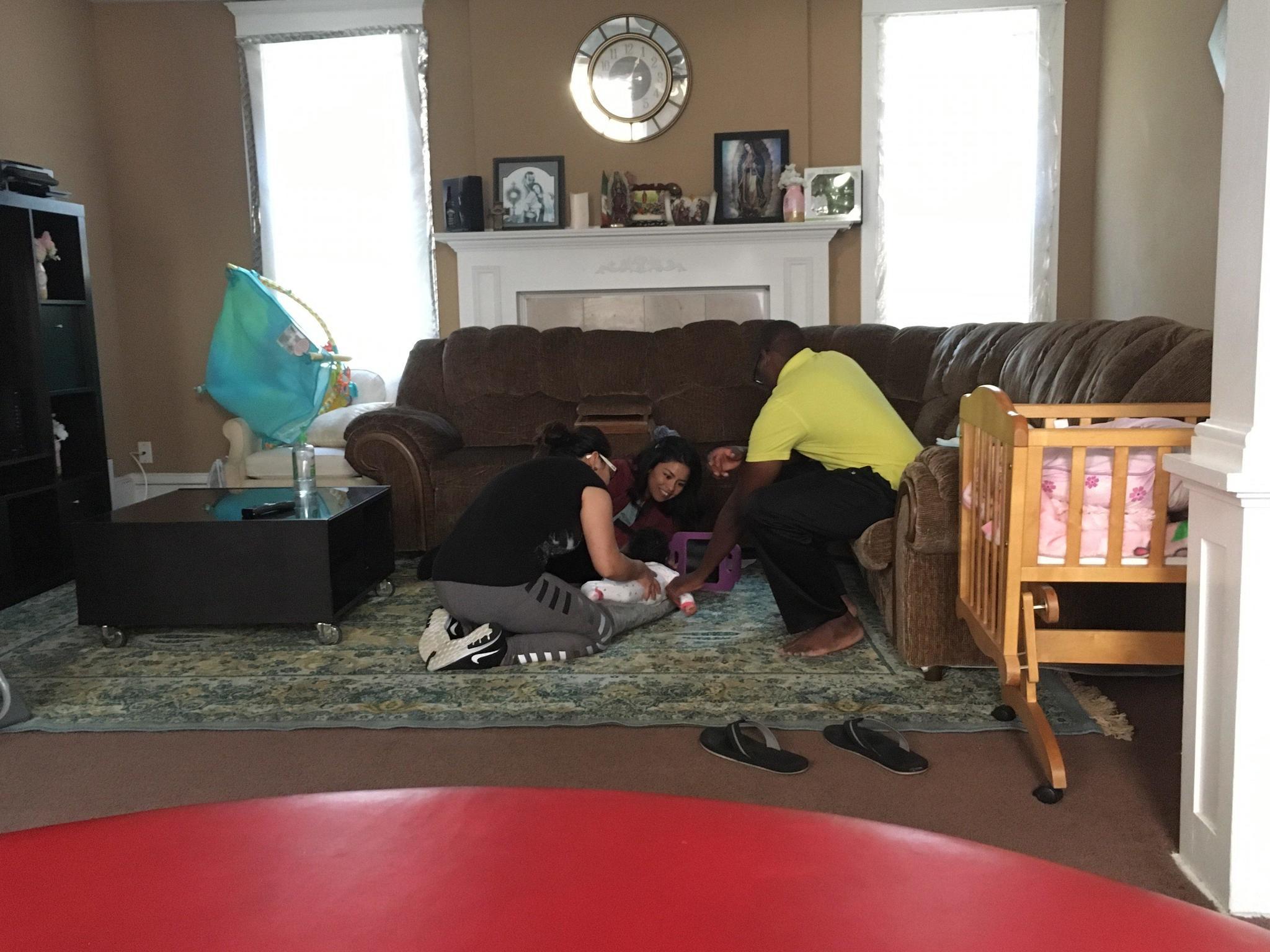


Marilyn Rodriguez sat on the floor of an East Side home with new parents and their nearly four-month-old daughter singing “head, shoulders, knees and toes” in Spanish.
They had discussed speaking and singing and introducing language to their daughter. The infant’s parents and grandmother will be speaking several languages, including English, Spanish and Swahili, and the child will soak them up like a sponge, Rodriguez told them.
For Rodriguez, who works for East Aurora School District 131’s Jumpstart program, the goal of this meeting, like her visits with other families, is to help new parents Diana and Jean Mvuyekure teach their child. Rodriguez used to work in an East Aurora middle school, and said she wondered how support at a young age could have affected some of the students she encountered.
“I can come in here and tell them a million times, ‘read to your baby, read to your baby.'” she said. “But when they sit there and they say, ‘I do it because I’m trying to be a better parent, I do it because this helps my child,’ when they have those moments, to us it’s just like, yay! It’s a celebration within us.”
The Jumpstart program, run by the public school district and funded by a state grant, has existed for 20 years in East Aurora. Team members, along with four other East Aurora educators, will be recognized at the Illinois State Board of Education’s “Those Who Excel” banquet at the end of October, according to the district.
The program’s five parent educators visit the homes of families with children up to age three, at which point they’re eligible to enter preschool, program educators said. In some cases, such as with the Mvuyekures, Jumpstart team members will begin working with a mother while she is still pregnant. Participants are registered in the school district system, so the principal who oversees the Jumpstart program equated the prenatal participants to “kids being in school before they’re even born.”
East Aurora is not the only Fox Valley school district to provide these types of services to children before preschool. Both Elgin School District U46 and West Aurora School District 129 offer similar services, sending educators to the homes of families with infants and toddlers.
Kathleen Kogut, the East Aurora preschool principal who oversees the Jumpstart program, said she can see the difference Jumpstart makes among preschool students. They seem to have more empowered families who feel more comfortable in school and advocate more for their children, she said. In turn, children see that both their school and their family are committed to helping them learn, and they will see value in education, she said.

“In communities we struggle with attendance and parents have so many responsibilities with work and with managing their whole lives,” she said. “Sometimes, school can fall a little bit to the side, and this program really puts it up front.”
The program is geared toward families where certain factors might create challenges — teen parents, immigrant families who do not speak English, or homeless families, Kogut said.
It offers screenings for potential issues and group activities. Playgroups can help introduce parents and kids to the idea of preschool, Jumpstart educator Maria Garcia said. Field trips to the library or a children’s museum help parents become more comfortable.
During regular home visits, which follow a set curriculum, educators focus on development, highlighting the importance of bedtime routine or tackling issues that are a struggle.
“In education, (you) expect the teacher to teach the child, but we don’t ever do that,” Kogut said. “We want to reinforce the parent as the teacher.”
Educators also focus on the whole family during home visits, because what affects a family can affect a child, said one parent educator, Wilma Vargas.
If a mother doesn’t speak English and wants to learn, educators will help connect her to language classes. If a father doesn’t have a job and wants help with a resume, they will connect him to services, Kogut said. Sometimes, educators provide supplies, such as books, to families.
“For some of the families, too, we are basically the only support they have,” Garcia said.
Up to 75 families can participate in the program at any one time. Each of the educators can take on 14 or 15 families at once. The program has been based out of several different buildings over the years — which some educators said might have made it hard for families to track down — but is now located at East Aurora’s Early Childhood Center.
Rodriguez said having the support of the program could have affected some of the middle-school students she saw in her previous role. The educators encourage parents to cheer their child on as they learn to crawl or turn a page in a book, and to ask questions if they need answers. Later, as their children are in middle-school, that could translate to a parent cheering on a student who has just finished eighth-grade, or a student learning from a parent to ask for help when needed.
In her current role, she said some of the parents educators visit are isolated because they have no family, no transportation, or are new to the country.
“They’re afraid, they are limited,” Rodriguez said. “It’s a very large Spanish-speaking community, but they don’t always know each other, even though they live next to each other. They’re in fear of being deported or they’re in fear of just being outcast. They just don’t feel like, I can go to my neighbor and say, like, how can I feed my children?”
Diana Mvuyekure said she first heard about the program through an aunt, and she is hoping to learn so she can help her child be smart and healthy. So far, she has learned about “tummy time” and focused on reading to her daughter, even while she was pregnant.
“I did not know anything about babies,” she said. “This is my first baby.”
On her recent visit, Rodriguez left the Mvuyekures with a booklet of songs in English and Spanish, telling them they could cut out the lyrics and glue them together to make a book of lullabies. As kids grow older, seeing their parents participating in such a project make it more meaningful to them, she said.