



When Quint Thompson stood in front of a room full of experts and successful business owners to accept an award as one of the Chicago suburbs’ top entrepreneurs, the 46-year-old Aurora man was fully aware his story was different from the other winners.
And in his acceptance speech last fall at the Hilton in Lisle/Naperville, he indeed spoke of that difference, telling the crowd of about 120 it was not education or experience that got him where he was today; but rather sheer determination and the desire to “want it as badly as the air you breathe.”
And yet, it’s the chapter of his life the tall, well-dressed winner left out — the part not publicly known — that truly makes Quint Thompson’s story one to remember.
He earned this award only a few years after being released from the Illinois Department of Corrections, where he had served half of a 21-year sentence for armed robbery.
“I would not advise people to take the road I took,” Thompson told me recently when we sat down to chat in the fitness center, QT3 Systems, that he opened a few years ago in downtown Aurora. “But what I learned on that road is what makes me the success I am today.”
I first heard about the ex-con-turned entrepreneur this spring from Kane County Judge Cliff Hull, who presides over the Juvenile Justice Center, after Thompson had spoken to a room filled with young offenders serving time there.
From what I was told, Thompson had these kids from the get-go, by using a power point presentation to ask them what descriptions they thought would apply to him. Their choices: successful businessman, high school dropout, drug dealer, convicted felon who served time for armed robbery.
Pam Ely, program manager with the justice center, recalled the impact Thompson had on these incarcerated youth after they learned their guest was all of the above. “Those kids were glued to every word he was saying,” Ely recalled. “He spoke for an hour but could have been there for six hours.”
For Thompson, the time spent with those troubled youth in that jail setting was equally memorable. “Of all the things I have received,” he said, shuffling through the letters many later wrote to him, “their words mean the most to me.”
I had asked Thompson if he would share his story of redemption when I first heard about it months ago. But he demurred, explaining he was not ready, just as he was not willing to share his former life with that room filled with important people at the Hilton last fall.
Thompson knew how hard it is for an ex-con to escape the mistakes of his past, especially in the business world when your name and reputation often become the brand by which you succeed or fail.
But as he’s become more secure in that brand, Thompson has come to realize that, as proud as he is of his ability to motivate people to get healthier, it’s his back story that perhaps has even more power to change lives. And so he is said he is ready to let those mistakes and consequences demonstrate to all of us the resiliency of the human spirit.
Like so many at-risk African-American boys, Quint Thompson, who moved to Aurora from Louisville, Kentucky, around age 5, hardly knew his father. But he had a close relationship with his mother Kathryn, a nurse, who he says “imbedded in me the importance of discipline and guidance.”
Under normal circumstances that might have been enough to keep him on the straight and narrow. But Kathryn had one deep flaw that became her demon: She was a crack addict, Thompson said, and despite multiple attempts at rehab, she struggled to stay sober, pay the rent, put food on the table or provide her three children with any sort of consistent stability.
Life was rough for Thompson and the two younger sisters he said he often felt compelled to feed and shelter. And as a youngster struggling with his journey to manhood, he tried to hide the pain.
Thompson describes himself as a “good student and athlete,” even making West Aurora’s varsity basketball team as a freshman. But teachers and coaches “had no idea what I was dealing with at home,” he said. No one seemed to notice he had to wear the same shabby pair of shoes on the court as off. Nor did they notice no one was in the stands to watch his games or see to it he had a ride home after practices.
“Those kind of things affect a kid,” he said.
As Thompson got older, “the struggle became so much harder,” said Tonya Brewer, his cousin who took him in off and on for many of his teen years. “I think for most of it he was in survival mode and, as a result, made some bad choices.”
Recruited by gangs “almost on a daily basis,” Thompson never joined because “I wanted to make my own decisions; not have some hierarchy telling me what to do.” The more familiar he became with the streets — hustling, stealing, dealing drugs — the longer he got away with his sins “and the more entitled I felt.”
Even when he got caught and had to spend time in boot camp, Thompson says the lessons he could have learned went over his head.
“I grew up thinking I was justified in doing the things I was doing … I had too much freedom,” he said. “And with all that freedom came choices I was not mature enough to handle.”
Thompson said it was after his mom lost her job that things went “really bad.” Following a short reprieve living with an aunt in Ohio, he came back to Aurora because “my mom was still using and she needed me to help her.”
Thompson ended up in the Kane County Jail in 1998 for retail theft. But his life bottomed out two years later when, at age 30 and working in a warehouse to support himself and his two small children, he grabbed a gun from the trunk of his car and robbed an Aldi store on Ogden Avenue in Aurora.
According to newspaper accounts, Thompson tied up two store employees with duct tape, and forced one to open the safe. After an employee freed himself and set off a silent alarm, police immediately surrounded the store, and negotiators were brought in to defuse the situation.
To this day, Thompson says he can’t explain why he did what he did that evening, describing it as “an almost out of body experience.”
“I did not plan it … I hate guns,” he said, adding that the “old rusty” weapon he pulled from a toolbox in his truck was not even loaded.
“I guess at that time in my life I felt cheated because I did not have the opportunities others had and I was mad, frustrated,” he said. “I guess I figure the money would help make things right.”
And yet, even from the moment those cuffs were slapped on him, Thompson remembers making a heartfelt resolution to “turn my life around.”
To this day, Brewer is convinced her cousin had “some sort of nervous breakdown.” When the calls started coming from people about the robbery, she said she’d hang up in the phone in disbelief. Even later when watching the news on TV, “I refused to believe it.”
A year later, after a plea agreement, a DuPage judge sentenced Thompson to 21 years; four for retail theft and 17 for armed robbery. He served 11 of it, mostly at Dixon Correctional Center, where “every day seemed like a year.”
And throughout those years, he built on his resolve to change the narrative of his story.
Thompson says that, while he did have a few mentors in his life, he never felt the need to listen to them. Inside those prison walls, however, you have no choice but to pay attention to the lessons that come your way. Some were from fellow inmates “who had done some horrible things.” But because they would never be free and he still had a second chance, their words suddenly took on new significance.
“I felt a spirit guiding me,” he said. “And for the first time, I really listened.”
Because he had “nothing but time,” Thompson was able to “focus intently and clear my mind.” That included figuring a way to keep out of that revolving door so many prisons become. For Thompson, it was not working in a factory, going to school or relying on a support system. “What I had to do was become bankable,” he said. “I had to have credit, capital, collateral.”
And so, for six years Thompson worked on that goal. Through his girlfriend, he opened up a secured credit card in his name with a $300 limit that she would pay off faithfully at the end of each month. As his credit score rose, more applications for cards came in, which he received and then tore up.
He also wrote religiously to credit bureaus in attempts to raise his score. With so much time on his hands, he devoured the advice of financial experts and studied business journals. By the time he walked out of prison seven years ago (he was discharged from IDOC in 2014), Thompson said he was broke but had more than $75,000 in credit with zero debt.
Now all he had to do was figure out what to do with it.
Thompson’s initial plan was to start a moving business with a former inmate who had experience in the profession. But when Thompson was released and could not locate him, he decided instead to focus on something he knew a lot about because of his years behind bars: pumping iron.

While on parole and working out at a local fitness chain, Thompson convinced the owner to give him a janitorial job. Within a week, he said, he was moved to the front desk; a week later, to the juice bar; and a week after that, the owner had him targeted for personal training and sales.
But after a year, Thompson, who was honing confidence and personality, realized he could make more money on his own. So he quit his job and began building his own clients through social media and Craigslist, first by commuting to Chicago for in-home sessions; then later at a small gym in his Aurora home.
It was after “buying a bunch of product” and having no place to store it that Quinn decided to rent a tiny space on the second floor of a downtown building, where all he could offer his three clients were a few resistance bands and bar bells.
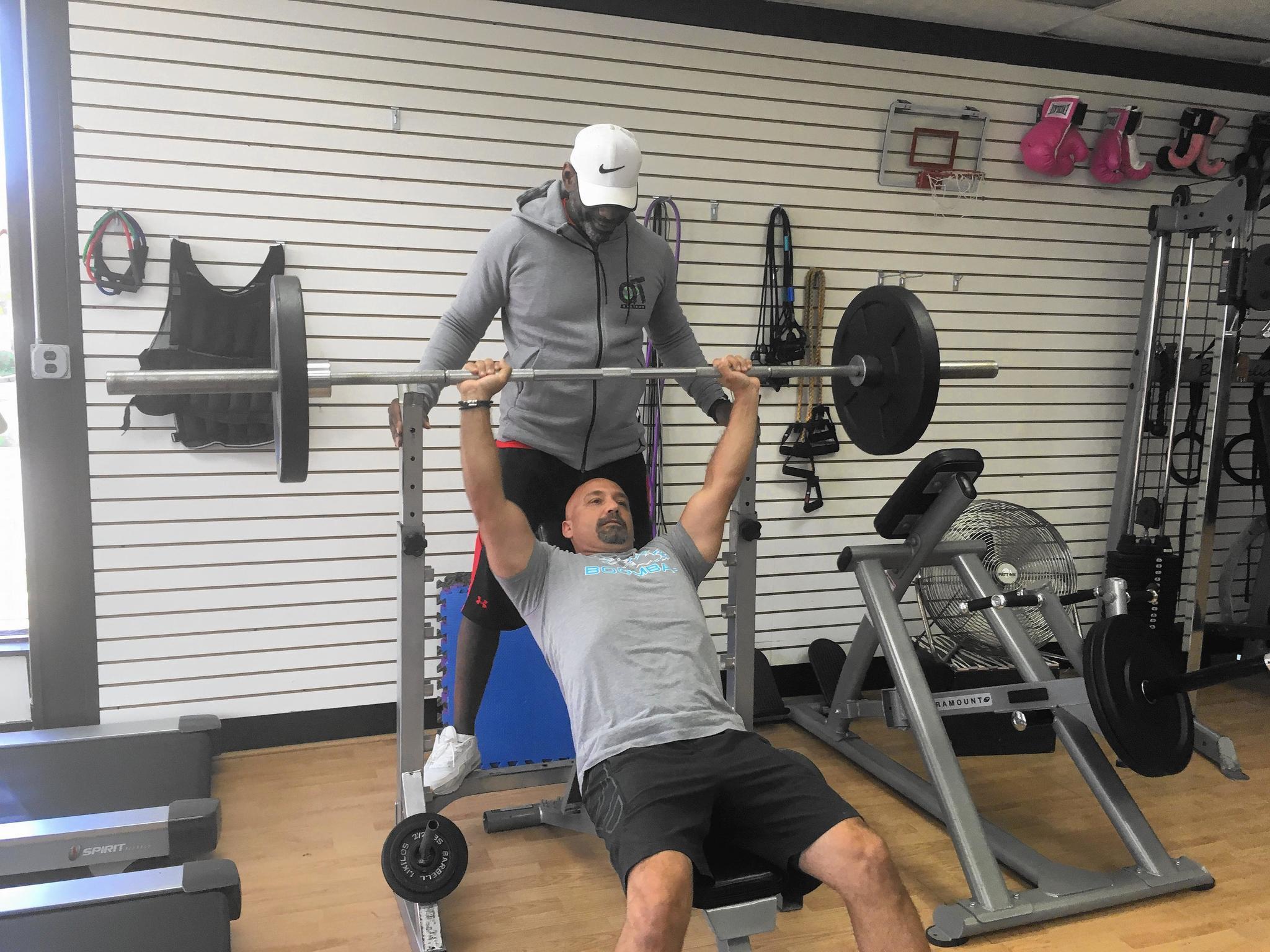
A year later, in 2012, “with no start-up money, no business or marketing experience,” he opened QT3 Systems down the street, at 2 West Downer Place.
“It was chaotic,” he recalled, “but I remained calm and collect and no one ever knew.”
As his clientele grew, Thompson gradually purchased fitness equipment at factory outlets. And after having a soft opening at the gym, he expanded the square footage — a massage therapist, nutritionist and trainer now work with him — and held a grand opening last October.
It was the Aurora Chamber of Commerce that nominated him the for the Entrepreneurial Excellence Award; and Thompson said he “was shocked” when notified he won in the category for new business.
Thompson recalls being the only African-American in the room at that 18th annual awards dinner sponsored by the Daily Herald Business Ledger. “Sometimes we take a chance because we want to,” he remembers telling the audience. “And then there are other times we take a chance because we have to.”
Thompson only wishes his mother could have been there to see him accept the award. Kathryn, who was diagnosed with breast cancer a year after getting sober, died in 2011 — a devastating blow to her son who says “I never stopped loving or believing in her.”
“And I know how proud she would be of him,” said Bower. “We are all proud of him.”
Aurora Mayor Richard Irvin, who grew up with Thompson and under similar circumstances, insists important lessons can be learned from this story. When these at-risk kids, who he not only knew from his childhood but later from representing them as their attorney, get into trouble, “they aren’t even surprised,” he said. “It’s like they are expecting” to get arrested and spend time in prison.
But if these young minority males, especially those like Quint with so much intelligence, are given an opportunity, Irvin added, “they can do great things, as long as we recognize their potential before it’s too late.”
Thompson’s story also shows that even serious errors in judgment — “I made them too, but didn’t get caught,” the mayor noted — can be overcome.
“Quint knows he has the gift to change people’s lives because he sees how he changed his own,” said China Hearon, who started out as Thompson’s client two years ago, then became his friend and is now his fiancé.
Hearon, who works for the West Aurora School District, says she did her research and knew about the trainer’s past before hiring him but saw how respectful and professional he was. And she quickly realized “he’s not let the past define him but rather has learned from it, has grown and moved on.”
His cousin, who remains one of Thompson’s staunchest cheerleaders, agrees.
“There’s something about him,” she said. “For Quint, the sky is not the limit. He wants to go far beyond that.”