
The Batavia City Council Monday night voted to postpone a vote on a developer’s plans to put apartments in the historic Campana building on the border of Geneva and Batavia.
Evergreen Real Estate Group has submitted a zoning application with Batavia to renovate the former Campana factory for a mixed use, mixed-income development with 80 market-rate and income-restricted apartments.
Aldermen Monday night voted 10-4 to table the vote amid questions the city and developer have over a written protest filed Friday with the city that might require a two-thirds majority vote of the City Council on the project.
Voting to postpone the vote were aldermen Lucy Thelin Atac, Susan Stark, Dan Chanzit, Alan Wolff, Scott Salvati, Tony Malay, Nick Cerone, Drew McFadden, David Brown and Michael Russotto. Voting the other way were aldermen Michael O’Brien, Martin Callahan, Elliot Meitzler and Mark Uher.
Robert Byrnes of Batavia Avenue Properties owns an office campus that is contiguous to the northern and northwest property line of the Campana property, according to the document.
“The protestor is the owner of more than 20 percent of frontage property as defined by the city’s ordinance and the Illinois Municipal Code, said ownership being sufficient to require a two-thirds vote of the City Council to approve the proposed amendments,” the document reads.
Aldermen at an Oct. 9 Committee of the Whole meeting voted 9-5 to recommend approval of the Campana plan.
A two-thirds majority would require 10 affirmative votes of the City Council.
Evergreen development director David Block said his group needed time to evaluate the validity of the document.
“…Given the mathematical reality, we would like to request that the zoning ordinance and plat of subdivision be tabled for two weeks to allow us, the city staff and council the opportunity to evaluate the validity of the protest that was filed with the city,” Block said.
The developer said they “identified numerous problems” with the protest document.
“We are ready to move forward with the proposal as it stands right now. However, tying up the project in court doesn’t benefit anybody,” Block said.
Block left open the possibility of a redesign of the proposal for the Campana Building. Block said over the next two weeks they intend to work with their design construction teams to see if there might be some ways to address some of the concerns of residents and aldermen who continue to vote against the proposal.
“We have some ideas. But since this protest just surfaced late on Friday afternoon, we need some time to flesh them out,” Block said.
Block said they would return in two weeks with their assessment of the protest document. He said if legal counsel determines it is not a legal protest, they would most likely ask to proceed with a vote on Nov. 20.
“If the attorneys believe that it might potentially have merit, we would like to discuss with you how best to bring these potential changes to the project through the appropriate processes at the city before returning to the City Council for a final vote,” he said.
“Our intention is to be responsive to some of the concerns we heard about the project. We also believe in the project as it stands today,” he said.
Chanzit, who said he was prepared to vote in favor of the proposal, said if the developer does go back to the drawing board it will have to be a “substantial redesign” to change people’s minds.
“I have 200 residents of the Holmstad (retirement community) who continue to call it inhumane (living standards),” he said.
The Campana project has been the subject of 14 public meetings that began in May. The plan commission held three meetings involving extensive verbal and written testimony.
Opponents have raised a variety of concerns, from the suitability of a former factory being converted into residential units to the traffic it would generate at the Fabyan Parkway and Route 31 intersection.
Preservation advocates have praised the project, while others have endorsed the concept because it would fill a need for affordable housing in the area.
Callahan said the ruling on the merits of the protest should be determined by staff and city attorneys.
Batavia City Administrator Laura Newman said the city will be making an independent decision on the validity of the protest.
“There has been insufficient time to do the legal research necessary for our attorneys to determine the validity of the protest,” Newman said.
Aldermen decided in another 10-4 vote to reopen public comment about the project Monday night since the item was removed from the agenda.
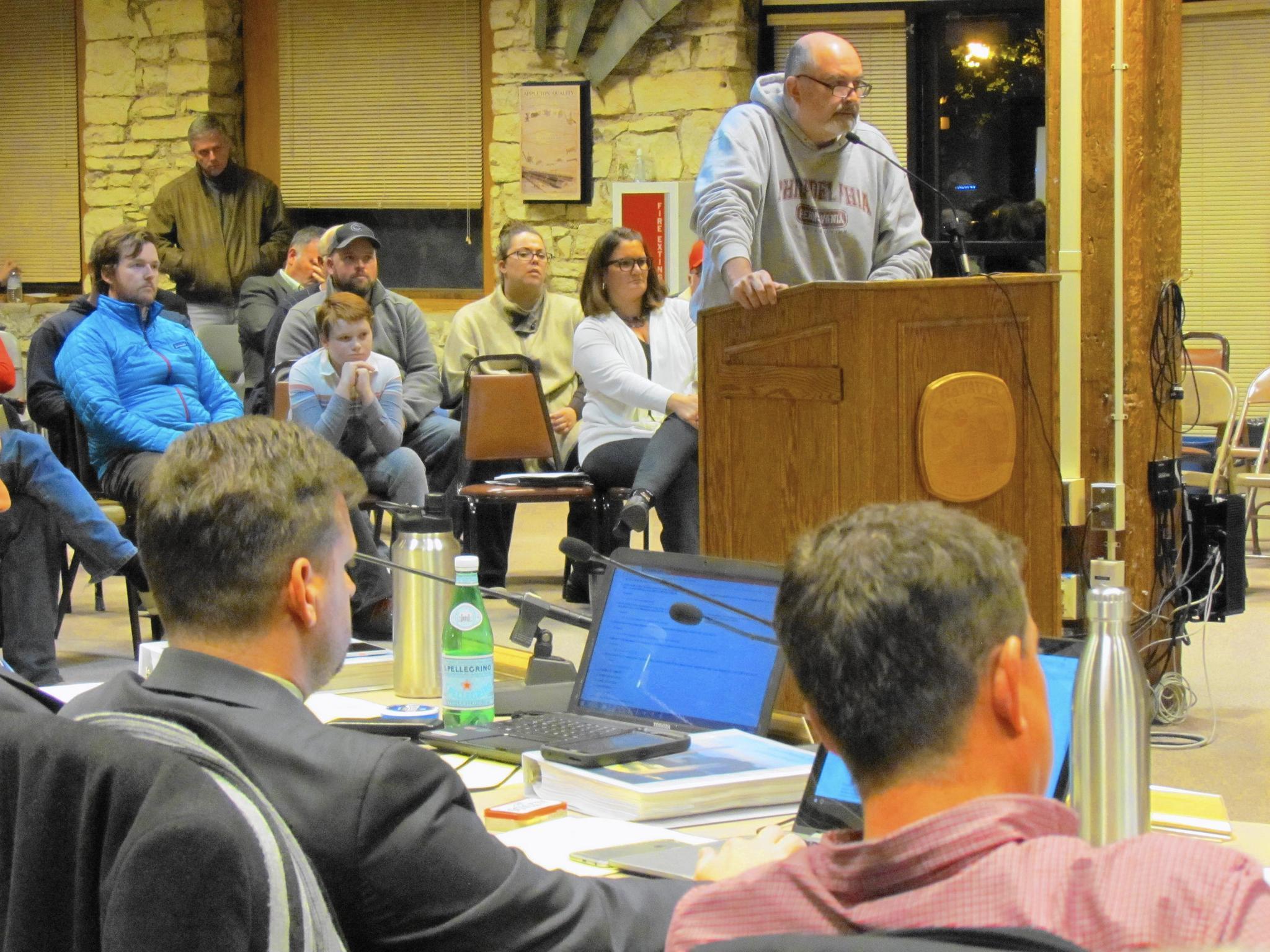
Batavia Mayor Jeff Schielke used his gavel to quiet applause of one objector and another time to discourage “booing and yelling” from audience members prior to the hearing of public comments.
Among the speakers was Byrnes. He said the protest was sent four different ways to the city, developer and their attorney to ensure it was properly filed.
“I discovered the state law recognizes that neighbors of property are actually somewhat important. Properties that are being rezoned should not be done in a vacuum. That’s a good principle to follow,” Byrnes said.
Byrnes was asked what his objections were and if he had an opinion on affordable housing. He said he is on record as saying he didn’t care what happened with the Campana property, whether it was redeveloped for residential or office use.
He said the primary concerns he has pertain to traffic issues approaching the intersection and the access points to the property.
“It doesn’t matter what goes in there. It’s getting in and out of there safely, if at all,” he said.
Newman informed aldermen Nov. 6 via email that Evergreen has proposed a redesign of the development that “responds” to some of the concerns residents have with putting in apartments in a former factory.
The developer did not publicly disclose details. However, the email sent to aldermen and referenced by Callahan Monday night proposes to replace 25 residential units on the first floor on the east side of the building with commercial uses and building an addition on the northwest side of the building with parking either below or on top of the units.
Batavia planning and zoning officer Joel Strassman over the telephone Monday afternoon said the city has not received drawings from the developer about the proposal.
He said exterior changes most likely would require another review by the Historic Preservation Commission. The 131,000-square foot building has been listed on the National Register of Historic Places since 1976 and received a local historic landmark designation in 2003.
The facility has business tenants in the original building and in the north addition.
Linda Girardi is a freelance reporter for The Beacon-News.
An earlier version of this story incorrectly named Batavia Ald. Scott Salvati.