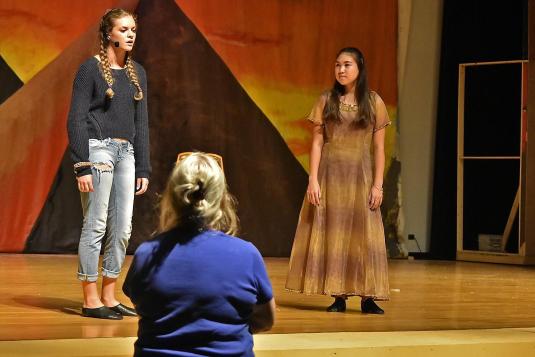

Through power ballads and powerful female leaders, the musical “Aida” honors love in all its diversity and complexity.
Trinity High School performs “Aida” on Nov. 17 and Nov. 18 at 7 p.m., and Nov. 19 at 2 p.m. Tickets are $10 for adults and $5 for children, students and seniors. All performances take place in Trinity’s auditorium at 7574 Division St. in River Forest.
Trinity is celebrating its centennial. Ella Eisman, a Trinity sophomore and assistant director for “Aida,” said the musical is ideal for this milestone year.
“We have two strong female leads, which reflects Trinity nicely,” Eisman said.
Senior Nora Blasi plays Amneris, one of those strong leads. While Amneris begins the play as “a brat,” Blasi said, she grows in “self-awareness.”
“I like how she changes at the end,” Blasi said.
Eisman also noticed Amneris’ change.
“Amneris, who starts out as self-centered, ends up being a very strong leader,” Eisman said.
Amneris is Egypt’s princess. Aida is a princess, too. However, Aida’s homeland, Nubia, has been invaded by Egypt. Held as a captive, few know Aida’s royalty.
Musical director Theoni Richardson said that there is growing rapport between these two princesses.
“The two female leads are from two very different cultures, and they take the time to understand one another by the end of the show,” Richardson said.
Elizabeth Gerth, a junior who plays Aida, describes a pivotal moment.
” ‘Easy as Life’ is a solo that Aida’s singing where she’s deciding between Radames and her people,” Gerth said. “It’s a stepping stone for her character, and she’s being selfless for the first time.”
Even before this scene, though, Aida “lifts other people up,” Gerth said.
“The Gods Love Nubia,” Aida’s song of hope to her fellow Nubian captives, is a standout song to Richardson.
“It’s definitely a feel-good number, and anyone who’s been struggling can relate to that,” Richardson said of the gospel-inspired song.
“Aida” includes many feel-good songs, according to Dance Choreographer Nikki Renfroe. One of those songs is “My Strongest Suit,” Renfroe said. As Amneris sings of her love for fashion, others dance in a fashion show-like number.
“It’s upbeat, it’s sassy, and the girls get to pretend to be a model for 30 seconds — and it’s a really fun thing to be a part of,” Renfroe said.
Even villains have upbeat songs, said Kevin Hartman, a sophomore from Oak Park and River Forest High School. Hartman plays Zoser — Egypt’s chief minister and the musical’s chief villain.
“He’s serious in the acting scenes, but his songs are very cheery songs,” Hartman said.
“I’ve always played villains, because my vocal part is bass. They always cast basses as villains,” Hartman said.
Zoser, who Hartman said is “evil to the end,” is still important: “He definitely drives the main conflict of the story — the reason why Radames is so stressed.”
Radames, an Egyptian general who is in love with both Amneris and Aida, and unknowingly captures Aida’s father, Amonasro, in a raid, has reason to be stressed. Zoser is Radames’ father, and Zoser is poisoning the Pharaoh to place Radames on the throne.
After a series of whimsical musical, Renfroe describes “Aida” as “much more grounded.”
“Because they’re in Africa and in Egypt, we have drums, and I did bring in some African influences,” Renfroe said.
The set, with painted pyramids set against a sunrise — or sunset — accentuates “Aida’s” themes, says junior Mica Barrett, “Aida’s” backstage manager.
Describing the set as “versatile” and “not limited to a certain feel,” Barrett said that the crew added subtle touches, like including sand in the paint that covers a pillar.
“It’s interesting to see what we can keep historical and what we can keep modern to resonate with audiences now,” Barrett said.
Eisman agreed.
“It’s nice to be part of something bigger that reflects real human emotions,” Eisman said.
Rachel K. Hindery is a freelance reporter for Pioneer Press.