
Back in early July, a drive out to the farthest reaches of Lake County took us way out west to Bonner Road, which dead-ends at Darrell Road, forming an intersection that sounds like a pop duo from the 1970s.
Those of us who use Bonner and Darrell as a gateway to the wonders of Island Lake, Crystal Lake and Huntley and beyond — maybe even Rockford, since there is no easy way to get there from central Lake County — took notice when both roadways were resurfaced in or around 2017. In a world of potholes and crumbling shoulders, some things don’t slip your attention.
But on this July 2019 evening, it was also observed that this smooth, relatively fresh asphalt was covered with … something. It had a sandy quality to it, but it also resembled that “fresh oil” application you’ll see just prior to a full resurfacing job.
After guessing that maybe the Exxon Valdez had wandered through the area and left behind a mess that could only be cleared out with either sand or a ton of cat litter, the answer was found on the Lake County Division of Transportation’s Facebook page:
“Have you recently seen a ‘sand-like’ substance on County roads? Our contractor is applying pavement rejuvenator to recently resurfaced county roads at 19 locations.”
So that explains it. Well, all except for the “pavement rejuvenator” part, which might also be used to describe an exotic and industrial-strength skin cream. Perhaps sensing this confusion, the post added an explanation:
“The rejuvenator acts as a glue which leads to less rocks chipping off and prevents water from sitting in cracks to reduce damage from freeze-thaw cycles. The ‘sand’ is an aggregate that is spread over the rejuvenator liquid to help prevent it from getting on vehicles. The aggregate is swept up the following day.”
Additional information on the goal of this procedure was found at the LCDOT website, which explained that when applied to roadways with recently completed surfaces, the “maltene-based pavement rejuvenator” is projected to extend the 15-year life of new asphalt pavement by about five years.
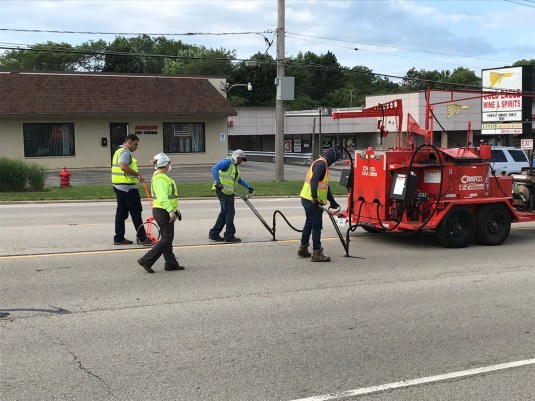
Also seen this week, in this case on Peterson Road west of Milwaukee Avenue in Libertyville, was another procedure used by LCDOT to extend roadway life — crack sealing, in which a road crew injects a tar-like sealant in the tiny fissures that develop in asphalt surfaces about 3 years old and up.
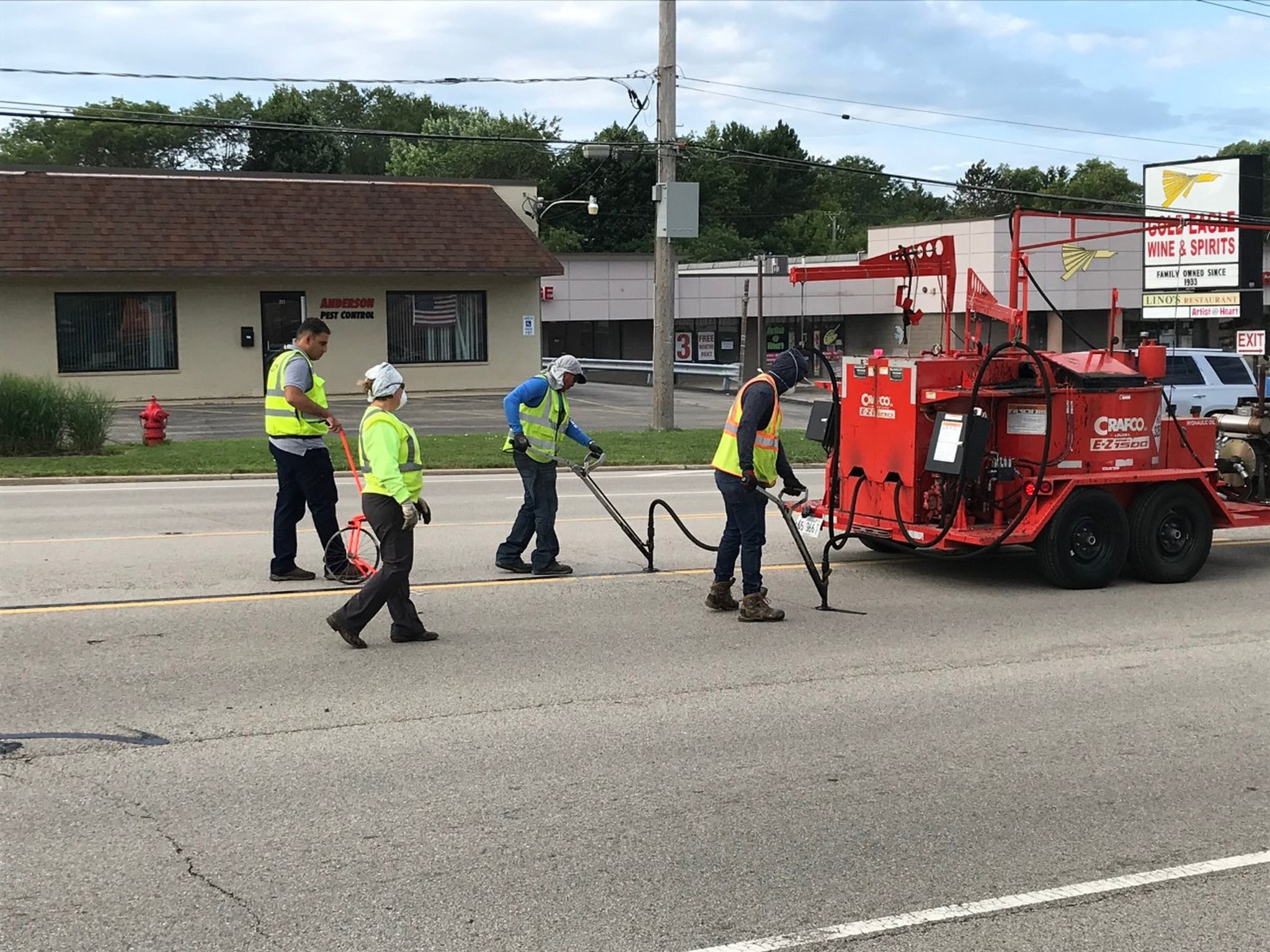
The county budgets $250,000 annually for sealing, and you’ll notice it in a daytime lane closure here and there. A truck-and-trailer crawls along preceded by a worker air-blasting debris off the surface while more workers follow injecting black goo into the crevices like pastry chefs.
According to LCDOT documents, pavement rejuvenation is more costly, with $750,000 budgeted for the practice in 2018, and $300,000 being lined up annually starting this year through 2023. The math in 2019 works out to — pause to make use of a calculator — about $15,800 per roadway application.
Along with Bonner west of Route 12 and Darrell from Bonner to Route 176, roadways undergoing the process this summer include, but are not limited to, Almond Road from Washington Street and Route 120 in Gurnee; Aptakisic Road from Buffalo Grove Road to Milwaukee Avenue in Lincolnshire; Cedar Lake Road from Nippersink Road and Route 120 in Round Lake; Delany Road from Sunset Avenue to Route 41 in Gurnee; Grass Lake Road from Deep Lake Road to Route 83 in Lake Villa; Greenleaf Avenue between Washington and Route 120 in Gurnee; and Lewis Avenue between 21st Street and Wadsworth Road in Zion.
The rejuvenation concept itself seems sturdy enough — spend about $15,000 now to add five years to the life of a road that would cost upward of $1 million per mile to grind down and resurface. But, this being the age of airing any and all grievances on social media, there was some online blowback to the process, along with blowback to the blowback:
“Oh so that’s the gunk on the hood of my car? Great!”
“These contractors just keep taking our tax dollars for fake road applications that are expensive and don’t perform as advertised.”
“Wait, wasn’t the gas tax increase to FIX our roads? This sounds like a smoke screen to avoid appropriate rehabilitation of roads. Something fishy and who is pocketing the money!”
“Today was the first rain after it was applied on Hunt Club Road. Can you explain to me how this in water runoff is safe for our water ways? Or how the aggregate affects our sewer systems?”
“Maybe all you complainer (sic) should just stay off the roads after all it is your choice.”
“People complain when our roads are in poor condition. Then complain when they are reconstructed to make them new again. Then complain when trying to preserve that new road to make it last longer. Geesh!”
“People are seriously complaining about this? We can’t really be this delusional.”
Taking a more tactful approach was this post addressed to the county: “We appreciate what you are doing to try and keep the roads in better shape but the stuff just makes a mess no matter how you slice it. It’s stuck all over my car with the gravel. And I only drove 10 mph over the stuff. It’s been a few days, still no street sweeper and the gravel is still out there. Plus, you have no traction at stop lights. Thanks for all that you do for our County roads.”
There was another comment that seemed to have been presaged with thought: “Maybe better signage (putting something up a few days before the application) and people can adjust their travels accordingly would help because this seems like something new in the past couple of years.”
For the record, LCDOT responded to some of the above posts, including that crews could be sent out with a sweeper if the public reports any aggregate remaining on roadways that needs to be cleaned up.
As for our vehicle, it appeared to be none the worse for the wear after the total two-mile drive on the rejuvenated Bonner-Darrell, which might be coming soon to a county fair music stage near you.
As for whether or not the roadway rejuvenation process in general will pay dividends in the long run, we’ll have to wait and see how all the targeted surfaces look in 15 to 20 years.