

For readers who have been following the Post-Tribune’s coverage of President Jose Padilla’s plan to sell the Brauer Museum’s three most valuable works of art to renovate dormitories, the name “Philipp Brockington” may ring a bell. Late last April, Brockington, a retired VU law professor, long time Porter County resident, and one of the Brauer Museum’s most ardent and generous supporters, invited Richard Brauer to join him as a plaintiff in a lawsuit Phil’s lawyer, Patrick McEuen, filed against Valparaiso University and Attorney General Todd Rokita, seeking an injunction to block the sale. Their case, that such an action would violate terms of the trust through which the works were obtained from art educator and collector Percy Sloan in 1953, was never addressed. Instead, as Amy Lavalley reported, Porter County Superior Court Judge Jeffrey Thode ruled that Brockington and Brauer lacked legal standing in the case. He affirmed, however, that the attorney general does have standing, and there the case remains still unresolved. Opponents of the sale still hold out hope those issues Brauer and Brockington have championed will prevail.
Whatever happens, Brockington’s own brave battle to defend the Brauer has ended. About the same time Judge Thode issued his ruling, Phil was in the hospital battling pneumonia. Phil’s last battle, which he won, at 83 years of age, was to go home. There, after suffering for years from debilitating effects brought on by Parkinson’s disease, he entered hospice care, and late Sunday afternoon, on Nov. 5, Phil died, at peace and among friends, with his beloved cat, Fleuret, at his bedside. On Saturday, Dec. 2, friends, neighbors, and former colleagues packed the McGill Gallery of the Brauer Museum Art to celebrate his life and express their gratitude for his gifts. In fact, many of those gifts, the tangible ones, about half of the 46 works of art he and his late partner, Howard Reeve Jr. (1948-2011) donated to the Brauer, have been put on exhibit in the Ferguson Gallery. Other paintings donated by Phil and Howard hanging in other galleries have been specially marked, including a portrait of founding director Richard Brauer that hangs just inside the entrance, commissioned by Phil, paid for by the by the Brockington Reeve Fund, and painted by VU alumnus Caleb Kortokrax. In Kortokrax’ portrait Richard is seated in the vault downstairs among his most beloved and treasured acquisitions. Kortokrax’s excellent rendering of “Red Rust Hills” by Georgia O’Keeffe sits to right of Richard, and Childe Hassam’s “The Silver Veil and the Golden Gate,” the second most valuable work in the collection after the O’Keeffe, appears behind him.
At the gathering Saturday, it was Richard Brauer who spoke first, with eloquence and passion, at length and in loving detail, not only about those works Phil and Howard donated to the Brauer, but also about the wonderful full color catalog Phil helped muscle into existence, as writer, publisher, and underwriter — he did, in fact, donate every copy to the university. Also, Brauer spoke about what kind of man Phil became because of his lifelong engagement with the arts. Then Jonathan Canning, current director of the Brauer, offered his reminiscences about meeting Phil upon his arrival in Valparaiso, and assured everyone that the Brockington Reeve Fund would continue to bear fruit for the museum, bolstered by a gift forthcoming from Brockington’s estate, support which will help the Brauer continue to build, preserve, and display the permanent collection Brockington clearly loved and helped to shape. To conclude the formal program, Kevin Pazour, executive director of the Porter County Museum, which Phil and Howard also generously supported, shared an anecdote about Phil. According to Pazour, on one particularly hectic day at POCO, Phil showed up unannounced with an easel, his watercolors, paper, and brushes, to paint Kevin’s portrait. Maybe Phil was motivated by his sense of fairness; if Brauer could a have portrait, why not Pazour? In the end Phil wouldn’t give the portrait to Kevin because he didn’t think it a good enough likeness. Kevin insisted without success that Phil sign it. In the end, it was a signature work of a sort, good enough to make for a good story about Phil Brockington’s generosity, his practice of the arts, and his unwavering commitment to excellence.

– Original Credit: John Ruff
I served as master of ceremonies for Phil’s gathering and ended the event by reading a poem Phil dictated from memory to an old friend, Susan Adams, and me. It’s a poem in four verses about his cat. This all took place two days before Phil died, during the a very busy Friday afternoon for a man in hospice. When I got there Phil lay in a hospital bed in his living room facing his garden out the window. He had invited Jonathan Canning and Kevin Pazour to his home so each could choose which art works in his possession would be appropriate for their collections. At one point he summoned them to his bedside to ask what each would do with funds from his estate Phil had yet to commit to their museums. It reminded me of a scene early in Shakespeare’s “Tragedy of King Lear,” though it played out much differently and not at all tragically, and Phil displayed none of Lear’s sense of entitlement and self-importance — there was no competition for Phil’s affection, only graciousness and candor, and generosity from all sides and in all directions. Donna Travelbee, Phil’s housekeeper and the executor of his estate, stood by. Attorney Morrie Sunkel, Phil’s former student, stood at the foot of Phil’s bed with a legal pad, jotting down changes to Phil’s will as Phil requested them. Dick Brauer sat in an armchair next to me talking with Kevin Pazour. At one point I had to shush them so I could hear Phil’s dictation. I recall Phil sending Susan into his study to retrieve a book by Robert Frost, to show us Frost’s signature on the title page. I also recall Phil making generous provisions in his will for his cat.
Phil’s determination to remember his poem about his cat, and make sure I got correctly what he dictated to me, his voice barely audible as he struggled for breath, was characteristic of him. The poem is also characteristic of Phil — it’s wry, witty, brusque but sweet, even tender. Here it is, without a title:
My cat is ever so pretty,
You can see that I like her a lot.
She goes by the common name Kitty,
But her real name is Fleuret le Chat.
You may ask where that name came from,
That French name she bears with such grace.
The answer contains no conundrum —
A fleur de lis covers her face.
She is named for my grandmother’s mother,
Who was Canadian French to the core,
But Fleuret is a name like no other,
“le Chat” means the cat, nothing more.
Now I’ve told you a bit of the story,
About how Fleuret got her name.
I hope you can see that I love her,
I love her a lot just the same.
Phil managed to remember and dictate the first two stanzas to me on that Friday afternoon as he took breaks from dispossessing himself of his worldly goods. The other two stanzas Susan took down the next day. There were two lines of a fifth stanza Susan thought we could drop from the poem, as it seems to come to a fitting though abrupt end with stanza four.
At the time I wasn’t sure why I had been summoned there, why Susan came and got me as I didn’t have a car. The first thing I did when I got there was to remind him of our first meeting, back in 1989. He nodded that he remembered; I was a new faculty member giving a brown bag lecture to the Faculty Club in Huegli Hall on something I was writing about James Joyce, who I think is funnier than he is difficult, which is saying something. I think Phil agreed, and he laughed when I described myself in my paper as Groucho Marxist. That’s how our friendship began, how our shared interest in modern literature and a joke brought us together.
Phil and his partner Howard Reeve had a farm out in the country, Coburg Planting Fields, where they grew hostas and day lilies; Phil, in fact, hybridized day lilies, and almost everyone at his memorial service raised their hands when I asked who had Phil and Howard’s day lilies in their gardens. Phil and Howard had a barn on their property they converted into a beautiful library; it struck me as something you would find in the South of France or in Tuscany, not in rural Washington Township, Porter County, Indiana.
My wife Gloria served as registrar and associate at the Brauer for 25 years; she became friends with Phil and Howard who were always around, first as docents, then as donors, which probably explains why we got invited with former director Gregg Hertzlieb and his wife to dinner in their library. Howard broiled the steaks while Phil gave us a tour of their home and showed us highlights of their art collection and their gardens. Dinner in the library was amazing. Years later, when he and Howard decided to move to town, we were invited back. I recall Phil taking us out to the library, as they were downsizing, and Phil urged me to take books he was ready to part with. Obviously, he was not ready to part with his signed copy of “The Clearing” by Robert Frost.
Philipp Brockington was a man with many skills and many achievements. He died beloved by his many friends, neighbors, former colleagues, and bridge partners. I decided to write this remembrance while helping Jonathan Canning hang the Ferguson Gallery with a selection of best art works Phil and Howard acquired and donated to the Brauer. The exhibit gives testimony not only to Phil’s great generosity but also to his intelligent, broad, and eclectic taste. One wall is all 19th century portraits Phil and Howard donated to give context to Junius Sloan’s portraits. Near one end of that wall is a portrait by Jane Stuart, daughter of Gilbert Stuart, best known for his portraits of George Washington. Stuart became the earliest female American artist in the collection with that gift. To the right of it hangs a transfer lithograph in black and white by American expatriate Impressionist painter Mary Cassatt, “Sara Wearing Her Bonnet and Coat.” If worse comes to worse and the Brauer’s Georgia O’Keefe never returns, Mary Cassatt would become the important American female painter represented in the collection. At the other end of the gallery look for a lovely Charles Demuth painting in watercolor and graphite entitled “Peaches and Fig.” Demuth was a contemporary of O’Keeffe and part of her of a circle of modernist artists before she relocated to New Mexico.

– Original Credit: John Ruff
If you have a taste for landscape, I recommend a selection of works by Hoosier Impressionists across the room. Phil and Howard love local and regional art, obvious in those landscapes, and in different ways in two large canvases at opposite ends of the gallery, one by Vaino “Vin” Hannel entitled “The Abrahams,” the other an enigmatic work by contemporary artist Joel Sheesley entitled “Open to Change.” Phil and Howard were certainly open to change. Perhaps we see that best in the lithographs and etchings, and a single photograph that rounds out the exhibit.
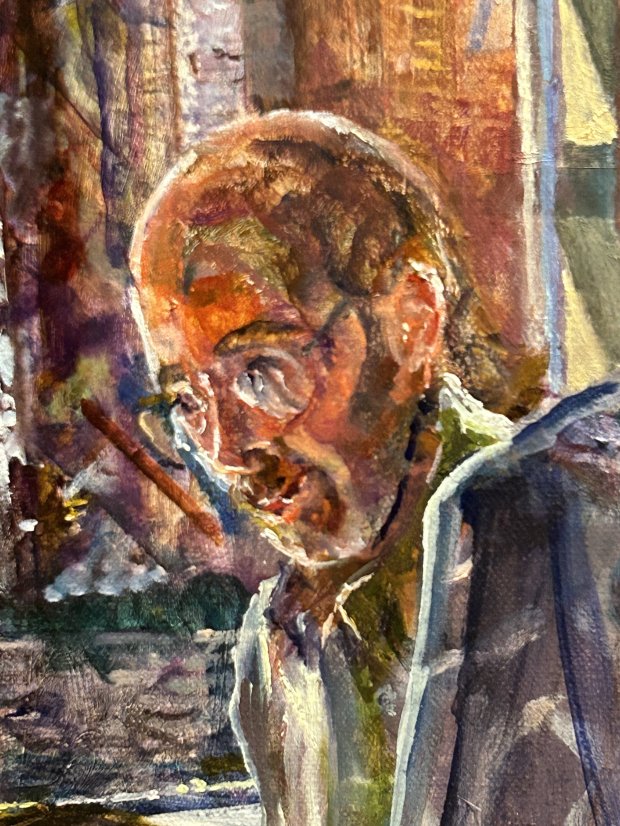
There is one large portrait in the Ferguson Galley not a gift of Phil and Howard you need to see, by former VU art professor and painter Audrey Ushenko entitled “All of Mankind II.” It is a large, exuberant swarm of people who appear in the Guild Lobby of the VUCA, the Chapel of the Resurrection visible through the windows to the left, the Louie Sullivan doorway through the entrance to Brauer on the right. Men and women, old and young, who’ve made the Brauer what it is and what it still promises to become, appearing, some standing, others, mostly children, in motion. Phil’s there off to left by President Alan Harre. Across the way two putti put a laurel wreath on a bust of O.P. Kretzmann. In two framed portraits within the portrait, born aloft by other putti, Josephine and Byron Ferguson appear. Generous patrons Phyllis and Richard Duesenberg stand below them by former members of the Collection Committee, Bob Springsteen from the Business Office, Jack Hiller from the Law School. Art faculty appear, celebrated and gently satirized (David Morgan depicted as Buddha). Former preparator Adam Heet appears, as does his brother Tom representing the gallery attendants. Former directors Richard Brauer and Gregg Hertzlieb share center stage holding an oil sketch of Junius Sloan’s largest painting of Kaaterskill Lakes. In the interest of full disclosure I need to identify Gloria Ruff, former registrar and associate curator, and my wife, as the Good Fairy whom Ushenko has painted presiding from above. Even Percy Sloan appears, depicted by his father, Junius, as a serious adolescent all dressed up. Phil is dressed more casually. Audrey has depicted him basking in the sunlight as a man of leisure, and smiling. Phil has joined an elite group. He will be missed and long remembered.
John Ruff is an English professor at Valparaiso University.