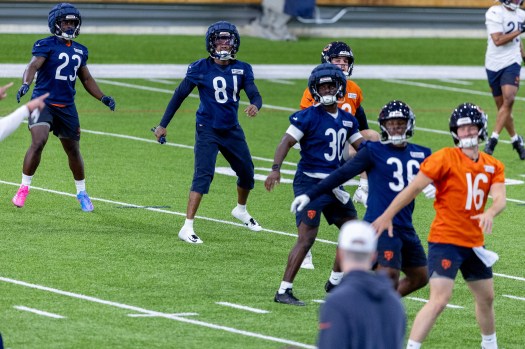
CANTON, Ohio — 10 thoughts after the Chicago Bears rallied from 10 points down to defeat the Houston Texans 21-17 at Tom Benson Hall of Fame Stadium on Thursday before a thunderstorm rolled through and led officials to call the game with 3:31 remaining in the third quarter.
There will be much grander things for the organization to celebrate this weekend, as former Bears return great Devin Hester and defensive lineman Steve McMichael will be inducted into the Pro Football Hall of Fame, as well as defensive end Julius Peppers, who spent a portion of his career with the Bears as well.
1. The Bears played it safe by holding out 35 of the 91 players on their roster: all starters, including quarterback Caleb Williams, and many key backups.
The vast majority who didn’t suit up are healthy, and the game plan for next Saturday’s game at Buffalo probably will be significantly different.
The Bears appeared to make it out of the game without significant injuries — and that’s the first box coach Matt Eberflus wanted to check. Now we’ll have to see if a backup quarterback competition heats up after Brett Rypien completed 11 of 15 passes for 166 yards and three touchdowns. He’s the first Bears quarterback to throw three touchdown passes in an exhibition game since Justin Fields in the 2022 preseason finale just up the road in Cleveland.
Rypien got four series after Tyson Bagent received only one to begin the game. They’re listed on the unofficial depth chart with an “OR,” meaning they’re more or less co-No. 2s behind Caleb Williams.
Not many people had “Rypien shreds Texans” on their bingo card, and it’s not like he has received a ton of reps in training camp. He threw touchdown passes of 20 and 9 yards to Collin Johnson and connected with tight end Tommy Sweeney for a 22-yard score down the seam.
Rypien said he’d thrown maybe one pass to Johnson in camp, but he saw the size advantage the 6-foot-6, 220-pounder had.
“He’s been in this offense, he knows the offense well, he’s heard the verbiage, he understands the concepts and you can see that,” Eberflus said of Rypien. “He definitely understands the space that needs to be occupied by the receivers and then how they get open, and you could see that today. He was throwing guys open.”
Rypien, 28, is the oldest quarterback in the room. He’s 2-2 in his career as a starter — the same record Bagent had as a rookie. The Bears signed Rypien because of his familiarity with the scheme, but they also liked what Bagent was able to show a year ago.

Does Rypien, who bounced from the Los Angeles Rams to the Seattle Seahawks to the New York Jets last season, see a competition brewing behind Williams for the No. 2 spot?
“I don’t,” he said. “I just focus on what I can control every single day. I love working with these guys. Tyson, Caleb and Austin (Reed) have been awesome. It’s weird being the oldest guy in the room.”
Could something materialize between Bagent and Rypien in the weeks to come? There was more of a premium placed on getting through this game healthy than making weighty personnel decisions based on performance. (The Texans rested their frontline guys too.)
It was a good step for Rypien, who last started for the Rams in Week 9 last season in a 20-3 loss at Green Bay. He passed for 130 yards and was intercepted once.
“This one meant a lot to me,” he said. “I had a bad taste in my mouth all offseason after my last start in Green Bay. I didn’t know how this season would go, didn’t know if I’d get a chance to compete for anything.”
He probably has earned a shot to battle some.
2. General manager Ryan Poles and coach Matt Eberflus exuded confidence at the start of training camp when they said this roster will be more difficult to make.

They weren’t bragging or saying the Bears have arrived or they’re set everywhere. Just a matter-of-fact assessment that the talent level has been raised, and after one preseason game and two weeks of practice, that’s evident.
Some players have flashed in practice or in this game — maybe in both. But when you look at the depth at individual positions and start wondering about the 53-man roster and how each side of the ball will look, well, I kept running into the same question for a good handful of players.
What’s the path for him to make the roster?
Beyond injury, how can these players make the team? In many cases, they will not. Some might have spots on the practice squad. Here are five players who have gotten their names out there.
1. WR Collin Johnson
People will talk about his ability to use his big frame as a boundary X wide receiver, but maybe the most important thing he did was make a tackle on the kickoff team. Any chance Johnson has of making the roster will be predicated on his ability to help in a variety of ways.
He played 169 snaps on special teams in 2020 for the Jacksonville Jaguars and 108 the next season for the New York Giants. He has to prove to special teams coordinator Richard Hightower that he can be valuable in two, maybe three, phases.
2. LB Carl Jones
The undrafted rookie from UCLA is making a transition. He was primarily a rush end in college, and while the Bears list him as a defensive lineman, the 6-foot-2, 230-pounder is playing linebacker. He moves pretty well and is physical, so he ought to be interesting for a look on special teams. Jones had a game-high seven tackles with one for a loss and an assisted tackle on special teams.
Photos: Chicago Bears 21, Houston Texans 17 in the Pro Football Hall of Fame Game
3. CB Reddy Steward
The undrafted rookie from Troy spent most of the last week running with the first team at nickel back with starter Kyler Gordon sidelined by a calf injury. Steward has done well — he had a pick-six against Caleb Williams in 7-on-7 drills in practice — and the coaches have a pretty good idea about what they have in Greg Stroman and Josh Blackwell, the other options at nickel.
The more chances Steward gets, the more he proves he has terrific football instincts. I’m hearing the team needs to see how he’s tested when he goes against speed. Steward is a little on the small side, listed at 5-11 and 178 pounds, but he was durable during a five-year college career. Those measurables are probably what prevented him from being drafted. There’s something to like here, but can he be a factor on special teams?
4. CB Leon Jones
Another undrafted rookie, Jones had two pass breakups Thursday and has had his moments in camp too. The Arkansas State product is a totally different player than Steward; Jones has great size at 6-1, 195. It’s a really crowded and young group of cornerbacks, but no one is getting rid of good ones who can play.
5. G Bill Murray
It’s not often Eberflus drops a name out of the blue, but that’s precisely what happened earlier this week with Murray. He played right guard Thursday after he had been on the left side some in camp and is trying to get work at center when and where he can.
“Nope,” Murray said when I asked if he heard that Eberflus brought up his name. “I try not to look or read or see anything like that.”
With the frontline players sure to get some action in the next two preseason games, opportunities will be confined to practice reps for some younger players. There will be some jobs up for grabs and some pretty good discussions, but it really is a more difficult roster to make.
“To me, if you’re at the back end of the roster at linebacker, at receiver or whatever those hot spots are — halfback — the more you can do,” Eberflus said. “You’ve got to be able to do a lot. If you’re a four-core guy and you’re playing on all the special teams and you’re lighting it up, that’s probably a good thing. To me, it’s all competition. That’s why we do camp.”
3. When Tyson Bagent says he wasn’t dialed in to the Bears’ offseason moves — and the possibility they would add an experienced quarterback — he’s not kidding.

When free agency began in March, Bagent was training at Golden West College in Huntington Beach, Calif., with 3DQB, the program developed by former major-league pitcher Tom House and Adam Dedeaux, a former pitcher at USC and the grandson of longtime Trojans coach Rod Dedeaux.
Tom Brady and Drew Brees are among those who have worked with the program, and Bagent ran into a who’s who of NFL quarterbacks during his week there: Jared Goff, C.J. Stroud, Jalen Hurts and Bryce Young, among others.
“I was just really trying to home in on very minuscule details, incorporating your lower half with your upper half, body positioning, just all to be more consistent than before,” said Bagent, who was there with his younger brother Ezra, a quarterback at Shepherd University. “I thought it was very helpful to be able to think about things differently and understand when I miss, so I can quickly detail to myself why I missed so I can fix it myself. That’s when you can really progress.”
In his preseason debut, Bagent got just one series before Brett Rypien took over. The offense had a decent opening drive going before a false start on tight end Tommy Sweeney led to a punt instead of going for it on fourth-and-1 at the Texans 37-yard line.
Bagent was 2 of 3 for 16 yards, with the incompletion a throwaway when he was pressured on a bootleg.
“I feel super confident how camp has started,” Bagent said after the game. “I am excited to get some more playing time. It’s nice to get out there and get even one drive with the guys. Everything has been super smooth to this point.”

The hope is the offseason work Bagent put in helps solidify his standing as the No. 2 quarterback a year after getting four starts in place of Justin Fields.
“Seeing all of the other quarterbacks (at the 3DQB camp), it causes you to rise to the occasion,” Bagent said. “You’re definitely not out there in the backyard just working on your game.”
Still learning coordinator Shane Waldron’s offense, Bagent said the process is much smoother after going through a crash course on the NFL under Luke Getsy a year ago.
“It’s been way smoother this year being able to learn an NFL offense for the second time,” he said, “than it would ever be when you’re thrust in there your first year and you’re trying to play catch-up while having it all down.”
4. The changes to kickoffs this season is the NFL’s most significant rule change in a long time, maybe since the addition of the 2-point conversion in 1994.

And a case can be made the reimagined kickoff is a greater fundamental change because many games don’t involve a 2-point try.
The Bears and Texans put the new rule to the test for the first time, and you can be guaranteed special teams coaches around the league were tuned in because nobody knows exactly what it will like. No one is certain if their technique will be sound. It’s an entirely new world, all in the name of safety as the league tries to eliminate what it believes was a rash of injuries created by full-speed collisions on kickoffs when coverage teams had a long run up to contact.
What did we see?
There were eight kickoffs. Bears rookie wide receiver John Jackson had a game-high return of 31 yards. But there were no fireworks: Three started at the 26-yard line — 1 yard past the old touchback spot.
“Kickoff team wins today,” Matt Eberflus said. “It was good by the cover teams. I thought that the return teams struggled a little bit staying on blocks.”
Eberflus was asked if the Bears are holding back some stuff they want to try in the regular season while also experiencing the new setup.
“I think it’s both,” he said. “You’re going to try to do that a little, but, man, we’re trying to figure this thing out. You have to figure it out. Hey, what is it going to look like? We’re really just trying to figure it out and do the best thing we can, and that’s going to be ongoing through the whole season.”
Under the new rules, the ball still is kicked off from the 35-yard line, but the 10 other players on the kicking team now line up at the receiving team’s 40 — 25 yards downfield from where they used to be.
Nine or 10 players on the receiving team must be in the “setup zone,” between their 30 and 35. You’ll likely see nine players in that zone, as special teams coordinators I spoke with believe teams almost always will employ two returners rather than the previously customary one returner.
Returners will be in the landing zone, between the goal line and the 20, and the only people who can move before the ball is touched or hits the ground are the kicker and returners.
On a touchback in the end zone or a kick that goes out of the end zone for a touchback, the ball will be spotted at the 30. On a kick that lands or is fielded before reaching the 20, the ball is spotted at the 40 — the same as a kick that goes out of bounds.
Here’s where it gets interesting. A kick that hits the ground in the landing zone — before the goal line — and then bounces into the end zone and is downed results in a touchback, with the ball spotted at the 20.
It raises a ton of nuanced strategy questions for special teams coordinators. I spoke with three coaches to get a feel for what they believe kickoffs will look like and how they will evolve. It’s a work in progress for every team.
What does the ideal returner look like? Is he a thicker, stronger guy like a running back now?
“The Bears have two really good options as I see it,” one coach said. “Velus Jones has been good. Lot of speed and he’s a stronger guy. Then they have (Khalil) Herbert. He’s a good inside zone runner. They could say, ‘We’re going to press this and we’re coming downhill,’ and I could see the ball cutting back because there are going to be natural creases. An inside zone runner with good vision, a guy who runs well behind pads, I think that’s a guy who fits real well.”

What does the ideal kickoff look like, now that hang time is no longer a concern because no one can move until the ball is touched or hits the ground? What will blocking schemes look like?
“The kickers are going to be able to move the ball,” a coach said. “You used to be able to read an approach on the kicker and you knew where the ball was going, and the wind and other things would be clues to help you see where the return was headed.
“Now the kicker doesn’t want to hit the touchback, so I think you will see more kickers approach from 5 yards as opposed to 10 to 12 yards where they have the long run up. Now these kickers can kick it a little more line-driveish to make the returner chase the ball and catch the ball on the run. That’s why you’re going to see the two returners.”
Will the rule change lead to personnel shifts on coverage and return teams that affect roster construction?
“I don’t think so,” one coach said. “How many kickoffs a game are there? You’re not talking about a lot of plays. Teams running a base 4-3 defense still have an advantage because they probably have more players that can run and tackle. I don’t think that changes.”
What does the rule change do to traditional return strategy in which you set up to the right or left or sometimes straight ahead?
“You’re not going to see a lot of double teams because they’re on you right now,” the coach said. “And you don’t know where the kick is going. Even though I might try to run a double team, now I am giving something up on the back side. If the kicker kicks it in a spot where I didn’t anticipate, then that unblocked player is now in play.
“So I think you have to be a little strategic. Within your returns, you have to be able to account for different things. So, ‘I love this return if they kick the ball to my right, but what happens if they kick it to my left?’ It still has to be a good return for me and I can’t get my (returner) killed.”
The coach added that if a team has an ace returner — let’s use the Pittsburgh Steelers’ Cordarrelle Patterson as an example — the kicking team might want to consistently kick away from Patterson. In that case, the Steelers might be able to design double-team blocks for the second returner, knowing percentages are good he will be fielding the ball.
What’s the one thing coaches are really curious about? What do they want to learn most from watching others?
The consensus here was pretty clear: No one knows what the most consistent and effective blocking techniques will be because the return team has 10 defenders lined up as close as 5 yards to its front line. One coach said he taught one technique for a few weeks and realized it wasn’t best. He junked it and took a different approach.
“I used to teach the front line when the ball was kicked, get your eyes on the returner because he is going to the ball,” one coach said. “Then you know where the ball is going to be. Now? You can’t peek because as soon as you do, that guy right on top of you, then he’s past you.
“Are teams handling blocking like this a punt-return play or kick-return play or are they going to try to blend them together with the technique of blocking up front? It’s hard.”
What’s the unintended consequence?
Obviously the NFL wanted to do away with a play that had no action. Only 21% of kickoffs were returned last season. Any shift like this will create outcomes that maybe weren’t expected or wanted.
“I still think what’s going to happen is some of these head coaches, some team is going to bust a couple long returns and they might go, ‘Just kick it through the end zone,'” one coach said. “I could see that happening late in the game. ‘I don’t want to flirt with what could possibly take place on this play.’
“That is why what was originally proposed was a touchback spot at the 35-yard line. That would take out the ‘Just kick a touchback.’ You’re going to have some of that. How much?”
OK. But this play will be safer, right? That was the goal in the first place.
“The guy that now is in the most danger is the returner because now he’s getting hit,” a coach said. “He’s the guy that will sustain more injuries. You should now limit hamstring injuries, collisions. There are still going to be guys getting overpowered, but the running downfield and just looking like ‘Braveheart,’ that should be gone, which will be good. It looks weird, doesn’t it?”
5. The story of how Devin Hester came to the Bears goes back to 2004, two years before he was drafted.

Mark Sadowski, a 1992 St. Rita graduate, was working for the New Orleans Saints and was scouting Miami’s game at North Carolina State during the 2004 season.
“Gosh, I can remember it like it was yesterday,” Sadowski, now the Pittsburgh Steelers director of college scouting, said earlier this week. “I’m in the press box and he returns (the opening) kickoff for a touchdown. I can envision it right now. He caught the ball 5 yards deep in the end zone — right in the middle of the ‘O’ of ‘Wolfpack’ — and he took it. It was the fastest thing I had ever seen.
“I was like, ‘Holy smokes! This is that dude. It’s No. 4. This is that guy!’ From that point on, I started full-throttle doing background stuff on him. Totally following him.”
Sadowski remained with the Saints for another seven months until the Bears hired him as an area scout after the 2005 draft. Hester — who will be enshrined in the Pro Football Hall of Fame on Saturday — was firmly on his radar every time he ventured to Miami, which was a loaded program at the time.
“He was one of those players that can get lost in the shuffle because he didn’t have a true position,” Sadowski said. “I was extremely fortunate to see him play in several places live during his career at several different positions.
“I know there is a video going around social media about draft day, but our other meetings in December (2005) and February (2006) and with the coaches, all of that stuff wasn’t videotaped. I saw him play as a featured running back against LSU in the Peach Bowl. I saw him play slot receiver at Clemson. I saw him take snaps at nickel, corner and safety and obviously all the stuff in the return game.”
Everything Sadowski saw motivated him to learn more, and shortly after Bears general manager Jerry Angelo hired the Bridgeport native in May 2005, Hester popped up on the radar again.
“We did things a little differently when I worked for Jerry,” Sadowski said. “We did a bunch of summer work. We did cut-ups on as many guys as we could on all the teams in our area. So we kind of knew about all of the underclassmen in our area in the summer.
“That first summer, we were cranking it out. I had plays from Devin back then and he played so many different spots.”
Sadowski would go to Miami more, always armed with questions. Hester was fascinating because in a top-10 program with talent and depth across the roster, he was good enough to get on the field at a variety of positions even if he didn’t stick at one.
“I was more intrigued with finding out who the person was,” Sadowski said, “because going into a school like Miami at that time, the real ‘U,’ you’re looking at 20-something guys and they’re all legit dudes. I remember getting into heated discussions in our meetings with our coaches. There were rumors about mental aspects and learning, and stuff like that drives me bananas.
“I am a firm believer every athlete can learn. He just learned a different way. I became really good friends with his learning specialist and his tutors and the coaches that did work with him. That’s why a guy like (former Bears wide receivers coach) Darryl Drake had such an effect on him because Darryl listened in the meetings and Darryl, may he rest in peace, wanted Devin to succeed and was willing to do extra work with him.
“I may have seen him play earlier in his career, but I was really locked on him after that Wolfpack game. From that point on, I spent a lot of my time on campus doing all of their other guys but digging extra, trying to find out what made Devin tick. And the more I uncovered, the more I found he was just such a great human being and a great dude. Very humble.”
As the 2005 college season played out and draft preparations ramped up before the holidays, Sadowski knew he needed a strategy to present a player who was, by all accounts, electric but didn’t have a defined position. He knew there would be difficult conversations and pushback. It would be a tricky sell.

“Everyone and their mother is going to say they loved him now,” Sadowski joked. “He was great and they wanted to take him.”
Right.
“In preparation for the presentation, I wanted to stress how he was a multitalented athlete that played on a top-10 team without being a full-time starter,” he said. “He had a bunch of starts at various spots. But I wanted to prove that he was capable on a top-10 team to start at nickel, corner, safety, running back, as a slot receiver. So my point was to sell that he had value on an offense or a defense. We drafted him as a corner just out of need. We wanted to fill that position. I kind of swayed it more toward that.
“That was the approach originally to bury all the negativity floating around with him — he doesn’t have a spot — and that he is not just an undersized, smaller guy. A lot of those really good returners were not as big as Devin, not as strong. When Devin had the ball in his hands, the game slows down for him. That’s his gift. That was the approach: put down all the negativity that he didn’t have a position.
“The second part was to sell that he was a dynamic player with the ball in his hands that can score touchdowns. Ultimately, I think that is what got him over the hump. I hadn’t seen anything like him in the Southeast, and having a bunch of first-round picks with the Saints, I had seen a lot of really, really good athletes, especially at The U and Florida State and even Florida, but this guy was different. There was just something about him that can’t be overlooked.”
Sadowski credited Angelo, college scouting director Greg Gabriel and coach Lovie Smith for listening throughout the process as Sadowski made pitches for Hester. He said that was one thing that made Angelo successful — he processed information from all of his employees while considering the big picture.
“And Lovie listened to passion and he listened to conviction and he knew there was a lot of conviction,” Sadowski said.

The Bears were hunting cornerbacks and doing work on many of the prospects who came off the board in the first few rounds. They set up a private predraft workout with Miami’s Kelly Jennings, who wound up going to the Seattle Seahawks at the end of Round 1.
“All I asked Jerry and Lovie to do was could Devin come with Kelly when we had our brass down there,” Sadowski said. “Just let coaches and brass get a feel for him. I don’t want to say that was the turning point because I knew there was some intrigue there, but I knew also once our top guys got on campus and had a chance to meet this young man and see how special he was and how humble he was and how hard he worked and how important it was to him, a lot of the research I presented, they were able to confirm it.”
So Sadowski entered the 2006 draft with confidence the Bears could land Hester. The team has released video cut-ups of draft-room discussions just before the pick was finalized. All part of Angelo’s methodical approach.
A final sell job from Sadowski?
“This guy can score,” he said. “This guy can score touchdowns.
“I believed in him. I knew what he was as a person and how dynamic he was. Just getting those top guys on board to see that, that was it. It was a done deal. Devin, he was born to be a Bear. In a nutshell, that’s how it all went down.”
Sadowski will travel from Steelers camp in Latrobe, Pa., to Canton on Friday to witness all of the ceremonies for the first player he presented as an area scout to reach the sport’s highest honor.
6. It looked like rookie defensive end Austin Booker had a handful of successful rushes that put a Texans offensive tackle on skates.

Press-box statistics gave the fifth-round pick from Kansas only one tackle. I came into the game curious to see what Booker, who has really opened some eyes at camp, could do.
A week ago, on the morning of the first practice in full pads, he announced his arrival to anyone on the team who wasn’t aware. During the two-minute drill, he won on four consecutive snaps with four different rushes. It was a wow moment for those watching.
“He’s just tough to hit as a pass rusher,” defensive coordinator Eric Washington said. “He has a great feel for how to contort his body, how to flip or rotate his hips and shoulders so that he can keep advancing toward the quarterback and put himself in great position to follow through.”
One thing that has struck me about Booker isn’t his length — it’s his ability to use that length. We assume every tall, rangy defensive lineman with long arms will have an edge because of those physical tools. I’ve fallen into this trap. Look at the length on that guy. He has a chance to be a freak. Then you watch him play and he’s as ordinary as can be. Booker has a feel for using his length to keep offensive linemen out of his chest and to set up moves.
He was self-analyzing after the game at his locker, lamenting not finishing on a few plays in which he easily drove the tackle back.
“I just have to convert off that power faster,” he said. “Whether that’s throwing them by or pulling them through, outside or inside. I’ve been grabbing tools and taking stuff out of people’s toolboxes the whole time during camp. I’m continually adding.”
We’re a ways off from knowing what Booker can do in the regular season against starting-caliber tackles, but there’s some intrigue at Halas Hall about him that’s worth watching.
This doesn’t always pan out. Remember, Dominique Robinson had 1½ sacks and seven tackles in his debut as a rookie in 2022 against a really good San Francisco 49ers team. And now he faces an uphill battle to make this team.
7. Fans weren’t the only ones hoping Caleb Williams would get a taste of preseason action Thursday.

Former Bears quarterback Jim Miller, who will be the analyst for Fox-32’s broadcast of the Aug. 10 game at Buffalo, was looking forward to it too.
“Minimum, I’d like to see two series (at Buffalo),” Miller said. “Like to see him move the ball, run a sharp operation, be crisp. I was kind of disappointed. I thought he would play this first preseason game. That is how it was done when there were four preseason games, and now they don’t do it at all with that last one and no one plays.
“So they let him sit this one, get two series at Buffalo, two series or maybe a full half the following week against the Bengals. I’d like to see him play in that last preseason game at Kansas City, but they probably won’t. Coaches want to get to Week 1 healthy.”
Miller spent two days at Halas Hall at the start of camp preparing for his Fox work and handling responsibilities for SiriusXM. He came away impressed, and it’s the most upbeat I’ve heard him about the team’s quarterback situation in some time.
“I am impressed with Caleb’s maturity,” Miller said. “I have talked to him a few times now. Things don’t seem to bother him. I know a lot of people have been thinking if things go bad or things don’t go the team’s way or his way, could there be a blow-up of some sort? I really don’t think so.
“Here’s why: If you look at the Notre Dame game last season, he responded. He bounced back. He played good games. I think he has the maturity, the demeanor to handle it. I came away impressed with him because the bad plays don’t seem to bother him. The two days I was there, there was some good. There was some bad. The bad plays didn’t bother him, and I liked that.”
A snowball effect with other Bears quarterbacks has led to QB purgatory, a place the franchise knows all too well.
“If you look at any other quarterback that has been drafted there, they feel vilified,” Miller said. “You have to have a certain demeanor to handle it. You have to understand it’s coming and you have to be able to deal with it. Caleb seems to have the demeanor to deal with it.”
The first test — well, it’s probably more like a quiz considering it’s an exhibition — comes at Buffalo.
8. Jay Hilgenberg got in a couple of rounds of golf this summer with coach Matt Eberflus and GM Ryan Poles, and that led them to invite the seven-time Pro Bowl center to training camp.

Hilgenberg wasn’t just another visitor wearing a white bucket hat and taking in the action from the sideline Tuesday at Halas Hall. He was on the field with coaches during drills and sat in the offensive line room for meetings afterward.
“Very impressed with (run game coordinator/offensive line) coach Chris Morgan, what he teaches and how he explains it going over the tape with everybody,” Hilgenberg said. “It’s just a great operation they have going. He teaches. He doesn’t get overly excited. He explains everything. He lets everybody know exactly what’s going on and the reasons behind it.
“He’s very good on technique too. We were watching one-on-one pass rushes and just the way he can break it down and describe some of the fundamentals and techniques to help the players succeed.”
Hilgenberg noted that on a few occasions in team drills, quarterbacks would ask Morgan for input on plays.
“He’s very calm and he doesn’t get the players nervous,” Hilgenberg said. “Just explains it the way it is. I think players appreciate that.”
Yes, Hilgenberg addressed the offensive linemen briefly in the meeting room, but more than anything he was there to learn. His credentials as a starter on the 1985 Super Bowl champions and a high-level player got the attention of the room.
“I’m not much of an off-the-field talker,” he said. “I got pretty vocal during games and when the heat was on. These guys, it’s so much more advanced now what they do in the league than what we did. I said something: ‘I’m telling you our playbook and what we did offensively was probably what (you) were doing in high school.'”
Hilgenberg has done a lot of media work analyzing the team in recent years, especially on the pregame show that was on WBBM-AM 780, and he was even-handed in his takes. When criticism was warranted, he didn’t sugarcoat things. So I was curious about his biggest takeaway from his day as a camper.
“The whole offensive line, they look athletic,” he said. “That’s what I like. A few years back, I saw the guys were carrying too much weight. These guys look athletic. They move. I love the philosophy Coach Morgan and Eberflus believe in, the offensive linemen coming off the ball. I haven’t seen that philosophy with the Bears offensive line in years. I am really excited to watch and see how these young guys get their opportunity.”
9. We’ll see what the numbers look like when details of DJ Moore’s contract extension come out.

The expectation is the team picked up several million dollars in cap space for 2024 by finalizing a four-year, $110 million extension that includes $82.6 million guaranteed. The team was operating — under the Rule of 51 — with a touch more than $12 million in cap space. Now the Bears could be set to have roughly $20 million in space for the start of the season.
I wouldn’t get carried away thinking about additions they could make. The practice squad will carve out a chunk of that, and the team needs to be prepared for injuries and elevating players to the active roster during the season. But the Moore deal almost certainly created more operating space for this season.
10. Scouts from the Tennessee Titans, New York Giants and Pittsburgh Steelers were in attendance.

The Bears open the regular season against the Titans on Sept. 8 at Soldier Field.
10a. The Bears will practice Saturday and Sunday at Halas Hall before a day off Monday. Then they have three consecutive practices before departing for Buffalo.
10b. Referee John Hussey and some members of his crew will be at practice next week going over new rules and points of emphasis for the season with Bears coaches and players. Hussey’s crew worked this preseason game.
10c. There were a couple of really strong runs by Roschon Johnson and Khalil Herbert. It’s a small sample size against players who aren’t core defenders for the Texans, but the Bears have to reimagine their running game a little bit this year. The quarterback won’t be propping up the rushing numbers in a big way. Johnson and Herbert both have value as complementary players to D’Andre Swift.