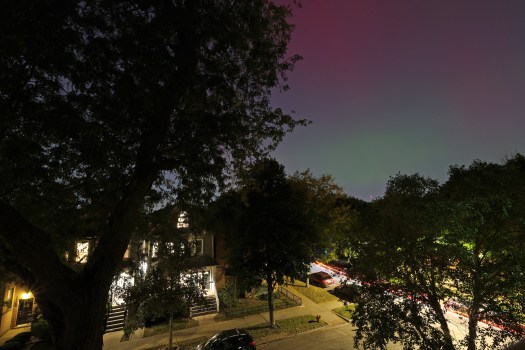


Chicago-area residents who missed the chance to witness the northern lights Thursday night might be able to catch the heavenly show Friday night, said National Weather Service meteorologist Shawn Dahl.
Dahl said late Friday morning the northern lights may appear in northern Illinois skies Friday night, but the chance of that happening was decreasing as the day went on due to solar storm levels subsiding.

The U.S. National Oceanic and Atmospheric Administration issued a severe geomagnetic storm alert Wednesday after an outburst from the sun was detected earlier in the week. Such a storm increases the chance of auroras — also known as northern lights — and can temporarily disrupt power and radio signals.
NOAA’s Friday forecast showed continued higher-than-normal activity, but the chances for another overnight show were slim farther south of Canada and the northern Plains states.
And even if skies full of pinks, purples, greens and blues appear over northern Illinois, clouds may impede views of them.
“We should see increasing cloudiness (in Chicagoland) this afternoon into this evening,” said National Weather Service meteorologist Casey Sullivan. “It’s what we refer to as high clouds. It’s cloud cover that’s 20,000 to 30,000 feet above the ground. It may be thin enough that you could see some of the northern lights if they occur.”
Eva Ramos, 54, of Bartlett, said she and her 20-year-old daughter caught the northern lights around 9:30 p.m. Thursday at Adeline Jay Geo Karis Illinois Beach State Park in Zion.
“Oh my God, it was just like the most jaw-dropping experience to see,” Ramos said. “It is just so amazing.”
Ramos said she has seen the lights before, but never so clearly.
“It’s something that everybody needs to see,” Ramos said, who has been interested in the northern lights for about four years and belongs to several northern lights-related Facebook groups.
“I’m a stargazer. It just warms my heart that I was able to experience this, and especially with my daughter.”
What causes northern lights?
The sun sends more than heat and light to Earth — it sends energy and charged particles known as the solar wind. But sometimes that solar wind becomes a storm. The sun’s outer atmosphere occasionally “burps” out huge bursts of energy called coronal mass ejections. They produce solar storms, also known as geomagnetic storms, according to NOAA.
The Earth’s magnetic field shields us from much of it, but particles can travel down the magnetic field lines along the north and south poles and into Earth’s atmosphere.
When the particles interact with the gases in our atmosphere, they can produce light — blue and purple from nitrogen, green and red from oxygen.
Why have there been so many solar storms lately?
Solar activity increases and decreases in a cycle that last about 11 years, astronomers say. The sun appears to be near the peak of that cycle, known as a solar maximum. It’s not clear exactly when the cycle will begin to slow.
In May, the sun shot out its biggest flare in almost two decades. That came days after severe solar storms pummeled Earth and triggered auroras in unaccustomed places across the Northern Hemisphere.
How can you best see the northern lights?
NOAA advises those who hope to see the northern lights to get away from city lights.
The best viewing time is usually within an hour or two before or after midnight, and the agency says the best occasions are around the spring and fall equinoxes due to the way the solar wind interacts with Earth’s magnetic field.
The Associated Press contributed.