
To help inform voters on who’s running for Chicago’s elected school board, the Chicago Tribune education team posed a series of questions to the candidates in each district. These questions ranged from basic information on their background and campaign platform to their stance on several issues facing Chicago Public Schools.
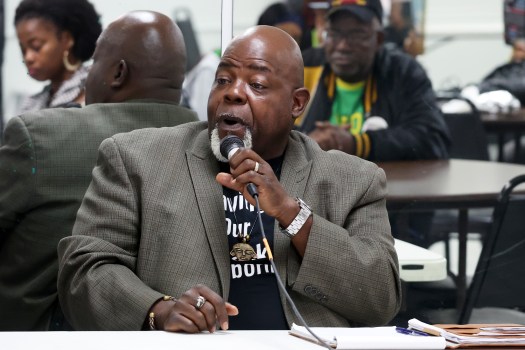
See the answers from Aaron “Jitu” Brown, candidate for elected school board in the 5th District, below.
About the Candidate
Name: Aaron “Jitu” Brown
Age: 58
Neighborhood: Austin
School District: 5
Education: Kenwood Academy
Current Job: National director at the Journey for Justice Alliance
Previous Political Experience: Jackie Robinson School’s Local School Council, Dyett High School Local School Council, CPS Black Student Success Working Group member, 2024 People United for Action, co-founder & coordinating committee member Kenwood Oakland Community Organizer board member, Kenwood Oakland Community Organizer board chair, Westside Long Term Recovery Committee, board member, Step Up Louisiana, board member, Midwest Academy, board member, Equal Education (South Africa), board member.
Questions and Answers
In the interest of transparency, the candidate’s responses shown here are published as written and have not been edited by the Tribune.
Did you attend Chicago Public Schools or is anyone in your immediate family a CPS student? Yes.
Have you worked at Chicago Public Schools or another school? What is your background in education?
I am a Chicago Public Schools alum and parent and a proud resident of the Austin community on Chicago’s West Side. For over 30 years, my work has focused on educational justice and equity. For many years I was the education organizer at the Kenwood Oakland Community Organization, one of Chicago’s longest standing community organizations, where I organized campaigns for greater investment in public education, worked to improve schools serving Black students, and ran youth leadership programs in schools. I was the lead organizer in the campaign to save Dyett High School from closure, which culminated in myself and others going on a 34-day hunger strike that led to Dyett being reopened with over $14 million in new investments. Out of that campaign, I helped envision the Sustainable Community School model now being implemented in communities across the country. What we did for Dyett I want to do for schools across the 5th District and across the city.
From 1999 – 2013, I served on Local School Councils and trained hundreds of LSC members across the city. I was the community school coordinator at Chicago’s first community school, South Shore School of Entrepreneurship from 1999 – 12005, and taught Black history at St. Leonard’s High School, the nation’s only accredited high school serving people returning from incarceration. Since 2013, I have been proud to serve as the National Director of the Journey for Justice Alliance, an alliance of community organizations in 40 cities working to improve schools.
Why are you running for a seat on the Chicago Board of Education?
As an educator, youth mentor, and longtime community organizer in the movement for educational justice, I have seen the way corporate and profit-driven interests have led decision-makers in our city to fail our young people and our school system over and over again. In addition to working to win needed investments in neighborhood schools on the West and South sides, stop racist school closures, and expand the sustainable community school model, I have been apart of the fight to win a democratically elected School Board in Chicago for many years. In 2015, I was one of the lead organizers who formed Communities Organized for Democracy in Education to put a referendum on the the ballot in 37 of 50 wards that showed nearly 90% of voters wanted an elected board. My belief is that we need community voices on the board that governs Chicago Public Schools in order to make our school district best meet the needs of our communities. As a CPS alum, CPS parent, mentor and educator to countless CPS alum across the city, and organizer of school communities, I am driven by a commitment to equity and to the vision that every young person in Chicago deserves a world class education within safe walking distance of their home. Now that we will get to elect our School Board representatives for the first time, I am running to collaborate with community to win steps toward that vision.
How would you describe your district?
For years, Chicago Public Schools ignored inequity and then punished schools that were intentionally underserved by the district through punitive standardized testing, ineffective interventions and ultimately school closures. Now, these closures have negatively impacted the education and the lives of two generations of young people in District 5, and particularly the West Side of Chicago, which is among one of the areas in the city most impacted by school closures. Many of the neighborhoods (Austin, Garfield Park, North Lawndale, West Humboldt Park) in the district have seen utter decimation of neighborhood schools. While the charter industry has driven and profited, these closures have led to increases in community violence, worsening academic outcomes, and other forms of destabilization not only for students and their families but for communities at large. This speaks to the needs for investment in neighborhood schools and to invest in a sustainable community school model. What I also see across the Fifth District are a diversity of power community leaders and organizations working together for the betterment of their communities. I had the honor of being apart of the West Side Flood Relief Committee, a group of neighbors who came together to help other residents get access to FEMA resources after the catastrophic flood in 2023. I have relationships with Local School Council leaders across the district who are tirelessly working to take care of the schools they represent. And have the pleasure of spending a few mornings every week talking to parents who drop their elementary aged children off to school about their vision for the district. We are an expansive district that I’ll be proud to represent!
How would you describe your campaign platform?
As a School Board representative, my top priorities will be investing in neighborhood schools and fighting for more equitable school funding. For too long, structural racism in Chicago Public Schools has meant separate and unequal education along the lines of race and class. Families have been shut out of decisions impacting students lives. Standardized testing has been weaponized against Black and Brown children. Neighborhood schools have been underfunded, neglected, and entirely shut down. Whole communities have suffered from this kind of sabotage. The solution must be to transform CPS into an equitable district where every child and community has access to a quality neighborhood school walking distance from home. I will prioritize expanding the sustainable community school model, which will involve:
- Securing full and equitable funding for CPS
- Investing in quality schools in every neighborhood
- Increasing and retaining Black teachers
- Ensuring more culturally relevant curriculum
- Moving away from racist and punitive standardized testing
- Supporting local school councils
What is the single most important issue facing CPS students?
Inequity and underfunding are at the heart of the problems facing Chicago Public Schools. Currently, CPS simply doesn’t have enough funding to meet the needs of our roughly 320,000 students. The State of Illinois is not properly paying into teacher pensions for CPS like it does for other school districts or fully funding its own Evidence Base Funding model. In order to have fully funded schools with librarians, well-kept facilities, counselors, and reasonable class sizes, we need to solve the problem of revenue by going to our state and federal governments to fully fund our school system. Instead of pitting the needs of some young people and some schools against one another whether they be Black students in disinvested school buildings, ESL students, or students with disabilities, we should unify around a plan for fully funded schools.
Provide three to four key points you want voters to know about your campaign.
- I knock doors, attend community events, and visit schools every week all across the 5th district to connect with parents, community members and voters!
- I am a coalition builder who leads with humility, compassion and courage. I will engage the 5th district in re-imagining public education in our communities!
- I am running on a core belief that “community wisdom in partnership with academic expertise leads to school improvement.”
Given this year’s budgetary problems and disagreements on how to solve them, what do you propose for the district’s funding in future years? Would you support the district in taking on any loans in future years to fund the annual budget?
It is not my 1st choice. I think dissolving TIF’s and directing a large percentage of those resources to CPS along with other progressive revenue options (hospitality tax, etc.) is an option that is more practical. It is travesty that only 25% of CPS’ budget comes from the state, where other states are at or above 50%. Taking out a loan is the absolute last resort. What is out of the question is the status quo of balancing the budget on the backs of Black and Brown students.
The Chicago Board of Education recently adopted a new 5-year Strategic Plan. Which aspects do you support and which would you change, if any?
I support the Board’s commitment to prioritizing of neighborhood schools, which is essential to moving closer to a system where Chicago families have a world class education within safe walking distance in every neighborhood.
As thousands of migrant families settle in Chicago, how should the District handle the influx of English learners? What more should be done to ensure consistent bilingual education is provided and funded?
The issue of new arrivals exposes the deep inequity that exists in CPS. Before the influx of new arrivals, Latine and other immigrant families had to fightfro aces to ESL services, smaller class sizes and culturally relevant curriculum to meet their children’s needs. So the entrance of new arrivals into CPS illuminates the urgency of a real commitment to equity, not just lip service.
By hiring more ESL instructors, committing to the sustainable community school model that allows school communities with partner with agencies that can address many of the social needs that families may have, and committing to a lower counselor-to-student ratio, we can better meet the needs of all our students.
Do you believe the district has historically underinvested in South and West side schools? Yes.
If yes, what solutions would you propose to address inequities and opportunity gaps in the school system?
We need to fully fund and enact the new Evidence Based Funding formula and go beyond property taxes as the primary source of revenue for schools because they inherently reinforce inequity in the system. Instead, we should be looking at progressive streams of revenue to fully fund our schools. In the short term, we should also be using TIF surplus funds to fund school improvement and school equity needs instead of letting them sit as slush funds for development projects like they have historically.
Since his election, Mayor Johnson has indicated a desire to move away from school choice and bolster neighborhood schools. This was recently reinforced by in the District’s 5-year Strategic Plan. Do you share this position? Why or why not?
There is no such thing as what has been branded as “school choice” in Black and Brown communities where public education has been decimated. You can’t have choice if you don’t have equity. If neighborhood schools are starved, there is no choice of a great school your kid can walk to. We should be investing in neighborhood schools so there is a choice of a world class school in every neighborhood.
What solutions do you propose to provide busing for students at selective enrollment and magnet schools?
Busing should be made available for any child who needs it. I would approach this by looking at how we get rid of some of the bureaucracy that exists within CPS so that we can be able to move toward being a school district that means the needs of all students.In addition to students in magnet and selective enrollment, we should be providing buses for students in a situation like a student who lives in Austin but wants to go to Dunbar to take auto mechanics.
Please share your thoughts on how the District and the Chicago Teachers Union can settle on a new 4-year contract.
We need to reconcile the fact that the state of Illinois isn’t paying into the Chicago teacher pensions like it does for other school districts across the state and it hasn’t fully funded its own Evidence Based Funding model. Only 25% of Chicago Public School district’s funding comes from the state, compared to other major cities that get 50% or more from state funding. Because the state of Illinois isn’t fulfilling its responsibility for funding education in Chicago, we are left with a structural and inequitable deficit. Together, the city and stakeholders need to be lobbying for the state to fully fund education in our city so we are not spending money that should be going to classrooms on debt service and the gap in pension funding we are not getting from the state.
In 2024, Chicago Public Schools’ average literacy proficiency rate is 31%, an increase from pre-pandemic years. These rates, however, were lower for students from low-income families, English learners and students with Individual Education Plans (IEPs). How should the district seek to improve literacy rates going forward?
I define education as “inspiration and information that prepare young people to impact the world.” So a culturally relevant and responsive curriculum is essential to inspire students to explore. Quality early childhood education (pre-k to 3) must be equitably provided as historically it has not. Fewer standardized tests and an emphasis on world language is a proven methodology to increasing curiosity and literacy.
What is your position on expanded funding and renewal terms for charter schools?
I am not an anti-charter school ideologue, but I am against the industry that has played a role in destabilizing education in black communities. We know that only 1 out of 5 charters outperform public schools. Yet, the profit-driven charter industry continues to suck resources away from a system of public education that should be able to provide every Chicago young people with the high quality education they deserve.
I am not in favor of closing existing schools. Only in the event that a school community (LSCs, Parent Advisory Councils, community based organizations) comes together and decides for themselves that school consolidation is what’s best for their community do I think we should consider closure or consolidation. I do not, however, think we should be looking to expand or give more money to charters.
Please provide your thoughts on how to keep Chicago Public Schools as safe havens for students to learn and flourish fear of violence. How do you propose the district approach this?
Most importantly, I think we should be investing in the sustainable community schools model and its village format that connects feeder schools through youth mentorship programs and vertical curriculum alignment. Investing in community involvement in schools is an investment in community safety. Further, I think safety comes from a community’s needs being met so fully funding schools where young people have access to counselors, libraries, activities, and restorative justice is a core part of how we make young people safe at school and beyond.