In the lead-up to Chicago Public Schools’ May 1 “day of civic action,” one school board member emerged as a particularly vocal critic, arguing repeatedly that the initiative has sown confusion among families and posed logistical challenges for the district.
Jennifer Custer, who represents parts of the Northwest Side, was elected with the support of the Chicago Teachers Union in 2024. But she has frequently broken with the union in key votes, a divide that has become more pronounced in recent months as elections approach.
Custer announced in March that she is running for school board president.
“Throughout this year-and-a-half process, there’s been so many times that I reflected on, ‘What if we did that differently?’” said Custer, who represents District 1B. “I think that I can set this board up for success in the future.”
The race for school board president is expected to be hotly contested — and among the city’s most closely watched contests in November. Sendhil Revuluri, a board appointee under former Mayor Lori Lightfoot, announced his run in October. Elected school board member and former CPS principal Jessica Biggs launched her campaign last month.
Also running is Victor Henderson, a business attorney who sits on the board of the Urban Prep Academies charter network.
Alongside Chicago Public Schools CEO Macquline King, the board president will play a key role in shaping district policy and presiding over meetings. Current president Sean Harden, who was handpicked by Mayor Brandon Johnson, has said he does not intend to run.

Until January 2025, the school board was made up of seven mayoral appointees. It is currently transitioning to a fully elected body, with 11 appointed seats and 10 elected seats. In November, all 21 seats will be up for election.
Custer lives in the Montclare neighborhood but has spent most of her career at suburban schools. She taught middle school language arts for seven years in Itasca before becoming an assistant principal in Addison. She has three young children; her eldest son attends a CPS neighborhood school on the Northwest Side.
As president, Custer said her top priorities would be streamlining board governance, stabilizing the district’s finances and focusing on student learning.
“That is the reason that we’re here, to make sure that the students are getting the best education possible,” she said.
Custer’s candidate committee has raised about $44,000 since last summer, according its most recent quarterly filing in late March. Much of that money has gone toward childcare, she said, which is a permissible campaign expense. Her largest donor is the Chicagoland Operators Joint Labor-Management PAC, which has donated $16,000 this election cycle. She has also received $10,000 from the political action committee affiliated with SEIU Illinois, which represents CPS support staff.
During the 2024 elections, Custer’s campaign was buoyed by CTU and the Illinois Federation of Teachers, which together contributed about $90,000. She acknowledged she does not have that backing this election cycle.
“I know our relationship has soured,” Custer said. “I certainly view them as a stakeholder. I deeply respect their membership.”
‘May 1 is happening.’ What to know about the CPS and teachers union May Day debate.
Last August, Custer voted to approve the district’s $10.25 billion budget — which faced opposition from CTU-backed and appointed board members for excluding a short-term loan and a disputed pension payment.
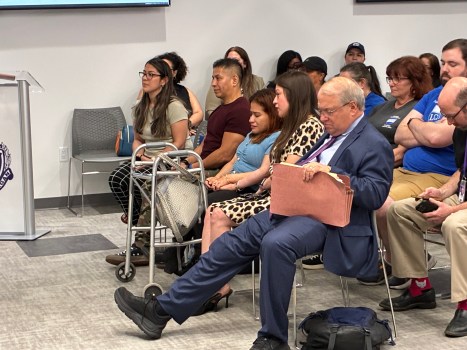
More recently, Custer aired concerns about CPS’s civic engagement day. At a board meeting last month, she attempted to force a vote on the district’s agreement with CTU, which allows students and teachers to attend civic engagement events. But the motion was not allowed to move forward under board rules governing public meetings.
Custer said she respects the significance of May Day, but questioned whether CPS should take an official position or alter the school day based on CTU’s advocacy.
“What we have to continue to balance is some of the political work that they do, and the purpose of the district and what we’re here to serve,” Custer said of the teachers union.
It wasn’t the first time Custer had diverged from other board members. In March, she was the sole vote against the permanent appointment of interim CEO King. She later told reporters that she heard concerns from her constituents about King’s communication and leadership style.
“I want to make no mistake that I am here to support Dr. King,” she said. “I want to see her be successful. But that means we have to have hard conversations.”
To run for board president, candidates must collect 2,500 signatures from Chicago residents and turn them in to the city between May 18 and 26. Other school board hopefuls only need 1,000 signatures, though they will likely face challenges on the ballot. The list of candidates will be finalized Aug. 27.
“I’ve had a vast array of experiences that have prepared me for this role, I would say, more than some of my counterparts,” Custer said. “I am able to jump in as president and understand the system that we are working in.”