Jimmy Soto, right, hugs his cousin and co-defendant, David Ayala, after a court hearing for their certificates of innocence on July 30, 2025, while celebrating with family, supporters and their attorneys at the Leighton Criminal Court Building. Released in 2023, Soto and Ayala earned the unfortunate distinction of becoming the longest-serving wrongfully convicted people in Illinois after 42 years behind bars. (Brian Cassella/Chicago Tribune)
James Soto and his cousin, David Ayala, stood outside the doors of a Cook County courtroom Wednesday at the end of a more than four-decade entanglement with the criminal court and prison system, nervously riding out a final 20-minute delay in their hearing to receive an official declaration of innocence.
“It doesn’t happen until it happens. I waited so long,” Soto said, listening for a call back into the room.
Family and supporters audibly exhaled when the decision came several minutes later: a certificate of innocence was granted for the two men, the longest-serving wrongfully convicted people in Illinois.
Ayala and Soto were released from prison more than a year and a half ago after a judge exonerated them. But the certificate of innocence means even the arrest records from the case will be erased. Soto said having the certificate will allow him to travel without restrictions, and both men said it would help them to move on with their lives.
“Our vindication is not based on some sort of technicality,” Ayala said after the ruling. “This is clear proof of evidence, what we’ve been saying for over 42 years.”
Cook County prosecutors previously dropped all charges in the case. But Soto, Ayala and their family and supporters all said they still felt on edge in court before the certificates were issued.
“It feels like I’m in a dream,” Rose Ayala-Olson, David’s sister, said in the lobby of the Leighton Criminal Court Building. “He’s innocent. He always has been.”
Soto earned a college degree in prison and learned how to write court petitions for himself and others who were in prison. He had a reputation inside prison walls for using his self-taught knowledge to help others who were incarcerated with their legal issues, sometimes writing the first petition that would eventually win freedom or a sentence reduction. A professor once called him “one of the most successful non-licensed litigators inside of Stateville.”
Next month, he’s planning to take the LSAT, his attorney Lauren Myerscough-Mueller said.
Jimmy Soto is embraced by his cousin, David Ayala, during a celebration of his 63rd birthday at his sister Marta’s home in Deerfield on April 13, 2024. Jimmy and David, co-defendants in the crime for which they were wrongfully convicted, were both sentenced to natural life without the possibility of parole in 1982. (Vincent Alban/Chicago Tribune)
Jimmy Soto raises his diploma and cheers as he and his fellow prisoners receive their bachelor's degrees at a graduation ceremony for the inaugural class of the Northwestern Prison Education Program at Stateville Correctional Center on Nov. 15, 2023. Jimmy and his friend, Michael Broadway, second from lower right, went through the rigorous program together. (Vincent Alban/Reuters)
Jimmy Soto, shown here while still in Stateville Correctional Center, earned his bachelor's degree in prison just one month before he was exonerated on Dec. 14, 2023. He spent 42 years behind bars. (Vincent Alban/Reuters)
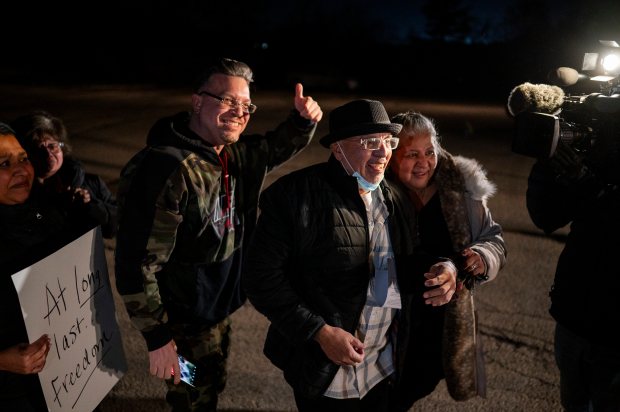
Jimmy Soto is greeted by friends, family and television cameras as he walks out of Stateville Correctional Center after 42 years behind bars on Dec. 14, 2023. Jimmy's sisters Pilar More and Marta Cruz were there to welcome him as well as his friend Robert Almodovar, third from left, who Jimmy helped get exonerated. (Vincent Alban/Chicago Tribune)
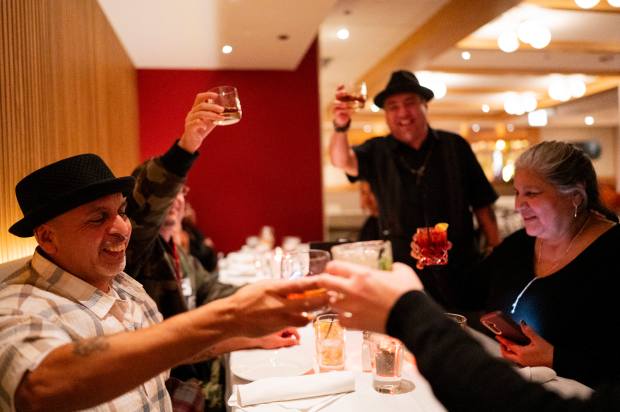
Jimmy Soto raises his glass to celebrate his release from prison on Dec. 14, 2023, at Rosebud in Chicago. "My first step is to go have a nice dinner of steak and lobster," he said after being released from Stateville Prison. (Vincent Alban/Chicago Tribune)
Jimmy Soto hugs a friend during a holiday party hosted by Jennifer Bonjean, a criminal defense attorney, following his release from prison earlier that day. (Vincent Alban/Chicago Tribune)
A family photo shows Jimmy Soto, top left, with his father, José Soto, his brother René Soto and his three sisters, Pilar More, Rosalinda Soto and Marta Cruz. (Vincent Alban/Chicago Tribune)
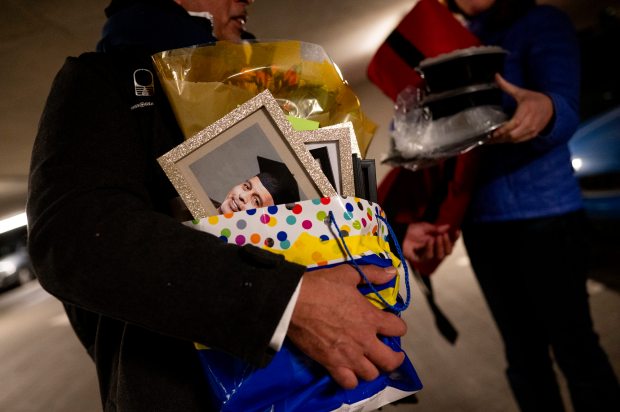
Jimmy Sotot carries gifts, including a framed portrait of him in his graduation cap and gown, after a party celebrating his release from prison, Feb. 16, 2024. While in prison, Jimmy earned his bachelor’s degree from Northwestern University, even though he had never set foot on campus. (Vincent Alban/Chicago Tribune)
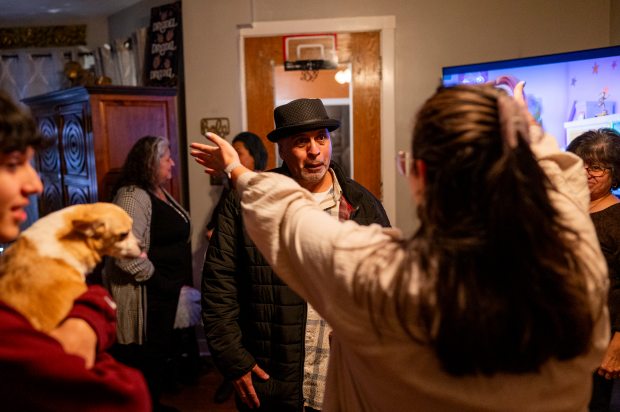
Jimmy Soto is greeted by family members, including his niece Katy Soto, right, following his release from prison earlier that day. “Everyone was always very sure,” Jimmy’s sister, Pilar, said of her brother’s innocence. “My sisters were always telling me, ‘We know where he was when this happened.’” (Vincent Alban/Chicago Tribune)
Jimmy Soto listens to music in his basement bedroom at his sister’s home in Chicago on March 5, 2024. Jimmy has regimented routines from his time in prison, one of which is listening to calming music before going to bed at night. (Vincent Alban/Chicago Tribune)
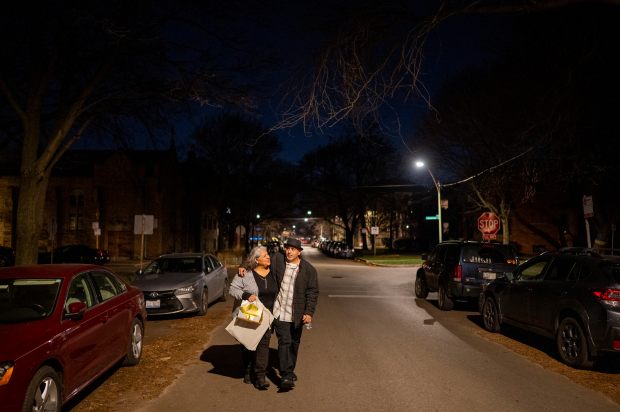
Jimmy Soto, right, walks with a long-time friend to his sister’s home following his release from prison earlier that day, Dec. 14, 2023. (Vincent Alban/Chicago Tribune)
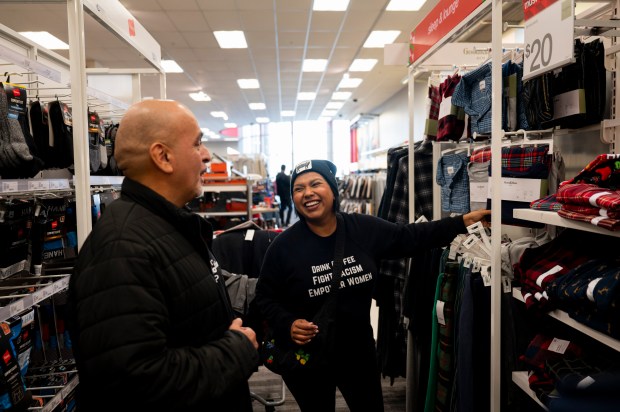
Jimmy Soto and his youngest sister, Pilar, pick out clothing at Target on the first full day after he was released from prison. Pilar was 8 years old when Jimmy went to prison. “He never forgot a birthday,” she said. (Vincent Alban/for The Chicago Tribune)
Jimmy Soto with other people exonerated after wrongful convictions during a party celebrating his release from prison on Feb. 16, 2024, in Chicago. According to the National Registry of Exonerations at the University of Michigan, Illinois has the most exonerations of any state at 540, according to data collected since 1989. (Vincent Alban/Chicago Tribune)
At a holiday party hosted by his sister, Jimmy Soto steps into the kitchen to eat alone after becoming overwhelmed by the crowd, two days after his release from prison. (Vincent Alban/Chicago Tribune)
Jimmy Soto meditates in his basement bedroom at his sister’s home, a practice he carried over from his time in prison where he did it “to keep his sanity.” (Vincent Alban/Chicago Tribune)
“He was one of my strongest supporters believing that I was innocent,” Jimmy Soto said after seeing his father’s grave for the first time on Father's Day in 2024. “It’s not closure but the peace that I found being there, feeling the spirit there, that he has found peace knowing that I am out. It is really special to me.” His father, Jose B. Soto, passed away in 2015, while Jimmy was still incarcerated. (Vincent Alban/Chicago Tribune)
Jimmy Soto tries on the vest of a three-piece suit at M. Stuart’s in Chicago on Dec. 27, 2023, for a suit he will wear on New Year’s Eve. (Vincent Alban/Chicago Tribune)
As 2024 begins, Jimmy Soto, center, and friends raise their glasses at the stroke of midnight to ring in the new year at Rivers Casino in Des Plaines. (Vincent Alban/Chicago Tribune)
Jimmy Soto reads while riding a CTA “L” train while commuting to his job as a paralegal at the Northwestern University Pritzker School of Law in Chicago. Jimmy has become more independent the more time he spends outside of prison, commuting on his own via public transit and with his own vehicle. (Vincent Alban/Chicago Tribune)
Jimmy Soto walks on the downtown campus of Northwestern University on Feb. 20, 2024, while commuting to his job as a paralegal at the Bluhm Legal Clinic at the Northwestern University Pritzker School of Law in Chicago. (Vincent Alban/Chicago Tribune)
Jimmy Soto meets Marilyn Mulero, who, like Jimmy, was wrongfully convicted of murder, at an art event for and about people impacted by incarceration at Walls Turned Sideways gallery on Jan. 27, 2024, in Chicago. (Vincent Alban/Chicago Tribune)
Jimmy Soto shops at a gas station near Chicago two days after his release from prison in December 2023. He made his purchase with gift cards given to him by friends and family since he didn't yet have a bank account. (Vincent Alban/Chicago Tribune)
With help from his brother-in-law, Adam More, and a friend from prison, Max, Jimmy Soto moves his belongings into his sister’s home in Chicago on Feb. 2, 2024. Many of the belongings were books, as Jimmy was an avid reader while in prison. (Vincent Alban/Chicago Tribune)
Jimmy Soto writes talking points on Dec. 17, 2023, for an upcoming interview with CNN, three days after his release from prison. (Vincent Alban/Chicago Tribune)
Jimmy Soto parallel-parks a car belonging to his brother-in-law after successfully completing his driver’s license test on March 14, 2024, in Chicago. (Vincent Alban/Chicago Tribune)
Jimmy Soto, left, walks with his friend and former cellmate, Robert Almodovar, through Wrigley Field during a Chicago Cubs game on April 19, 2024. Jimmy, who wears the number 42 for the number of years he spent in prison, helped Robert get exonerated for a wrongful murder conviction. (Vincent Alban/Chicago Tribune)
Jimmy Soto, left, sits beside his attorneys, Jon Loevy, center and Meg Gould, right, as they announce a lawsuit against the Chicago Police Department and the Cook County Prosecutors involved in his wrongful conviction at Northwestern University Pritzker School of Law on Oct. 22, 2024. (Vincent Alban/Chicago Tribune)
Breana Spight, left, a second year law student at the Northwestern University Pritzker School of Law, coaches Jimmy Soto during a tutoring session for the LSAT on March 8, 2024. (Vincent Alban/Chicago Tribune)
Jimmy Soto chants during a protest outside the State of Illinois Building on July 24, 2024, in Chicago. The group was trying to shut down Stateville because of its deteriorating conditions and to demand justice for Jimmy's friend, Michael Broadway, who died in custody at the prison in June. (Vincent Alban/Chicago Tribune)
Jimmy Soto hugs his friend David Merced, who emerged from the audience during a panel discussion to tell those gathered how Jimmy wrote a petition that helped get David released from prison, May 2, 2024. (Vincent Alban/Chicago Tribune)
Jimmy sits at his new desk during one of his first days working as a paralegal at the Bluhm Legal Clinic at the Northwestern University Pritzker School of Law on Jan. 29, 2024, in Chicago. (Vincent Alban/Chicago Tribune)
Jimmy, center, watches the sun rise along the lakefront with his brother-in-law, Adam More, at Montrose Harbor in Chicago Dec. 15, 2023. Jimmy said one of the first things he wanted to do after getting out of prison was to take a long walk with no barriers. (Vincent Alban/Chicago Tribune)
1 of 32
Jimmy Soto is embraced by his cousin, David Ayala, during a celebration of his 63rd birthday at his sister Marta’s home in Deerfield on April 13, 2024. Jimmy and David, co-defendants in the crime for which they were wrongfully convicted, were both sentenced to natural life without the possibility of parole in 1982. (Vincent Alban/Chicago Tribune)
Now in their 60s, Soto and Ayala were 20 and 18 when they were arrested following the shooting deaths of 16-year-old Julie Limas and Hector Valeriano, 18, a U.S. Marine on leave, on Aug. 16, 1981. They were sentenced to natural life in prison.
The case largely turned on a single witness who, in exchange for a deal, told a jury Soto carried out a shooting with him and a third person under orders from Ayala. That witness was later key to both men’s exoneration, when an Illinois appeals court found that other witnesses contradicted his “highly-incentivized” account.
Ayala served 15 years in the supermax facility at the now-shuttered Tamms Correctional Center, which was known for brutal conditions and was the prison where the state housed people on death row before the death penalty was abolished in Illinois.
Both men have been making up for lost time since their release, getting out in nature and volunteering, Myerscough-Mueller said.
Jimmy Soto celebrates with family, friends and attorneys after a court hearing for his certificate of innocence on July 30, 2025, outside the Leighton Criminal Court Building. (Brian Cassella/Chicago Tribune)
Soto last year filed a lawsuit against defendants including the city of Chicago and Cook County accusing police and prosecutors of using abusive tactics to get witnesses to tell a certain story, including threatening them with the death penalty and depriving them of sleep and food. He said he expects that process will continue for another four or five years. Ayala has filed a similar lawsuit seeking compensation for his wrongful conviction.
“This is something that I’ve been waiting for a long time, and to finally hear those words — I mean, it’s like a whole weight lifted off me,” Soto said of receiving the certificate.