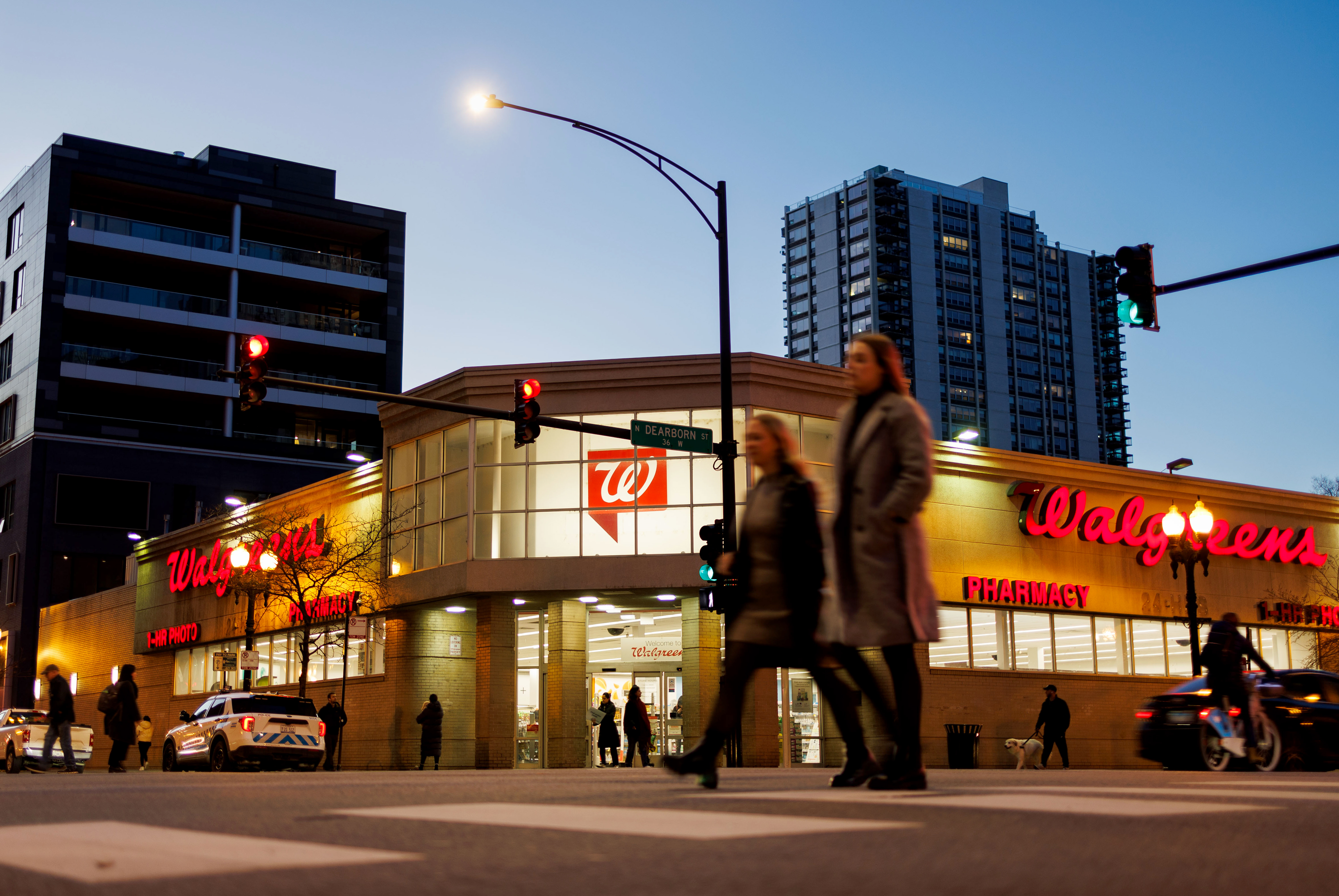

Walgreens Boots Alliance — which grew from humble beginnings in Chicago into one of the nation’s largest retail pharmacy chains — has officially become a private company, with private equity firm Sycamore Partners announcing Thursday that it has completed its acquisition of the business.
The acquisition follows an announcement in March that Sycamore would buy the company for about $10 billion. Sycamore is a New York-based private-equity firm specializing in retail, consumer and distribution-related investments.
Walgreens, The Boots Group, Shields Health Solutions, CareCentrix and VillageMD will now operate as separate, standalone companies.
Walgreens headquarters will remain in the Chicago area, according to the company. The company’s headquarters has long been in Deerfield.
Some experts have worried that the deal could lead to more layoffs and store closures, making it difficult for some patients to get their medications. Walgreens spokesperson Jonathon Hosea declined to comment Thursday on whether the company expects layoffs and said he had no updates on whether more store closures are possible. The company declined to make leaders of Walgreens or Sycamore available for an interview Thursday.
A new CEO has been appointed to lead Walgreens. Mike Motz will serve as CEO of Walgreens effective immediately, replacing former CEO Tim Wentworth, who will continue as an ongoing director. Motz was formerly CEO of Staples US Retail, which is a Sycamore company.
The sale follows years of struggles for Walgreens, which was founded in Chicago nearly 125 years ago. Over that time, the company grew into a behemoth, with about 8,500 stores and 220,000 employees in the U.S. and Puerto Rico.
But in recent years, Walgreens has faced industrywide challenges, including issues related to medication reimbursements and competition from online retailers. The company also pursued an ill-fated strategy to become more of a health care destination. As part of that strategy, Walgreens invested billions of dollars into primary care provider VillageMD, with plans to put Village Medical clinics in 1,000 of its stores by 2027. In March 2024, Walgreens disclosed an impairment charge of $5.8 billion related to VillageMD, and began backing away from its VillageMD plans.
Last year, Walgreens announced that it would close 1,200 stores over a three-year span, including in Chicago. Walgreens has also been slashing costs for years, including through layoffs in Illinois and other locations. Earlier this year, before announcing the deal with Sycamore, Walgreens suspended its practice of paying cash dividends to stockholders for the first time in 92 years.
Former CEO Wentworth had previously described a plan to turn around the company, partly by refocusing on its historic work as a retail pharmacy business.
Motz said in the news release that as a private organization, Walgreens will renew its focus on its stores, customer experience and pharmacy and retail operations.
“Walgreens benefits millions of Americans, and I am confident that, enhanced by the flexibility of operating as a private standalone organization, it can move with certainty, speed and focus to deliver meaningful value to its customers,” said Stefan Kaluzny, Sycamore managing director, in the news release.
Some industry watchers, however, have concerns about Walgreens now being owned by a private equity firm and what that might mean for employees, patients and communities.
The deal with Sycamore put a lot of debt onto Walgreens that Walgreens will now have to pay off, noted Matt Parr, a spokesperson for the Private Equity Stakeholder Project, based in Chicago. When including debt, the transaction is valued at up to $23.7 billion.
“Historically what we’ve seen with private equity closures is there is a high risk of bankruptcies, closures, layoffs,” Parr said.
Walgreens, however, isn’t just any retail business, Parr said. Many people rely on Walgreens to fill their prescriptions, and in some communities, Walgreens is the only place to do that, he said.
“When that pharmacy is closed because they’re not deemed profitable enough by Walgreens or Sycamore, you have a community that just completely lost their connection to necessary pharmacy services,” Parr said.
In April, Sen. Elizabeth Warren, D-Mass., expressed similar concerns in a letter to Kaluzny.
“These private equity buyouts of companies facing financial hardship — whether they involve health care companies, retail, or other types of firms — frequently lead to worse outcomes for employees and consumers: private equity firms sell off assets and close locations, employees lose their jobs, and consumers lose access to essential goods and services,” Warren wrote, adding that she was concerned about layoffs and pharmacy closures in Massachusetts.
But Anjelique Soriano, a health care sector analyst at Third Bridge, said “our experts indicate that this acquisition is a critical and necessary step for Walgreens’ survival.”
“Going private under a firm like Sycamore gives Walgreens a chance, allowing the company to execute a difficult and potentially painful turnaround — including significant cost management and store optimization — away from the constant scrutiny of being a public company and quarterly earnings.” Still, Soriano noted that the acquisition “introduces the risk that the solutions will be purely financial and potentially detrimental to the company’s role as a community health care provider.”
Sycamore is known for operating retail businesses, and “the strong case for it is to say with a level of operational focus and less embeddedness you’ll be able to flip this and do something better,” said Peter Boumgarden, the Koch Family Professor of Practice for Family Enterprise at Olin Business School at Washington University in St. Louis. On the other hand, Sycamore brought a lot of debt into the deal and is also known for implementing cost-cutting measures, Boumgarden said.
It should also be easier for Sycamore to potentially sell off parts of the former Walgreens Boots Alliance, now that it’s split it into five separate companies, Boumgarden said.
Kate Festle, a health care mergers and acquisitions partner at consulting firm West Monroe in Chicago, said in an email that Motz’s appointment as CEO reflects a consistent strategy Sycamore uses when taking retail companies private in which “they install leaders they know and trust, strip away distractions, and rebuild profitability outside the spotlight of a public company.”
Under the terms of the deal, shareholders are receiving $11.45 per share, with another one-time right to receive up to $3 per share based on proceeds of divesting certain health care assets, including the company’s equity interest in VillageMD.
Sycamore said in a news release that it acquired the business in partnership with longtime Walgreens Executive Chairman Stefano Pessina and his family, who reinvested 100% of their interests in Walgreens Boost Alliance.