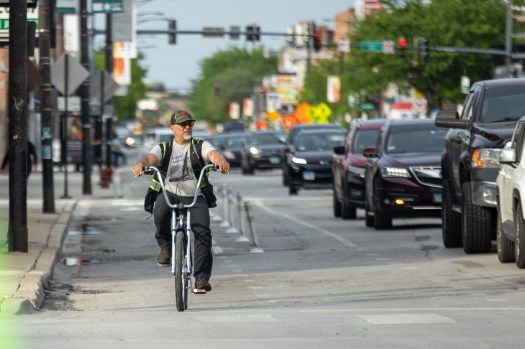
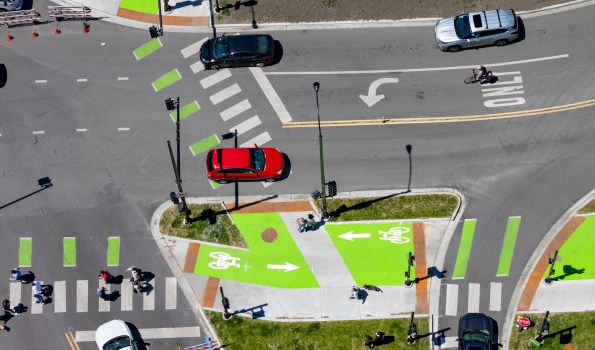
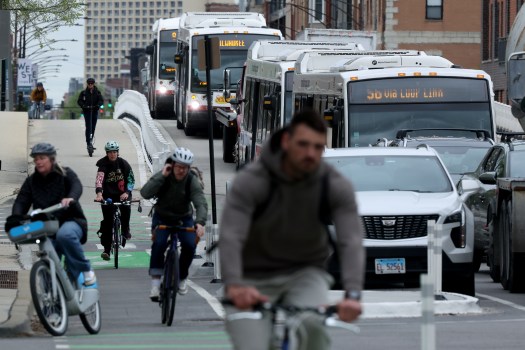
At a time when Chicago has emerged as a national leader in reducing fatal crashes on our streets, Mayor Brandon Johnson and the City Council are poised to turn back the clock with drastic cuts to street safety funding.
According to the Chicago Department of Transportation, the number of fatal crashes has fallen 30% in the city from its most recent peak in 2021. When compared to a 9% drop nationally, Chicago is now at the forefront of making streets safer for everyone who uses them.
This is an achievement we should be proud of. It’s the result of hard work and major investment alongside a relentless focus on redesigning roads to eliminate dangerous speeding.
Like most cities, Chicago pays for infrastructure improvements using bond funding. Yet the latest bond proposal before the City Council includes a staggering 70% cut to complete streets projects — the very projects that have driven Chicago’s remarkable reductions in severe injuries and fatalities.
These cuts would erase years of hard-won progress and make streets more dangerous, especially for people on the South and West sides who already bear the brunt of traffic violence and have fewer safe, affordable transportation options. When safety investments are cut, it is these communities that pay the highest price in lives, injuries and lost opportunity.
City leaders have not only a moral obligation to prevent avoidable deaths on our streets, but also a fiscal one in this era of tight budgets. The economic costs of traffic crashes far exceed the price of building and maintaining a safe street network, from medical bills and emergency response to lost productivity and long-term disability.
Investing in safe streets is one of the clearest, most cost-effective public decisions available: It protects public health, and it is sound financial policy. Well-designed, well-maintained roads also keep our transit system running and freight moving efficiently — core economic activities that strengthen Chicago’s tax base and overall competitiveness.
The City Council and the mayor must change course before this damage is done. They should fully fund safe streets in the upcoming capital improvement bond and continue building a Chicago where no one has to risk their life just to cross the street or get to work.
— Jim Merrell, managing director of advocacy, Active Transportation Alliance
Where harm would fall
The potential budget shutdown in Chicago at the end of the month feels way too real for me as someone who has lived in this city my entire life. I care about what happens here and what it means for my neighbors. We all remember the long federal shutdown and how disruptive it was, and I can’t help but think about how much worse it would be at the city level. When services stop, that hits everyone, but the people who rely on city-supported programs feel it the most.
Take youth programs, for example. A lot of these programs give kids a safe place to be, especially in neighborhoods that already don’t get enough resources. If the city can’t pass a budget, those programs could be paused or cut. That’s not just an inconvenience; it’s something that affects real families, real kids and the stability they depend on.
And even if someone doesn’t use social services, a shutdown still reaches them. Basic things we count on, such as sanitation, building inspections, permit processing, administrative help and other everyday city functions, could slow down or stop altogether. People forget how much of the city operates quietly in the background until it suddenly doesn’t.
A shutdown doesn’t just freeze the government; it freezes daily life for all of us who live here.
As someone who’s been part of this city my whole life, I don’t want to see Chicago pushed into this. We’re the ones who feel it first, the families, the workers, the neighbors who rely on this city to function. Our neighborhoods shouldn’t become collateral damage in a political standoff. Chicago only works because its communities do, and we need leaders who understand that basic services and public safety aren’t things we can afford to gamble with.
We deserve a stable budget, not a shutdown that leaves everyday people dealing with the fallout.
— Cristian Pulagrin, Chicago
Mayor’s tax plans
Chicago homeowners have begun paying a big price for the deep decline that’s hit the vacancy-filled downtown office market. A responsible mayor would work tirelessly to attract businesses to reinvigorate the commercial tax base and increase foot traffic to help downtown retail businesses as well.
Yet, Brandon Johnson and his progressive handlers at the Chicago Teachers Union have double-downed on their per-employee head tax despite its historic and decisive 25-10 rejection by the City Council’s Finance Committee. “Tax the rich” is their mantra.
Yet, a simple Google search reveals that Chicago’s commercial property tax rate is at least double the average of other major U.S. cities. Landlords typically pass these taxes through to their tenants — the very same tenants Chicago desperately needs to retain and attract.
Moreover, per Cook County ordinance, residential properties are assessed at 10% of their fair market value, while commercial properties are assessed at 25%. This means that for properties of the same market value, commercial properties inherently bear a larger portion of the overall tax burden.
So commercial properties are not paying their “fair share,” Mr. Mayor?
Johnson will quickly come to realize that business owners don’t simply pull out their wallets when taxation gets this aggressive. They downsize, relocate or, in worst-case scenarios, shut down.
I have represented office tenants in Chicago and across the U.S. for over 25 years as an attorney and commercial real estate broker. Nobody has ever been a better salesperson for other cities competing for new business investment than Johnson.
— Mike Cello, Chicago
Johnson and Trump
As the editorial “Johnson’s game of budgetary chicken puts Chicago’s future at risk” (Dec. 7) notes, although Mayor Brandon Johnson is the polar opposite of President Donald Trump politically, he shares both the latter’s stubborn my-way-or-the-highway style of governance and the latter’s unwillingness (and/or inability?) to consider the likely long-term consequences of his proposals/policies.
So, despite being political enemies, the mayor and the president are, at least to my mind, equally toxic to their respective governmental realms.
— Jim Searle, Chicago
Violence prevention
I read with great interest the editorial about community violence intervention (“Why we continue to support, and worry about, community violence intervention in Chicago,” Dec. 10). The Tribune Editorial Board describes one situation in which an unarmed interventionist jumped out of his car to de-escalate a confrontation between two men, with at least one of them armed. Who are these brave men and women, doing so much to keep communities safe?
Many have criminal records and past gang involvement, and they have served time in prison. Their past is why they understand the streets and how to intervene. They have credibility because they’ve been there. They have turned their lives around and are courageously doing all they can to keep our young people safe and out of trouble.
An editorial cartoon appears in print on the same page. It shows the New York Mayor-elect Zohran Mamdani interviewing a transition team applicant who says, “Oh, and I’ve never committed a criminal offense or done time in prison.” Mamdani says, “Next,” as he dismisses the applicant.
I know it’s fashionable to criticize those who would suggest that those with a criminal background should be given a chance for employment, housing, etc. I would hope the editorial board would see the hypocrisy in promoting a wonderful program (community violence intervention) while simultaneously mocking those with a criminal background. The board owes an apology to the brave men and women who bravely and courageously risk their lives on a daily basis.
Additionally, if the board is worried about crime, wouldn’t it want increased employment opportunities for those who are leaving prison or on probation?
— Patti Marino, River Forest
Note to readers: We’d like to know your hopes for the new year. Please send us a letter, of no more than 400 words, to letters@chicagotribune.com by Sunday, Dec. 28. Include your full name and city/town.
Submit a letter, of no more than 400 words, to the editor here or email letters@chicagotribune.com.