Editor’s note: Here is a selection of letters from Tribune readers sharing thoughts on Chicago’s bike lanes. We will publish additional letters in the following days.
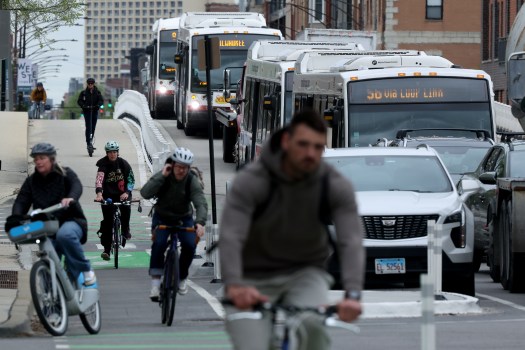
As a year-round bicycle commuter, I certainly prefer to have a lane of my own, whether it’s “protected” or not protected, because no one is really protected anywhere. Passengers still open their doors into a lane, pedestrians still cross without looking, runners still use the lane as a bicycle-themed track, e-bikes (many of which are just close cousins to motorcycles) and scooters still motor through way too fast, and shopping carts still get abandoned across lanes. Bike lanes in general are subject to trash (glass!), grates and broken pavement.
When it snows, the city of Chicago snowplows do a very good job in my area of cleaning up the streets. Unfortunately, the snow is pushed right into the bike lanes. Protected bike lanes rarely get plowed at all. During snowy winters, I have to choose between riding in the street or on top of frozen snow in my designated lane. Further, in my various routes, I frequently go from bike lane to no bike lane to protected bike lane, so I may be crossing car lanes to stay where I am supposed to be.
Sometimes, if I am turning onto a street that has a protected bike lane, it is confusing about where I am supposed to go because the parked cars block my view of the lane.
I don’t think there is a perfect solution for everyone. I’m not even sure there is a compromise without at least one demographic becoming irate. Ultimately, regardless of any discussion about lanes, it comes down to the following: Bicyclists need to ride in a socially appropriate manner, drivers need to care about anyone on wheels, pedestrians need to look both ways before crossing the street, side mirrors must be checked before doors are opened and people shouldn’t throw bottles out of their windows.
But if I could have one wish, I’d like for the city and those cleverly named snowplows to recognize some of us ride in all weather and need a clear path forward. Focus on the glass, the pedestrians, the grates and the potholes.
— Sarah Buck, Chicago
Driving has become harder
The rapid increase in bike lanes has made driving much more difficult and tedious, with numerous delays due to many streets being reduced to one lane in busy areas.
I live in Edgewater, and my travels frequently take me to Andersonville, Ravenswood, Lincoln Square and Roscoe Village. My primary road of choice is Damen Avenue. In many areas, what was once right-hand turn lanes are now bike lanes, requiring drivers going straight and those turning right to use the same lane. Drivers turning right are required to wait for pedestrians to cross, and those going straight must wait along with them. During busy times, intersections become jammed, and traffic slows down to a crawl.
Additionally, these bike lanes aren’t as busy as the city fathers probably thought they would be. It’s very frustrating to see so many empty bike lanes while there is a long line of cars waiting at a red light.
Worse, the advent of electric bicycles and scooters has made the activity in the bike lanes chaotic. Often, I see riders of manual and electric vehicles tussling for position, and they often swerve into the car lanes to pass each other.
Finally, more and more of these electric bicycles are going as fast as cars on streets where the speed limit is 25 or 30 mph. While cars are required to stop at stop signs, many of the bicycle riders just blow right through them. Are there no rules for them?
Recently, I followed an electric bike going between 25 and 30 mph north on Damen; the rider was interfering with both cars and other bicycle riders. At what point should these electric bikes be considered motorcycles and not bicycles?
The city installs all these bike lanes but neglects to enforce rules and regulations on the users. How frustrating is that?
— Michael Dunghe, Chicago
Ensuring we ‘stay in our lane’
Having been a Chicago resident for about 12 years, I do not own a car. I ride my bike, take public transportation or ride-share my way around the city.
Bike lanes on busy streets would be a blessing for bikers.
I’m nearly 70 years old; having reached this age by defensive biking. If I approach a congested intersection, I guide my bike to the crosswalk in order to be seen by drivers. If time allows, I motion to the drivers as to which direction I’m going. Several times, I’ve nearly been struck by drivers who are talking on their phones.
“Stay in your lane” is a phrase that has great applicability for what I have experienced on city streets. Bike lanes will help assure this
— Dave Williams, Chicago
Bike lanes an obvious need
People are riding bikes, lots of people and lots of bikes. They ride on sidewalks where there are no bike lanes. We know this. Bikes on sidewalks are a danger to pedestrians, period. Bikes on streets without bike lanes are a danger to bike riders. We know this.
Bike lanes are an obvious solution wherever practicable.
Bike lanes should not be for motorized bikes capable of going more than 25 mph. Those machines need to be licensed and insured and on the street with the cars.
— Roberta Jacobs-Meadway, Chicago
Keep lanes on side streets
In honor of Chicago Department of Transportation employee Riley O’Neil who was killed after being hit in a bike lane on Halsted Street, I suggest that all bike lanes on major streets, such as Halsted, be removed. Whoever thought it was a good idea to sandwich a bike lane between parked cars and heavy traffic lacks common sense. It was an accident waiting to happen, and unfortunately, O’Neil’s death was not the first in a similar situation.
How can city planners think that a bike lane sandwiched between two lanes of traffic on a very busy Roosevelt Road over the Chicago River is safe? Move bike lanes to side streets, preferably one-way streets, which have dramatically less traffic.
Our city is a grid with parallel streets, so it would be easy to find a nearby street very close to a main street to use as a bike lane. This would let traffic flow, which is so necessary for the vitality and economy of Chicago; provide a safer route for bikers; and ease the frustration of all of those on the streets of Chicago.
Common sense should prevail. This is not Copenhagen, which has wide boulevards where vehicles and bikes can be easily separated. This is Chicago, which has hundreds of miles of side streets that should be used for safe bike routes.
— Mike Kirchberg, Chicago
Consider raised bike lanes
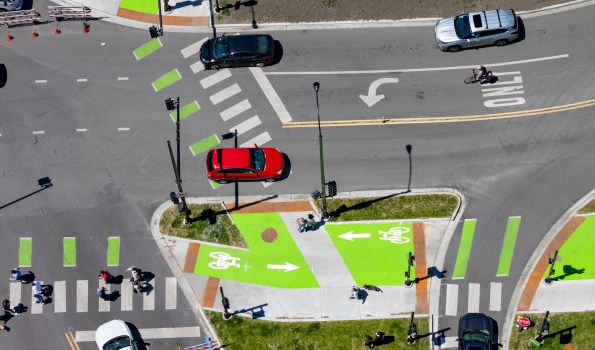
I was born and raised in Copenhagen, Denmark, where everyone from 5 to 100 years old ride bicycles! And it is safe and quite simple. The bike lane is raised a little from the street, and then the sidewalk is raised a little from the bike lane. In this way, cars simply cannot drive up on bike lanes, and parking is outside the bike lanes. Another safeguard is that when a bicycle reaches a traffic light, the cyclist cannot make a left turn, but must drive across the street and wait for the light to change there.
Despite the number of bike riders in Copenhagen, I have never encountered an accident. The only risk is that sometimes a visitor thinks that the bike lane is the sidewalk and will quickly hear a bike bell warning.
I am sure that on many major streets, an accommodation for a raised bike lane would be possible and might save lives.
— Karen E. Knutson, Glenview
What about a congestion charge?
I’m not sure why there is so much disdain for bike lanes in the city. Yes, there should be more bike lanes; the positives are well documented. They work in virtually every major city in Europe. They work in many other U.S. cities — the nation’s capital, for one.
What should be discussed is limiting the number of cars that come into Chicago, such as through a fee similar to what London has instituted, a congestion charge. Drivers park illegally in bike lanes, don’t know the rules of the road or right-of-way protocol, and they drive distracted and fail to even look for bikes, let alone pedestrians.
Fewer cars in areas where bike lanes are located would make the city safer and easier for everyone to navigate.
— Daryl Domask, Glen Ellyn
Submit a letter, of no more than 400 words, to the editor here or email letters@chicagotribune.com.