
Editor’s note: Here is a selection of letters from Tribune readers sharing thoughts on Chicago’s bike lanes. We will publish additional letters in the following days.
Chicagoans were riding bicycles on our streets before automobiles arrived. Today, cyclists are treated as lurking pests that are asking motorists to please surrender something that has always belonged to cars. But it has not.
Chicago’s streets are public space, and the right to move through that public space should not depend on owning a car.
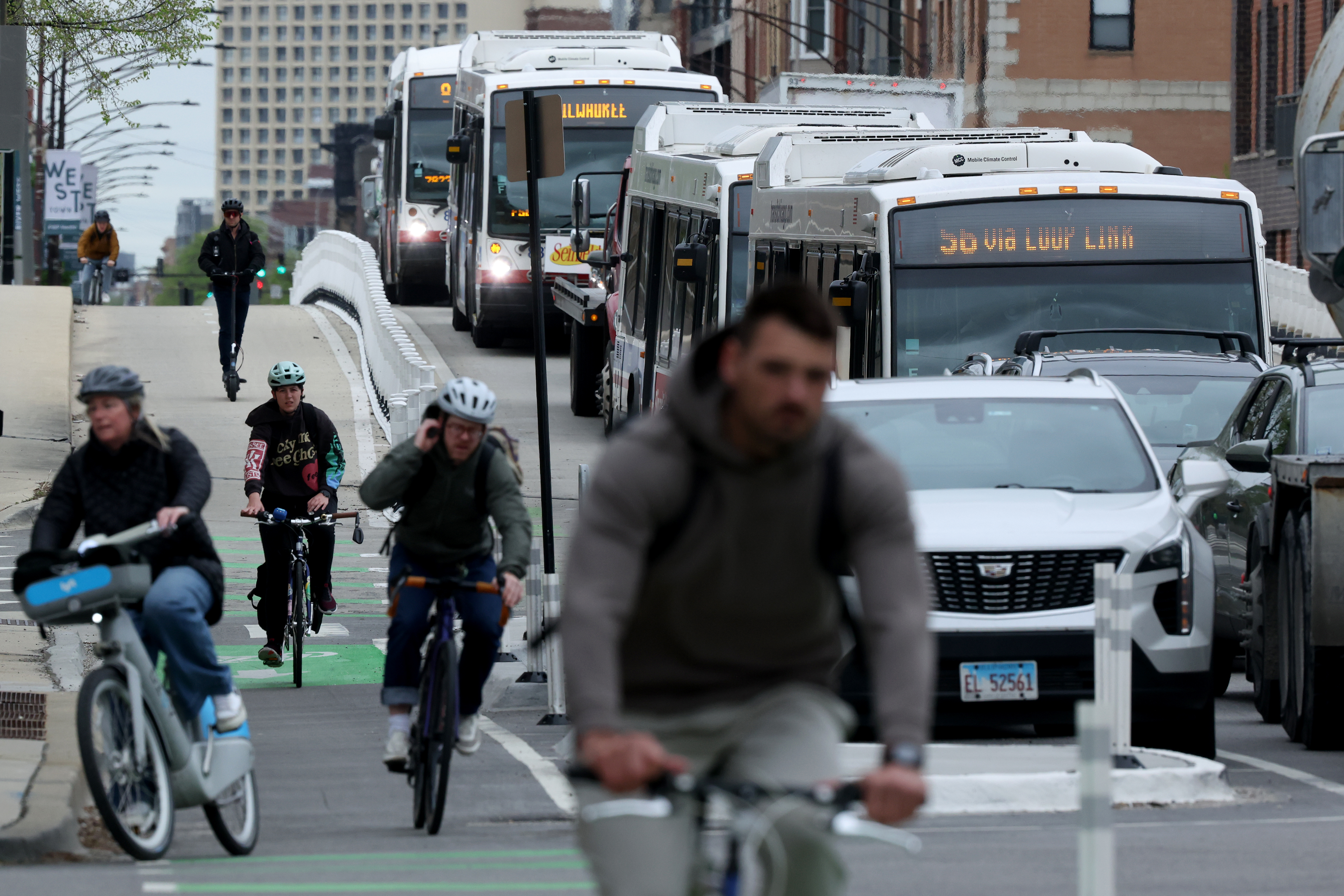
Protected bike lanes are part of something Chicago likes to excel at: transportation infrastructure. They are not favors. They allow students, workers, parents, older riders and cautious beginners to travel the city without placing their bodies beside fast-moving vehicles. As the Active Transportation Alliance says, “Protected bike lanes are proven to save lives, reduce injuries, and encourage more people to use bicycles as everyday transportation.”
Who doesn’t want to save lives, reduce injuries and encourage more people to bike?
Many of us are either too young to drive or cannot afford a car. Want a city that better supports artists? Invest in bike lanes. A bicycle costs vastly less to own and operate than a car. Safe cycling builds physical activity into daily life while reducing traffic, noise and competition for parking. Every trip shifted from a car to a bicycle leaves one fewer car competing for street space.
Who doesn’t want less traffic?
Protected bike lanes make movement more predictable: Cyclists have a clear path, and drivers know where to expect them.
Protected lanes may vex drivers, but a little delay or the loss of a parking space is not equivalent to a life-changing injury.
Chicago needs a connected citywide network of protected lanes, not isolated segments that disappear where riding becomes dangerous. Build them in every part of the city. Maintain them year-round. Design intersections so protection continues through the places where crashes are most likely. It can be done, and this is a city that can do it.
Bicycles are not a new arrival on Chicago’s roads. It is time our street design remembered that history and served the full public again. Stop treating bikes like Segways.
— James Pelton, Chicago
Better streets and neighborhoods
Every Chicagoan deserves safe, convenient and affordable options for getting around our city. Whether someone chooses to walk, bike, take transit or drive, our responsibility is the same: Build streets that make every trip safer.
We’re making significant progress. Since 2021, Chicago has reduced traffic fatalities by 30%, significantly outpacing the national decline over the same period. In 2025, 15 wards across Chicago achieved Vision Zero — meaning there were no traffic fatalities. That progress is the result of a deliberate, data-driven commitment to delivering proven safety improvements that move traffic at safer speeds, organize the street for everyone and save lives.
Bike infrastructure is a critical part of that work. We are working to build the safest, most affordable big city in America, and cycling is one of the most affordable ways to get around Chicago.
Since 2023, Chicago has completed more than 100 miles of bikeway projects, the vast majority designed as low-stress routes that are comfortable for riders of all ages and abilities. This has helped fuel a bicycling boom in Chicago, with the city’s Divvy bikeshare system continuing to break ridership records.
The benefits of safer infrastructure investments extend beyond people on bikes. Protected bike lanes help right-size overly wide travel lanes, encourage safer driving speeds, shorten pedestrian crossing distances and create more predictable streets for everyone.
Safe bike routes connect people to schools, parks, transit, jobs and neighborhood businesses. Recently, the Department of Transportation found no evidence that bike lanes hurt businesses in Chicago, reinforcing similar findings from cities across the country. Streets designed to prioritize people — not simply move as many cars as quickly as possible — become places where people want to shop, dine and spend time.
That’s why we’re building a city where safer streets and stronger neighborhoods go hand in hand. Traffic safety is community safety.
While a June 28 editorial (“Illinois and Chicago should move fast on Waymo approval”) presents autonomous vehicles as a cure-all for traffic fatalities, we’ll continue investing in what we know works: safer street design, stronger neighborhoods and a more vibrant city for everyone.
— Mayor Brandon Johnson and William Cheaks Jr., commissioner, Chicago Department of Transportation
Bike lane risks for pedestrians
I live on the west side of Dearborn Street, the bike lane side, on Printers Row. I’ve been here for 30 years. For 27 years, I enjoyed bicycling to the lakefront and then on the nice path to all the beaches.
As a child, I learned to ride safely in the streets, so I never felt the need for a designated path. Now I’m old, and I find these lanes dangerous for pedestrians! Our knees and hips make us slow, and those curbs are a menace in the winter when we try to cross the street and they can’t be seen.
I have been yelled at by cyclists to get out of the way when I am rightfully crossing the street. But to make matters worse, lots of folks are using the sidewalks for scooters and Divvy bikes. All wheels, except walkers and wheelchairs, should be on the street.
Also, again to the detriment of pedestrians, in the winter, the city plows the bike lanes, but we are left to slip and fall on the sidewalks. So we walk in the plowed bike lane and get cursed at by the cyclists.
There is no curb cut in front of the Transportation Building, so we have to carefully cross the bike lane to get to a taxi, and the cyclists have no mercy for us “grays.”
— Susan Ohde, Chicago
For the betterment of society
I support bike lanes that are protected in the city of Chicago. I don’t personally bike but have many friends who do. I care about their safety and well-being. I also believe in support for public sidewalks, public buses, public schools, public libraries and public parks. We live in a society where we share things, and my humanity is caught up in yours.
I realize that some people will choose to drive, but I believe society would be better if fewer people chose to drive because of cars’ effects on noise pollution, climate change and crossing of the street. There needs to be aggressive enforcement against bad drivers who run red lights and look at their phones.
Chicago should continue building protected bike lanes, which offer more protection than a line of paint. Traffic-calming measures should also continue to be expanded.
— Mawuli Grant Agbefe, Chicago
Encouragement is dangerous
As an avid bike rider and a resident of the Loop, I feel encouraging bikes and scooters is stupid and dangerous.
Bike lanes take up valuable space on very congested streets for the benefit of a few bikers and add to the exasperation of motorists who are challenged to be aware of bikers who appear to feel traffic laws don’t apply to them.
Biking through the city: good in theory but untenable in reality.
— Nancy Kumskis, Chicago
Bike infrastructure benefits city
Bike lanes are a fundamental component of good urban planning and traffic management. Protected bike lanes in particular encourage people to give it a whirl who want to bike but are too scared to because of cars. That is a beautiful thing that we should encourage and expand.
Bike lanes benefit drivers too. People speed in our cities or commit illogical moving violations, which cause others to become angry. Anger, impatience and disrespect on our streets come from our lopsided built environment that causes some drivers to feel entitled.
There is an average of about 300 car crashes a day in Chicago. Narrowing lanes and defining space better organize roads so people can better predict what’s going to happen in front of them. That makes decision-making less stressful and causes traffic to run more consistently because drivers make fewer errors.
In my mind, anything that makes things run more smoothly on our streets is better for all of us.
— Alex LaBee, Chicago
Protected bike lanes are a farce
With the city so in debt, how is it justified spending money on specialized bike lanes? Is there really any unbiased proof that they save lives? I suspect they cause more accidents. They reduce street width, causing accidents from car doors opening or pedestrians unexpectedly appearing while crossing in the middle of a block.
Chicago is not a bike-friendly city four months out of the year because of the weather. Snow in the winter and leaves in the fall fill bike lanes, making them dangerous to use. Protected lanes are difficult to clean.
To see just how ridiculous the new bike lanes are, drive on Belmont Avenue from Kimball Avenue to the Chicago River.
The city should abandon this expensive and unneeded farce, concentrate on keeping streets wide and, where needed, paint bike lanes between the street and parked cars. Those painted lanes should be as wide as possible, periodically repainted every several years to draw attention to them.
— Jim LaChapelle, Chicago
Painted lanes are no protection
Painting stripes on the street cannot protect cyclists. A driver turns to peek out the window to check for an oncoming bicycle. But with parked cars lined up behind, he or she may not be able to see very far back, to see a cyclist moving at 15 mph, who will only become visible after the driver has straightened up and begun to open their door.
Accidents will happen, no matter how careful we try to be. Cars have seatbelts, crush zones and air bags. And what protects cyclists — stripes on the pavement?
Our real mass transportation system was designed to serve those who operate a ton or more of rolling steel. You can’t safely mix a bicycle with that.
— Gerry Shacter, Buffalo Grove
Encourage use of fewer cars
Considering what we know about the effects of the mass use of private cars (greenhouse gases, reliance on fossil fuels, tire particulates), anything that makes it easier for more people to get around without a car is an obvious good.
In addition, I’ve noticed that violating speed limits becomes much more difficult, if not physically impossible, on streets with fewer and narrower car lanes — something that you’d think the “law and order” crowd would be in favor of.
— Isaac Gibson, Chicago
Balance the needs of everyone
I use all modes of transportation, but I do not support the continued expansion of bike lanes or many of the Complete Streets projects the Chicago Department of Transportation is promoting. While these changes are intended to improve safety, it is not always clear that they accomplish that goal. For example, how does extending sidewalks into intersections, placing pedestrians closer to moving traffic, make them safer?
On major streets, bike lanes often reduce road capacity, increasing congestion and travel times for drivers and buses alike. More vehicles sitting in traffic also means more emissions. Bike routes have an important place in Chicago, but they should be concentrated on lower-volume side streets whenever possible, allowing cyclists to travel safely without severely impacting the city’s primary transportation corridors.
Chicago’s transportation policies should balance the needs of everyone who uses our streets.
— David Bell, Chicago
City streets are unsuitable
I grew up in the 1950s and ’60s, long before anyone was talking about bike lanes. We rode our bikes everywhere then.
I met my future wife in high school. She lived 5 miles away, and I often rode my bike there. A few times, I rode on Irving Park and Western Avenue, but that was too dangerous. So I rode on side streets.
In 1995, I got a job in a nearby suburb, and for three years, I rode my bike to work year-round. No bike lanes necessary.
I understand the push for bikes today, but city streets were not made for another lane. So bike lanes are created at the expense of a car lane or parking spaces. I think that’s a big price to pay.
We have bike lanes springing up in my area, and, honestly, they often seem comical. There might be a milelong bike lane that suddenly ends, with nowhere to go.
People who ride bikes ride them for two reasons: to go somewhere or just for the exercise and fun of it. If they are going somewhere, they are not going to look for maps of bike lanes. And if for fun or exercise, they want longer bike paths than random bike lanes here or there.
— Larry Craig, Wilmette
More protected lanes needed
Governmental support of bicyclists is of the greatest importance. Bicycling takes cars off the roads, instills healthy behavior and provides an affordable way to travel in the city. Chicago’s past efforts to promote safe biking are admirable but not nearly enough.
Bicyclists must be fully separated from motorists. Painting bike lanes on busy arterial streets places riders at great risk. Not only are moving vehicles dangerous, doors of parked cars that are flung open can be catastrophic to riders in these lanes, as we have recently seen. We need more, many more, dedicated bike lanes that are physically separate from vehicles, both in motion and parked.
— Thomas Novicki, Chicago
Protected lanes and predictability
I haven’t used a bicycle in years, but as a city dweller and driver, I love to see my streets get upgraded with protected bike lanes. Why? Because protected lanes provide predictability — I know exactly where the cyclists are going to be, and I don’t have to worry about endangering them with my car.
Better still, the protected lanes prevent other drivers from using bike lanes as an illegal passing lane or parking spot, so I don’t get penalized for following the rules. I hope to see more protected lanes in our future and more cyclists using them.
— Benjamin Recchie, Chicago
Make more streets one-way
If most Chicago streets were one-way, there would be room for bike lanes, bus lanes and parking. And on the major thoroughfares, the green lights could be timed to a set speed of 25 mph. Sounds like a win, win, win and win.
— Richard Bruyere, Plainfield
Submit a letter, of no more than 400 words, to the editor here or email letters@chicagotribune.com.