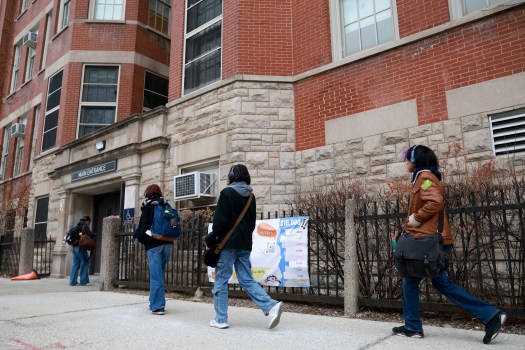

Zamara Ramos, 14, stood at the center of a crowd at the red-brick entrance of the Chicago High School for the Arts Tuesday morning. Beside her, dozens of her classmates raised hand-drawn posters: “Stop cuts, save the arts.”
“Since I was little, I’ve always wanted to be an actress,” Ramos said. “They’re breaking up hopes and dreams.”
ChiArts is known for its conservatory model, which allows students to dedicate three hours each afternoon to their chosen arts discipline. But next year, Chicago Public Schools will assume management of the Humboldt Park contract school — and its current 8 a.m. to 5 p.m. schedule will likely change.
Citing labor and funding constraints, the district has proposed embedding arts lessons throughout the day, and ending the school day at 3:30 p.m. Students could still opt into an additional 100 minutes of after-school arts programs.
Some families and educators, however, say compressing the model would strip away what makes ChiArts unique. Parents were informed of the potential changes at a community meeting last week.
“It’s a gem to be at a school that incorporates the arts,” said Ramos’ mom, Rousemary Vega. “Taking it and making it an after-school program makes it an option, not an arts school. It’s not what they came for.”

The Board of Education voted unanimously in November to absorb ChiArts, after its nonprofit operator said it would not seek a contract renewal. School officials pointed to rising operating costs and an “unsustainable” deficit.
As a contract school, ChiArts currently receives CPS funding based on enrollment, but an independent board manages day-to-day operations. During the 2023 fiscal year, the most recent publicly available data, the school received $6.3 million from CPS, accounting for half its revenue. ChiArts serves about 540 students, and opened in 2009.
Unchanged, the conservancy model would also cost CPS $2.5 million to maintain annually, according to Conrad Timbers-Ausar, the district’s acting chief portfolio officer. That doesn’t include the cost to fund the academic portion of that day.
“One of the reasons why we’re here is that the model is not sustainable,” Timbers-Ausar told the Tribune in an interview last week. “That’s the basis of the issue, right?”
Under the proposed new model, ChiArts would operate similarly to the district’s 72 fine arts and performing arts magnet schools. Timbers-Ausar said that the goal is to maintain the conservatory model to the “greatest extent practicable.”
Due to contractual agreements, the school day has to be limited to 7 hours and 15 minutes, he added. “We had to look at, what are the guardrails? What is the framework to put this square peg into a circle, and how can we figure that out?” Timbers-Ausar said.
ChiArts parent Lisa Miranda argued that embedding lessons throughout the day creates a “compressed” schedule that disrupts traditional academics. Students will be unable to take non-arts electives, she said.
Miranda also voiced concerns that her daughter — who has an Individualized education plan providing specialized instruction — might have little flexibility throughout the day if she needs accommodations.
“They’ve made (the schedule) so tight. Students can’t do more than the bare minimum,” Miranda said. “Yes, it costs money, but you can leverage what we’re doing here.”

The school’s teaching model may also shift. Currently, conservatory classes are taught by professional, practicing artists in each discipline, which includes theater, visual arts and music. But all teachers within CPS must have a teaching license from the state.
Risha Tenae Hill, a teaching artist at the ChiArts theater conservatory, urged the district to retain the school’s current academic and conservatory staff.
“We aren’t asking CPS to just keep the lights on,” Hill said. “We are asking to keep the soul of the school intact.”
A CPS spokesperson said in a statement that the district remains committed to developing a plan that is “creative, realistic, and financially-solvent.” Conversations with the ChiArts community are ongoing, the district said.
“We remain committed to continuing productive conversations with families, staff, and district partners to ensure ChiArts’ future reflects both its artistic excellence and its responsibility as a public school,” the spokesperson said.
Outside of ChiArts, two students leaned outside of the building’s second-floor windows, peering down towards the crowd gathering below. Student body president Samantha Gonzalez, a junior studying musical theater, said ChiArts has helped her find opportunities to pursue acting professionally.
“If our classes and schedules were to change, my experience would not have been the same,” Gonzalez said. “CPS … I urge you to listen to your community and students like me.”