

The Lake Township Community Center was accepting donations for those impacted by Tuesday night’s storm. Inside the center, a handful of first responders sat at long, plastic tables eating hot food that was set out potluck-style.
Throughout Thursday morning and afternoon, people drove up to the center to donate items like cases of water, cleaning supplies and food.
Jane Andriese and Grace Matke, both of Lowell, came by Thursday to donate bread, lunch meat, cheese, fruit, granola bars, and other food items for the first responders and community members impacted by the storm.
“I grew up here, so it’s touched home,” Andriese said. “It’s part of our community. We wanted to give back.”
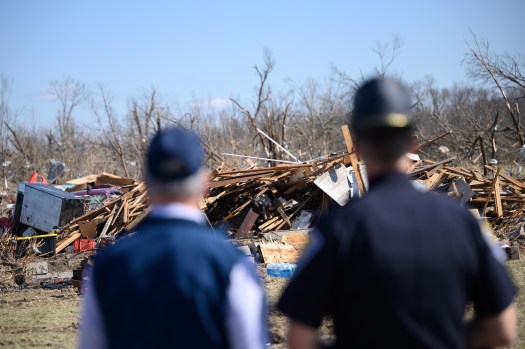
Gov. Mike Braun had an aerial survey of the storm damage around Lake Village, which was heavily hit by the storm, Thursday afternoon. Shortly before 1:30 p.m., he landed in a helicopter outside the Lake Village Fire Department, where he took some time to meet with first responders.
Kankakee, Illinois, across the Kankakee River from Lake Village, also suffered heavy damage in the storms.

Seeing the damage from the air, Braun said, “It was a little worse than we thought it would be.”
“Where it hit, it just seemed like it took everything out,” Braun said.
Over the last few years, Indiana has been hit by storms from the south and the north “harder than it used to be,” Braun said.
“Every time it occurs, it amazes me how the communities step up to do what always happens when you have a tragedy. This is no different,” Braun said.
After seeing the damage, Braun said he will head back to Indianapolis and consider what the state can do to support rebuilding efforts. Braun said he would also talk to federal officials Thursday afternoon to see what support could come from the federal level.
“We’ll see what we can do to make this as effortless as possible to get you back to where you were before,” Braun said.
Addressing the two people who died as a result of the storm, Braun said, “that’s always a tragedy.”

Newton County Coroner Scott McCord identified the victims as Edward L Kozlowski, 89, and his wife, Arlene Kozlowski, 84. Their preliminary cause of death has been ruled as “multiple blunt force trauma” and an autopsy is scheduled for Friday morning at the Tippecanoe County Coroner’s Office in Lafayette, Indiana.
Braun drove throughout Lake Village to assess the damage further, stopping at the Kozlowski home to assess the damage.
First responders searched hundreds of homes in the aftermath of the tornado, “in the dark, under difficult terrain,” and in sometimes dangerous conditions, given the downed power lines, Sgt. Glen Fifield, public information officer for the Indiana State Police-Lowell Post, said during a news conference Wednesday afternoon.
“They did the best they could,” he said, adding searchers located people with injuries as well as the two people who died in the storm.
A secondary round of searches Wednesday did not yield any additional victims, he said.
Of the buildings inspected Wednesday in the direct path of the tornado, Fifield said 24 had minor damage and another 18 had extensive damage. Additionally, there were seven hazmat incidents, which included gasoline and propane tank leaks.
More than 235 structures were damaged in the storm.
Barb Deardorff, who lives near Tefft, said Tuesday night’s storm damaged her pool cover, uprooted a tree, and left debris in her yard that’s not from her one-story farmhouse. The homes around her were also impacted, she said, with one house losing its roof.
“It was a pretty stark scene,” Deardorff said.
For most of the storm, Deardorff said she took shelter in a room in the basement that has concrete walls on three sides. When she heard that a tornado was headed toward Tefft and Dunns Bridge, Deardorff said she moved under a table in the room.
“You could hear, it sounded really wild outside,” Deardroff said. “I was hoping that the worst was going to miss me.”
Ultimately, Deardorff said the tornado passed by a half-mile south of her house.
Hugh Ulrich said he’s complained about Newton County many times in his life, but its people will never be among them now.

If it weren’t for the few out assessing the devastation after the tornado ripped through his friends’ front yard Tuesday night, no one likely would have found him trapped in his white Ford F150, out of which he’s lived for the past few years, felled trees piled on top and around it. He’d watched their house implode and knew immediately that no one could have survived.
Wednesday, he gratefully ate some sloppy Joe meat and potato salad that American Red Cross volunteers plated for him at its emergency shelter in North Newton Junior/Senior High School. “I still can’t believe I survived.”
Ulrich said he’d just left Phil’s on U.S. 41 and Ind. 10 when he heard the storm was heading their way. He stopped at his friend’s yard and thought he had what he would do figured out when he saw the massive black cloud heading his way.
“It reached the ground, and it got a hold of my truck,” Ulrich said. “Then a tree came in the passenger side, and there was spinning, but then it put me down and obliterated the house. Then I started shouting because I wasn’t going to be able to get out.
“I’ve been through so much these last few years and survived, and now a tornado. I’ve been missing my parents quite a lot lately, and I kind of thought this would’ve been a good day so I can join them,” Ulrich said.
Nikki and Scott Hanger also barely escaped the tornado’s path, their daughter-in-law Jill Hanger said Wednesday afternoon. The family was texting them all evening to get to safety, but Scott Hanger fought it until the last minute.
“He said, ‘I’ve been here for 36 years and rode out the other storms,’ but we told him this one felt different,” she said. “By the time they got out of the driveway to head to the fire department, the hail started coming down.”
When they came back to their house off Old U.S. 41, they found a whole wall to the outside blown off.
“We’re here grabbing all the sentimental stuff: photos we haven’t digitized, statuettes our great-grandfather painted and the important documents, but those were in the safe,” Jill Hanger said.
“Even the cat was safe,” said another of the Hangers’ relatives who declined to give her name. “She was in the bathroom, and she’s not a very friendly cat to people, but when we opened the door, she ran right to us.”

Brody Georgeff, 4, happily chattered about the houseguests he now has, Ernie and Rosie the donkeys, who are safe in his parents’ garage at the moment, as he walked with his aunt, Cindy McMahon, down the road where Ulrich’s truck was. McMahon was shocked at the level of damage as Department of Homeland Security workers examined the scene.
“I’m not one of those people who get crazy about storms, so we were watching the sky get all black,” she said. “We then went to my brother’s house and went into the concrete room in his basement with snacks and thought it was just going to be another storm.”
When she got home, she discovered it wasn’t.
“My patio doors had blown open, and there was hail inside my house,” McMahon said.
Kevin Donofrio, science and operations officer for the National Weather Service’s Chicago office, said Tuesday night’s storm was a “supercell thunderstorm.”
“We don’t get a lot of these in our area,” Donofrio said. “A supercell thunderstorm is just a thunderstorm that’s rotating.”
The storm took shape in central Illinois, Donofrio said, near Livingston County, and it became tornadic once it arrived in Kankakee County. A long-lived supercell tornadic thunderstorm — which is the first indication that a storm might become a tornado — continued through Kankakee County before moving to Indiana.
The storm most affected Newton and Jasper counties in Northwest Indiana, he added, before it moved to the state’s north central region.
“That was the thunderstorm that went on to produce a series of tornadoes,” Donofrio said.
As of about 10:45 a.m. Wednesday, Donofrio said the National Weather Service could confirm that at least four tornadoes came out of that storm, including Illinois’ Livingston and Kankakee counties, and Lake Village and Wheatfield, Indiana.
On Wednesday morning, the Chicago office’s team was learning the storm’s specifics, including its path, whether it was one “long-lived tornado,” and its strength.
In northeast Illinois and Northwest Indiana, peak tornado season is April, May and June, but in the last couple of years, the regions have seen more tornadoes in March, Donofrio said.
“They have the potential to be much stronger, which is what we were seeing with this storm,” Donofrio added. “These supercell storms, these are more common in the plains … And they have the potential to last longer, but they also have the potential to be stronger.”
Through the rest of the week, Donofrio expects to see several storms as the weather cools down and snow falls. Meteorologists don’t expect to see active severe weather, Donofrio said.

“You should still have a plan in place for where you’re going to go if you get a warning for your area and need to take cover,” he said. “And just in general, stay in tune with your latest forecast.”
Although Gary wasn’t hit by a tornado Tuesday night, Mayor Eddie Melton said the city plans to help with local communities that were hit by the storm.
“Lives were lost because of the rain, the storm and the wind,” Melton said. “I just want to thank all the public safety officials that worked tirelessly last night to help.”
The rain, hail, high winds and tornadoes Tuesday resulted in 11,088 NIPSCO customers losing power at the peak of the storm, the utility company said. The National Weather Service confirmed to NIPSCO that a supercell created four tornadoes across Newton, Jasper and Starke counties.
NIPSCO said Thursday at 2 p.m. that 93% of the 13,244 total affected customers had their power restored. Crews were still out Thursday restoring power, with a focus on Lake Village and Demotte, which were hardest hit.
The most impacted areas were Lake Village, Gary, Demotte, Hobart, Merrillville and Griffith, according to NIPSCO.
NIPSCO also reported damage to its Dunns Bridge I and Dunns Bridge II solar farms in Starke and Jasper counties as a result of the storm, according to a statement from the utility company.
While monitoring the storm in real time, NIPSCO employees “moved in to assess conditions and respond as soon as it was safe to do so,” according to the statement. Debris from the damage could have been displaced, the company said, and it’s working to secure, assess and respond to the area.

“We recognize there may be questions and concerns about potential environmental impacts related to the damage at the solar farm. Solar panel leaching concerns have been thoroughly evaluated in industry-leading research, which shows that the risk is extremely low,” the company said in the statement. “Overall, the available evidence demonstrates that both crystalline silicon and thin-film PV modules do not pose a meaningful risk of environmental or human exposure from leaching, even when damaged.”
As of Thursday afternoon, Lake Village reported 633 power outages and Demotte reported 189 power outages. Hobart, Merrillville and Wheatfield didn’t have power outages reported.
NIPSCO crews worked to assess damage, make repairs and restore power “as safely and quickly as possible.” Beyond power outages, NIPSCO reported broken poles and cross arms, as well as downed trees and power lines.
For safety, people should avoid downed power lines, damaged poles or other hazardous situations. Downed wires should be treated as live wires, so people should stay 30 feet away from downed wires, NIPSCO said.
In one of a series of live updates throughout Wednesday, Shannon Cothran, the Newton County sheriff, said the fire department conducted a second-day search and rescue throughout the community.
He also asked residents to call 211 to report storm damage.
County Commissioner Abby Rossiter urged residents whose homes were damaged by the tornado to take shelter at North Newton Junior-Senior High School in Morocco, given the return of cold weather. The school will offer shelter through Sunday.
“Please take care of yourself,” she said.
akukulka@post-trib.com; mwilkins@chicagotribune.com; alavalley@chicagotribune.com; Michelle L. Quinn is a freelance reporter for the Post-Tribune.