
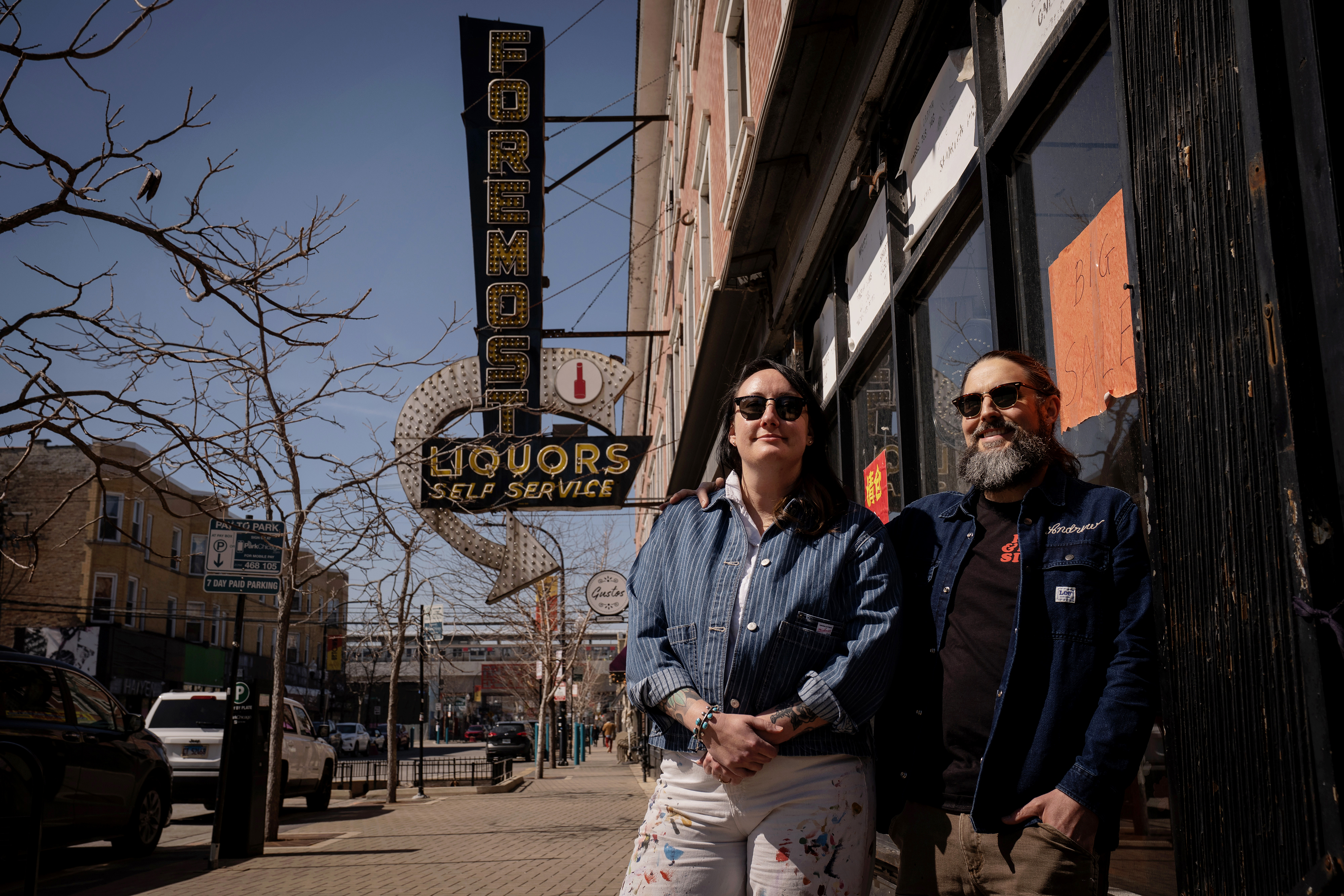

Whether painted, wood, bulb or neon, Chicago signs have a special place in the hearts of enthusiasts who aim to bring a new museum to the city.
The Chicago Sign Museum officially got its name last year, said Kelsey McClellan, who founded the organization with her partner, Andrew McClellan. Its purpose is to provide education on historic Chicago signs and play an active role in their preservation as they face extinction.
Although the Chicago Sign Museum doesn’t have a physical space yet, it has hosted sign tours around the city, put out sign maps, helped business owners restore their vintage signs and spread the word to sign owners about the city’s updated code.
“These signs give us an opportunity to tell the stories of our history and our individual experiences in the city,” McClellan said.
McClellan was already painting signs to pay the bills in 2011 when she went to study at the School of the Art Institute of Chicago. One day, she passed a business’s gold leaf sign and said she was “enamored.” She contacted the artist who signed the work and learned the craft from him.
Now, McClellan specializes in gold leaf, which she described as making reflective signs with thin, beaten sheets of real gold, specialized glue and paint. The McClellans run Heart and Bone Signs, a sign-painting business.
They are part of a rich history of sign makers in Chicago. Tod Swormstedt, the founder and curator of the American Sign Museum in Cincinnati, pointed to well-known sign companies with Chicago roots, such as Federal Heath Sign Company.Perhaps the most influential Chicago sign company was Beverly Sign Company in the ’40s, Swormstedt said. He wrote the foreword for “The Golden Era of Sign Design: The Rediscovered Sketches of Beverly Sign Co,” which the McClellans wrote. Beverly Sign Company helped stylize the use of panels and introduced more color to the signage world, Swormstedt said. Its contributions spread across the country.
“It was a Beverly’s take on sign design that became the Chicago look,” Swormstedt said.
But now, McClellan and others in the field warn that Chicago’s sign history is at risk of erasure. McClellan said she’s noticed the disappearance of more and more signs since the COVID-19 pandemic. In the fall, McClellan created a map detailing some of Chicago’s most iconic signs, such as the Erie-LaSalle Body Shop sign on the family-owned auto shop. But it has already come down after the owner sold the business to a national auto chain.
For McClellan, keeping signs standing is the best way to keep the movement alive. Signs tell the stories of immigrants and Chicago natives alike who invested in their small businesses and used them to signal the store’s value, McClellan explained. She recently worked with Foremost Liquors in Uptown in hopes of moving the store’s historic bulb sign to its new building. But McClellan said the sign came down a few weeks ago and was sold to a private collector.
Signs often become endangered when corporations buy up locally owned stores, McClellan said. It creates an attractive opportunity for small business owners to sell the signs to private collectors on their way out.

Martin Treu, 69, said another reason historic signs are disappearing is that they’re expensive to maintain. Treu recently became involved with the Chicago Sign Museum, but he’s had an interest in signs for much longer. He’s written a book on them called “Signs, Streets, and Storefronts” and said he was involved in writing Sarasota, Florida’s sign code in ’89.
He was also involved with successful efforts to update Chicago’s sign code in 2023. Before, Treu said the code had so many restrictions that it was nearly impossible for sign owners to update old signs. Now, the city has much more friendly rules on the books, Treu said, like one that allows sign owners with signs designated by the city as “vintage” to take the sign down for maintenance and put it back up as it was before.
He and McClellan have been working to educate sign owners on the updated code and how it affects them, as many still haven’t heard about it, the two said.
“There’s a lot of burden on historic sign owners, and they need even more help than they’ve got,” Treu said.
Column: Sign painting is not yet a lost art — these artists still create them by hand
Central Camera Co., a Chicago camera store open since 1899, feels the burden of maintaining its iconic neon sign that has hung over the Loop storefront since shortly after the location opened in 1929, said owner Albert Don Flesch. It’s difficult to find someone who can repair neon at an affordable price, Flesch said.
The McClellans restored Central Camera’s storefront earlier this year for free, handpainting the windows to recreate signage destroyed in a fire a few years back. Flesch said he appreciated their work in keeping the sign’s memories and feelings alive with the restoration. His grandfather founded Central Camera, and it was his childhood dream to work at the store. Flesch said Central Camera has become his legacy.“It’s nice to have history come alive again,” Flesch said.
McClellan also saves signs. She said her biggest preservation effort occurred in 2022 when she saved two “ghost signs” — faded signs painted on the side of buildings — on a Ravenswood building from demolition. She kept one sign, and the American Sign Museum has the other. Soon, the Chicago Sign Museum will be able to offer tax write-offs for signs donated by their owners, McClellan said.
Handpainted signs are worth saving, McClellan said, because they’ve become less common after vinyl graphics and large format printing technologies came out a few decades ago — driving sign making to become quicker and cheaper when made by a machine.
“Nearly overnight, thousands of sign painters lost their jobs, and all of this knowledge was lost in the industry,” McClellan said.
But the sign industry in Chicago still lives on. Swormstedt pointed to the Chicago BrushMasters, who pass on their skills to upcoming sign painters and run charity events. And he sees people develop an interest in signs through his work.
“I know people come to (the American Sign Museum) and say, ‘These signs are really cool. Why don’t we have signs like this anymore?’” Swormstedt said.
McClellan hopes the Chicago Sign Museum will generate the same appreciation among Chicagoans. The museum will soon have nonprofit status, McClellan said, and she’s on the hunt for physical locations to move into permanently.
McClellan said that one of the most rewarding parts of leading the Chicago Sign Museum is hearing people share memories involving their favorite Chicago signs. It’s this type of connection that makes the signs crucial for her to save.
“We’re at a critical moment in time where we need to collectively decide whether these signs are important to keep and maintain or if we’re okay with Chicago losing that part of its identity,” McClellan said.


