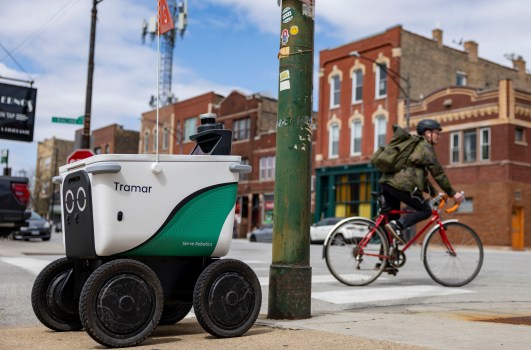

Food delivery robots are now ubiquitous in parts of Chicago, cruising down crowded sidewalks and scooching themselves through crosswalks. But sometimes the robots get themselves into pickles as they deliver tuna sandwiches and other fare to the city’s human denizens.
The lunch boxes on wheels have tumbled down subway stairs, crashed through bus shelters and even, in one case, learned to say “sorry.”
The sidewalk bots, operated by Serve and Coco Robotics, both California-based companies, have cruised thousands of Windy City miles without significant incident in recent months.
But there have been some significant episodes — such as one case this year in which a robot collided head-on with a Divvy biker in Lakeview.
Some incidents, like the bus shelter crashes, have become flashpoints in an ongoing debate: In a city where advocates have long argued that pedestrians are sidelined by cars on the city’s public way, should those pedestrians have to cede the sidewalk to robots?
“I take it on good faith that both companies know that they have a very low margin for error and tolerance from the public for things like this,” said Ald. Brian Hopkins, in whose 2nd Ward a Coco delivery robot collided with a city bus shelter March 24, leaving glass shards strewn across the sidewalk.
The robots are on trial as the companies operate under a pilot program that expires in May 2027. Chicago’s City Council would need to take action to allow the robots to stay in Chicago after next spring.
Hopkins, for one, said he was reserving final judgment on the robots’ future prospects for the time being. “If this bus shelter incident is the worst of the errors,” Hopkins said, “they’re probably in pretty good shape.”
But his colleague Ald. Walter Redmond Burnett of the 27th Ward, where surveillance footage showed a Serve robot rolling directly into a bus shelter and shattering it last month, said that “as it currently stands, Serve isn’t doing enough to prioritize the safety of our citizens.”
Serve and Coco say that serious incidents like the bus shelter crashes are rare. A review of city records shows the companies have jointly self-reported few incidents in the first months of the year, a time period in which the robots have made thousands of deliveries.
Serve, for its part, has owned up to its bus shelter crash with a cheeky ad at the site of the collision. “Dear West Town neighbors, I took ‘breaking into the market’ too literally,” reads the ad, which features an image of the guilty robot, Nasir.
“I’m really sorry about the bus stop…and the dramatic entrance. I promise to do better,” the ad says. Nasir’s digital display reads, “Nasir is sorry.”
Robot defenders say the bots take cars — which cause pollution and wreak plenty of havoc of their own in Chicago — off the roads.

“Every delivery we do is one fewer car trip,” Serve’s CEO, Ali Kashani, said in an interview with the Tribune. “There is a big difference between what could happen when a car has an accident versus what happens when a robot has an accident.”
Coco’s head of government relations and safety, Carl Hansen, said the robots help reduce delivery costs and help restaurants fulfill more orders during peak hours. “Our mission is to make local delivery safer, more sustainable, and more cost-effective for the communities we serve,” he said in a statement.
A review of recent robot safety incident reports shows the March crashes were not the first time the robots had run-ins with the city’s mass transit infrastructure.
Earlier this year, a Serve robot named Veruca was cruising down the sidewalk near the CTA’s Chicago Blue Line stop when it approached the station’s entrance and tumbled down the subway stairs, according to an incident report the company submitted to the city.
The cause of the fall?
“This incident was a result of our bot not recognizing the stairwell,” Serve concluded.

And in December, a Coco bot was “bumped” by a train at a Metra train crossing in snowy weather, according to an incident report submitted by the company to the city.
Hansen explained the minor collision, which resulted in no damage to either the robot or the train, occurred after “bystanders” attempted to assist the robot in the snow.
The bystanders “placed [the bot] in a position it would not have reached on its own,” Hansen said in a statement. “When the train approached, the pedestrians returned to the curb, but Coco was bumped at low speed.”
A more serious collision occurred when a Serve robot collided head-on with a person riding a Divvy bike on the sidewalk — which is generally prohibited in Chicago — in Lakeview.
Serve’s incident report said the pedestrian fell off their bike and “remained on the ground” for about a minute while bystanders offered assistance.
The company said it attempted to contact the bicyclist to offer an insurance claim.
When asked about the incident, Serve said “the rider said they were doing well and no further action is necessary.” Regarding the robot that fell down the subway stairs, Serve said the incident led to specific changes that have already been implemented.

The Tribune obtained details of recent robot safety incidents via a Freedom of Information Act request to the city’s Department of Business Affairs and Consumer Protection, which oversees the robot pilot in conjunction with Chicago’s Department of Transportation.
In a joint statement, the city departments said they communicate with Serve and Coco “regularly” about safety incidents and data reporting requirements. “We have asked both companies to share any details about the root causes of the incidents when they become available,” the departments said.
Both companies say that they make specific improvements to their technology or procedures in response to robot mishaps. Both said they paid for the bus shelters their robots damaged.
The Serve bus shelter crash in West Town was caused by a sensor failure, Kashani told the Tribune.
The CEO explained that the robots have several different sensors, which should theoretically ensure successful hazard identification even if one of the sensors fails.
“This was a case where all of the sensors did not see the glass, which, frankly, has never happened before,” Kashani said.
He said the company had already made updates to the company’s software to help robots better identify locations that could be high-risk.
Kashani offered an unqualified mea culpa on the issue. “It is our responsibility and our fault,” he said.

Unlike the Serve crash, the Coco crash was caused when a member of the company’s remote operations team “made a decision to navigate around one of the (bus) shelter posts through the shelter,” Hansen said.
Coco uses human operators to monitor its robots’ progress and jump in to help them navigate trickier aspects of the urban environment, such as construction zones. Last year, the company’s CEO, Zach Rash, told the Tribune the remote team was made up primarily of “college kids who are good at video games.”
“Muted lighting due to weather conditions made the bus shelter glass difficult to detect through the robot’s sensors,” Hansen told the Tribune, leading to the remote operator’s decision to direct the robot through the bus shelter.
Hansen said Coco takes “full responsibility” for the crash and said the company was adding training for its remote bot operators in addition to making improvements to how its systems interact with “complex urban infrastructure like glass structures.”
But despite plenty of public conversation about safety concerns, the robots seem to touch a more visceral nerve for some Chicagoans, and criticism of the bots sometimes borders on the philosophical. Some point out that the robots are doing jobs that would have once been done by people.
Lincoln Park resident Josh Robertson started a petition to pause the pilot program. He said the petition has garnered more than 4,300 signatures and hundreds of robot-related incident reports, running the gamut from collisions with people or pets, to obstructions of the sidewalk and even injuries.
But Robertson noted that in addition to concerns about safety and accessibility, the robots have become an “acute manifestation” of anxieties people feel about the changing role of technology in their daily lives.
The robots, he said, bring those anxieties home, “at street level.”
tasoglin@chicagotribune.com