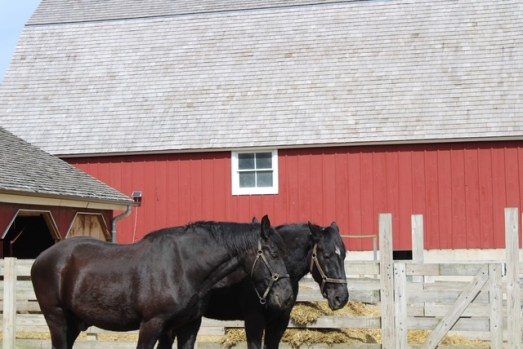

The sale of Glenview Park District’s “celebrity” horses, Bill and Bob, has ignited a furor on social media amid concerns that the district put them up for public auction, which could have ended with the pair being sold for horse meat, according to an official at a horse rescue organization.
The two draft horses have been a part of Historic Wagner Farm, managed by the Glenview Park District, for nearly a decade, supporting the farm’s educational programming through tractor rides and other demonstrations, according to an April 14 statement on the farm’s Facebook page.
Bill and Bob retired two years ago from their public-facing duties due to their age and inability to keep up with the physical demands of the job, the post detailed, and were succeeded by two new horses while still remaining on the farm.
Wagner Farm’s Division Director of Recreation and Museum Services Steve Neill said since Bill and Bob are publicly owned, they had to go through a public process to be sold and thus the farm placed them in a public auction.
Historic Wagner Farm is no longer able to provide “full retirement care long-term” for the horses, and they were subsequently put up for auction, according to Victor Garcia, a member of the board of directors at Glory Bound Rescue Ranch in Marengo, in McHenry County.
Garcia sent a buyer to purchase the horses on Tuesday, April 14 after learning late the previous evening they were being put up for auction.
Glory Bound Rescue Ranch is a non-profit organization dedicated to rescuing abused and neglected animals who are at risk of being euthanized.
Garcia told the Pioneer Press he does a lot of work in the Village of Glenview and learned of the sale through various personal connections he has in the community.
Garcia later called up the founder of Glory Bound, Jennifer Finkelman, and told her they needed to move quickly.
“I think we’re gonna need to make room for two more horses out at the farm,” he recalled.
Finkelman said Glory Bound purchased both horses for $3,000 the following day and plans to bring them back to their new home in Marengo after they travel to Northern Missouri to quarantine for two weeks, a measure that is routine practice, she added.
But the story could have had a very different ending.
“You can never say who is going to purchase the horses,” Finkelman told the Pioneer Press.

“People buy them up, and they have to make a quota, and they ship them off to Canada or Mexico, and they’re sold for meat.”
“Older horses are broken down to per-poundage price,” Finkelman added, “So, could you say a ‘kill buyer’ was going to buy them? Absolutely. And that is [the price] they sold for.”
Finkelman said upon researching the two horses’ histories at Wagner Farm, Glory Bound learned that one of the horses had a large cyst in its foot, which would require future medical care from a veterinarian and could enable a prospective buyer to only purchase one of the horses.
“I was told there was a possibility that they could be split up,” Finkelman said. “And that’s bad because they are very bonded. Even the person that’s quarantining them for us, she said it would be best that they stay together.”
The original Facebook post by Historic Wagner Farm announcing the sale has since been taken down, following a slew of public outrage regarding the decision to put the horses up for auction.
Wagner Farm has since posted an updated message on their social media page detailing the purchase by Glory Bound and the upcoming quarantine process.
“Bill and Bob have been a meaningful part of our Farm, and we’re grateful for the role they’ve played in our programs,” the post read.
But the news has continued to stir up controversy among community members and animal welfare advocates, with the new post garnering close to 100 comments, many of which criticize the farm’s decision to sell the retired horses at the risk of them being slaughtered.
“Do better Wagner farm, your next set of horses shouldn’t risk going to die as pet food because someone decided to make a few bucks on them on their way out the door,” one commenter wrote.
“It’s so sad to see horses give their lives to work like this only to be discarded when they need care and consideration in their most vulnerable years,” another comment read.
In a statement responding to the Glenview Park District’s decision to sell Bob and Bill, Neill, the Division Director of Recreation and Museum Services, said that as a “working and interpretive farm,” Wagner is “not able to provide the specialized, long-term retirement care those horses require.”
“Because the horses were publicly owned, they could not simply be privately placed. Using a public auction process allowed them to be available for sale in an open and appropriate manner consistent with how publicly-owned property is handled,” Neill said.
“Bill and Bob were brought to a regional draft horse auction, which is a standard sales channel for working horses,” he added on behalf of the district.
Wagner Farm, which is owned and operated by the Park District, is an 18.6-acre working dairy farm and interpretive history museum, one of the last remaining farms in the north suburbs of Cook County.
Once managed by the Wagner family, the farm was later sold to the Glenview Park District after the death of the last surviving family member, Rose Wagner, in 1997.
In March 1998, the park district created the Farm and Fields referendum ballot question to ask local voters to approve a tax increase for the Glenview Park District to purchase the farm alongside 35 acres of additional sports field, according to the district’s website.
Now, the farm serves as an educational and environmental resource for visitors who are interested in learning more about the agricultural history of Glenview and its surrounding areas.
Garcia said he hasn’t been able to reach Wagner Farm regarding their decision to put Bill and Bob up for sale, but added the problem extends well beyond the farm itself and ultimately comes down to “state laws for municipalities,” or in this case, laws for a park district, another type of local government.
“All the animals they have are municipal property; they’re bought by the Park District for the farm there, and [the farm] takes care of them and everything else,” Garcia said. “Of course, they can’t keep everything forever, and then the only way they could dispose of any surplus property they have is through auction.”
“So it’s really a problem with the way the state statutes are written and the way the municipalities are governed for it,” Garcia added. “It’s not necessarily their fault, the way this happened, because they’re not allowed to just sell…but there has to be a loophole somewhere.”
Garcia said he’d like to see changes introduced at the state level to protect animals deemed public property.
“The only difference here is they have heartbeats, right? But they’re not recognized that way,” he said.
Finkelman said Glory Bound has since created a donation page for public support in funding the continued care for Bill and Bob, which includes long-term housing, farrier care, veterinary support and transportation. The small non-profit relies on community donations, she added.
“It’s going to be a great experience for them to still be loved by the public and what happened to them was very wrong, but I’m very grateful that we could make it right,” Finkelman said.