

Beginning a week ago, what the local National Weather Service office called “an incredibly active stretch of weather” — including record-breaking rainfall and large hail — culminated Friday with more than a dozen tornadoes across northern and central Illinois. As water levels in area rivers kept rising over the weekend, the ripple effects of the severe storms are continuing into this week.
Residents across northern Illinois and northwest Indiana will also wake up Monday morning to widespread freezing conditions.

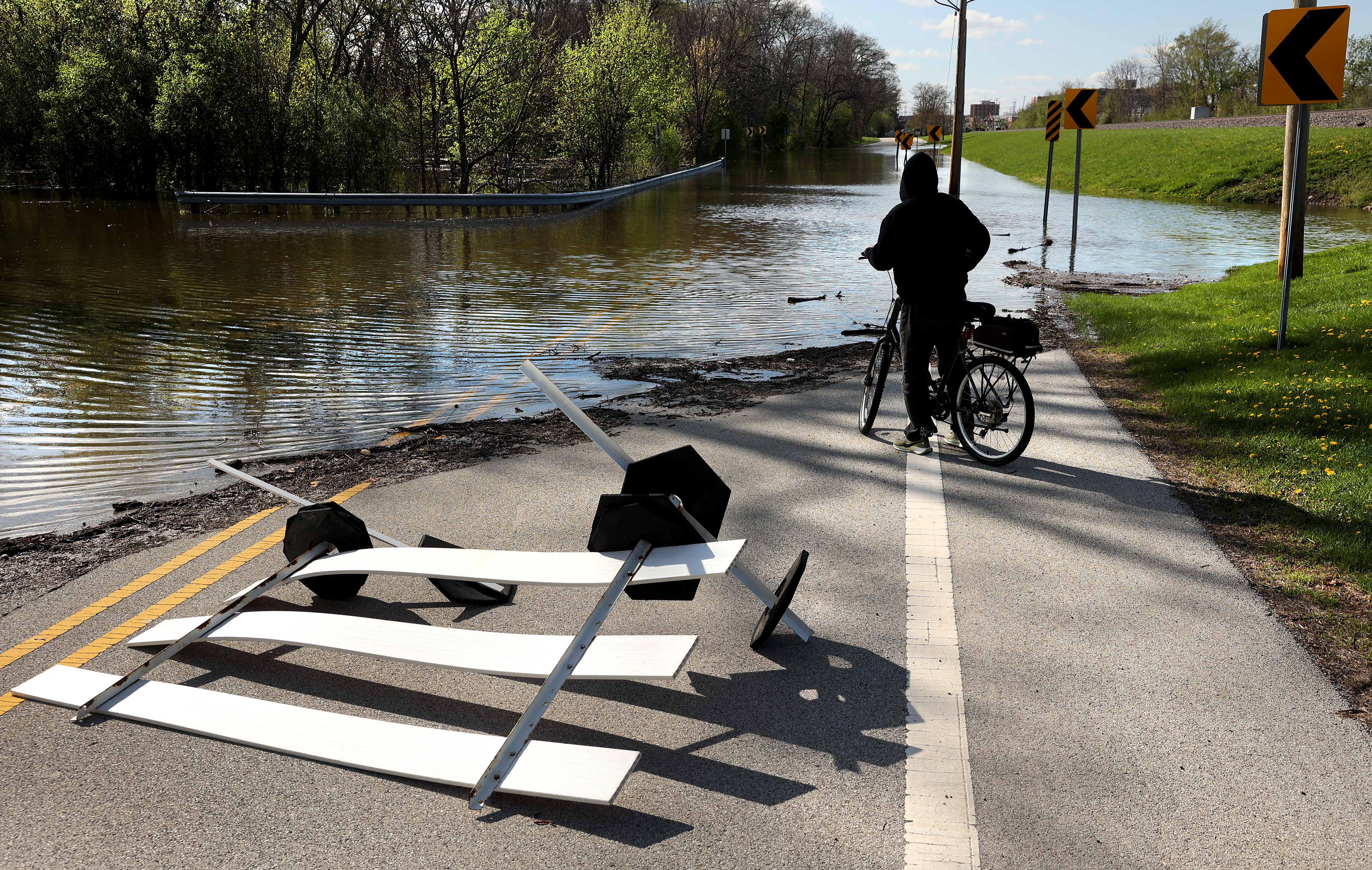
The Des Plaines River is expected to crest, or reach its highest peak, at 18 feet on Monday morning before gradually receding, according to data from the National Oceanic and Atmospheric Administration’s National Water Prediction Service. Even so, expected levels remain below the river’s record crest of 20.9 feet near the city of Des Plaines, set in 2013, according to NOAA data. Intense rains also pushed the Des Plaines, Chicago River and other waterways to near-record levels in 2020.
Other Chicago area rivers continue to experience flooding. The Fox River is forecast to reach 11.9 feet on Thursday at the Algonquin tailwater in McHenry County. The river’s record was 13.2 feet in April 2023.
Chicago is now experiencing its second-wettest spring on record and its rainiest April since 2013, according to the University of Illinois State Water Survey. As climate change intensifies, the air in the Midwest is becoming more saturated with humidity, a key ingredient of strong thunderstorms that can produce tornadoes.
Researchers also say the region is seeing more tornadoes, and tornado season is beginning sooner and lasting longer.
As of Sunday afternoon, National Weather Service offices across the state had confirmed at least 15 tornadoes on Friday, mostly in northern and central Illinois. The village of Lena, some 40 miles west of Rockford, experienced the strongest recorded tornado in the state that day. Shortly after 3:30 p.m. and in the span of 20 minutes, the column of air — 750 yards wide, roughly the size of 10 city blocks — violently rotated with 130 mph wind gusts, sweeping across an 8.5-mile path as it uprooted trees, downed powerlines and damaged roofs in the small town.
“Tornado outbreaks are not especially uncommon in Illinois, like the one we saw (on) Friday. But certainly not something we have every year,” said Trent Ford, the state climatologist. “That said, these outbreak events are dangerous, and something that research suggests may become more frequent, especially in spring, with more warming.”
Trends in recent decades point to an overall warming of average temperatures in Chicago and Illinois across all seasons, most rapidly in winter, due to human activities such as fossil-fuel burning that release heat-trapping gases into the atmosphere.
Temperatures were forecast to be slightly warmer Monday in central Cook County than the rest of the Chicago area, still with a chance of frost. The rest of the week, temperatures will bounce back to summerlike levels in the region, with highs in the upper 60s and 70s.
Flooding along the Des Plaines
Flooding has affected Cook and Lake county areas along the Des Plaines River, stretching from just east of O’Hare International Airport to the Wisconsin border.
The low-lying city of Des Plaines was particularly affected, with residents reporting basement flooding throughout the week. City officials have been closely monitoring the river levels as the forecasts evolved, said Public Works Director Tim Watkins.
“With recent rains, we saw a spike and predictions go up,” Watkins said. “We like to get a jumpstart to make sure we have our protective measures in place prior to the water getting beyond our control.”
Over the weekend, city officials closed Golf and Central roads between Des Plaines River Road and East River Road due to minor flooding on two streets, said Bradley Goodman, the city’s communications director. The city continues to offer sandbags to residents and businesses to place along their properties as river levels continue to rise.

Since then, Des Plaines has invested in sandbagging machines and other mitigation measures to better protect homes and businesses. The city’s public works facility has provided free sandbags this week for residents and businesses, like Chicago Behavioral Hospital, to fortify against Des Plaines flooding.
The hospital, which sits next to the river, has lined up over 200 sandbags as it prepares for the river cresting, said Pedro Pajare, director of operations at the hospital.
Stepping up in Lena
Tornadoes hit Harrison, Roscoe and Pecatonica in Winnebago County near Rockford; Gibson City and Buckley, some 30 to 50 miles east of Bloomington; McLean and Livingston counties; and Mendota in LaSalle County. The weather service office in Lincoln also confirmed two in Bloomington and three nearby: in Downs and Ellsworth, which tracked almost 34 miles, as well as in Normal and Towanda, and in Saybrook.
The Quad Cities office confirmed tornadoes in Denver and Colmar in west central Illinois and in Lena. Access to the latter was restricted to residents and emergency responders Friday evening, according to the Stephenson County Sheriff, as roadways were obstructed by debris and structures were compromised.

“We are extremely fortunate that this storm did not result in loss of life or serious injury,” Sheriff Steve Stovall said in a news release. “Our focus remains on ensuring the safety of our residents, securing the affected areas, and supporting the Village of Lena as recovery efforts move forward.”
As the town assessed damages and began to recover, community support flowed in; the fire department offered hot meals to volunteers, utility companies set up free charging and WiFi stations and contractors distributed care packages for those affected.
“We want to thank everyone who is stepping up to help our community right now. The support we’re seeing in Lena is exactly what makes this town special,” village police chief Brian Lamphere posted on social media Saturday. “Take care of yourselves while you’re taking care of others.”
On Friday night after the tornado struck, the village shared a heartening statement with its residents online: “Lena has always been a community that shows up for one another, and we will do that now more than ever. There will be challenges ahead, but we will rebuild, recover, and come through this stronger together.”