
Of all the courageous figures in the Great Migration, the Pullman Porters of Chicago surely stand alone. Millions of Black Americans made the one-way journey from South to North between 1910 and 1968, but very few had to return to the South as part of their new working day.
Riding the rails from Chicago to Louisiana or Alabama was an under-appreciated act of collective courage and, given the Pullman Porters’ crucial role in the building of the civil rights movement, pivotal to Black progress. Imagine the astonishment of these early 20th century men, had they somehow happened upon this exuberant past weekend at the Lyric Opera, where the seats were filled in large part by highly fashionable Black Chicagoans, all drawn to the work of Chicago’s first poet laureate, avery r. young, commissioned by Lyric to forge a very potent new American opera. Young is a multi-hyphenate artist who commands considerable celebrity.
Demonstrably so.
One of the characters in young’s “safronia,” a piece about that Great Migration and what it means to return to whence you came, is king willie tate (young favors lower-case in his writing). Tate is a Pullman Porter, but young is not here concerned with what happens on the rails, rather to a forcibly displaced family from Forsyth County, Georgia. Black inhabitants of the town of Oscarville were either murdered or forced away, and Black-owned property was seized.
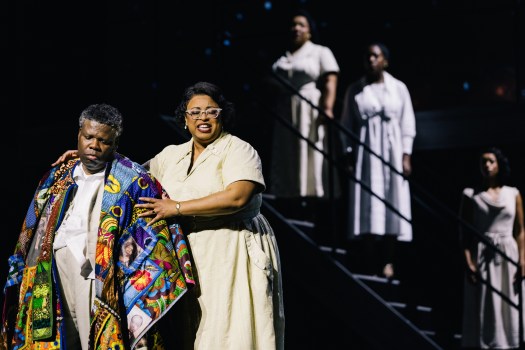
“Safronia” is the story of the family patriarch, baar booker (sung by young himself), his wife magnolia (Maiesha McQueen) and baar’s daughter, safronia, and her husband, said Pullman Porter (Lorenzo Rush Jr.). In two acts, “safronia” explores both the impact of what happened to this family in 1912 and their subsequent desire to claim back what once belonged to them, even after the death of their patriarch. Death in young’s landscape of magical realism, for want of a better term, is decidedly less than final.
Aside from two white antagonists (bossman, sung by Jeff Parker, surely doing the most vocally challenging role of his long career and Zachary James as cholly), “safronia” features a stellar, small Greek-style chorus as its ensemble. That’s made up of Sydney Charles, Bailey A. Champion, Miciah Lathan, Eric Andrew Lewis, Renelle Nicole, Jessica Seals, Maxel McCloud Schingen and Kendal Marie Wilson, all described as members of the “booker family,” being as young uses the word “family” not just to encompass that which is on the stage but to include the entire audience, as baar booker makes explicitly clear when he mirrors what young has to say in his own persona at the opening curtain speech and steps beyond the fourth wall to ask if his hearers are “in here.”
On Saturday night, a great roar of affirmation, actually several great roars, answered that question.
So what do we have, exactly? Young, who is credited with both music and libretto, absolutely has pulled off this task of forging a new Chicago opera from scratch for, although he has changed the names of places and people, we can surmise which city he is talking about as the new home of his family, a place where the “invisible red line” has substituted for Jim Crow.
The music on offer is a blend of styles, including gospel, blues and copious amounts of retro-funk, and it’s strikingly uptempo and percussive almost all of the time, even when the dramatic action would suggest otherwise. Given that we have the Lyric Opera Orchestra here, the presence of so many strings and so much brass in these genres lends a filmic quality to what one hears. I don’t know quite where young ended and his orchestrator and conductor, Paul Byssainthe Jr., began, but I’d wager Byssainthe’s contribution was essential to the depth and variety of what we hear.
Some of the musical experimentation feels like pure young, especially Parker’s use of falsetto, the contemporary-retro sound of a Hammond organ and young’s own improvisational sense.
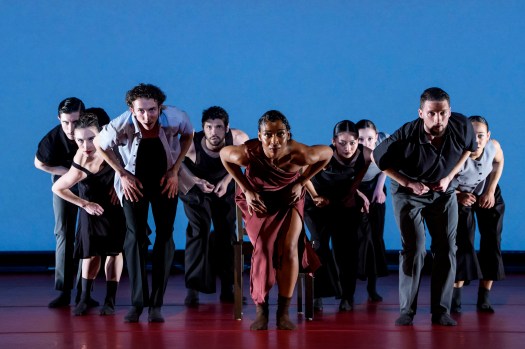
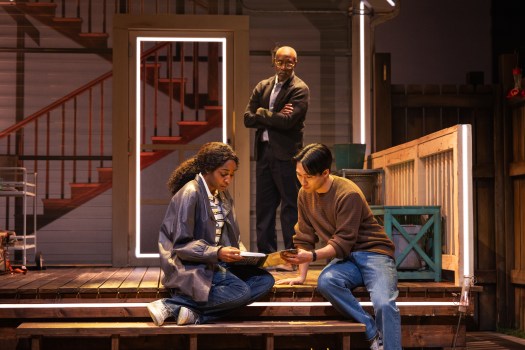
Whether this is a new opera or a new musical is open to debate. I’d argue most accurately the latter, given that the cast is not only miked but mostly made up of stellar Broadway and Chicago professionals, such as McNeal, McQueen and Rush. This one-weekend-only affair was by no means a fully staged show, although the use of large-format video from VAM Studio certainly made the visual swoop impressive, and the choreography from Kia Smith offered a lexicon of where this show might go. Court Theatre has already said it will fully stage the piece in its next season and that will probably reveal whether this show merits, say, a Broadway future or whether the Lyric concert-style hybrid will be its most viable template, now that Byssainthe’s orchestrations are available.
Young will, of course, have the chance to do further work. He should focus on Act 2, which arrives at its resolution abruptly, rather as if he ran out of time to finish. But I’m very enthusiastic about what he has achieved here, especially early on — no mean feat when you are also performing the leading role.

Generally speaking, poets struggle with writing librettos or lyrics because poetry is complicated and penned to be read and re-read, while lyrics, typically heard only once in competition with music, require simplicity and repetition, especially if the show is going to be staged without surtitles, as used at Lyric.
Young certainly could make adjustments based on that reality, but his language is so rich that his poetry also frequently makes its own lyrical case. Young has a way of making up nouns (like “froggy”) that roll off the singers’ tongues and getting to the “bone and blood” of the matter in such a way as to keep you leaning in, or, in young speak, “in there.”
Chris Jones is a Tribune critic
cjones5@chicagotribune.com