
Privacy and ethics while matching data with locations were hot topics during Friday’s panel discussion on GIS technology and uses.
The discussion was part of the Moellering Academic Panel on Spatial Sciences event hosted Friday by Vaparaiso University’s Department of Geography, Meteorology and Environmental Science and the Christopher Center Library.
“I think the biggest ethical risk with GIS today is what I would call repurposing,” GIS pioneer Michael Goodchild, professor emeritus at the University of California-Santa Barbara, said. “It’s easy for the user to repurpose, to use GIS to analyze data for which it’s not really suitable.”
GIS, or geographic information system, links data to specific locations to help users visualize patterns and make informed decisions. But whether those decisions are ethical is left up to the users, Goodchild said.
Nefarious purposes like surveillance can be done by following location services on a user’s phone, for example.
“We need to make a case that it’s also on the software developer to make sure the software is used for an ethical purpose,” Goodchild said.

Indiana Geographic Information Officer Marianne Cardwell said her agency’s GIS data can show how many bedrooms are in homes, verify addresses and other useful purposes.
Some people can ask that their data not be included. Police officers, judges and victims of certain crimes can ask, for example. But shielding that data can be conspicuous, too.
“I don’t think there’s any such thing as privacy anymore,” Cardwell said. “Probably there’s a pinpoint application on your phone right now that is selling your data.”
“The data you’re creating, think about how it can be used in a negative way,” she said.
Where you’re buying, what you’re buying, whether you’re using a rewards card all combine with open data on an Indiana map, said Stephen Aldrich, Indiana’s deputy geographic information officer. When a cashier asks you about signing up for a loyalty program, you likely don’t think about the terms and conditions of it, he said.
“It’s your data. It’s your publicly produced information,” Aldrich said. “I think we need to be aware that we are always accidentally creating data about our behavior and that our data may not be the way you want it to be.”
“We create a lot more data than you think,” and bad actors can exploit it, he said. “We don’t have a framework, maybe to keep them accountable.”

One thing you can do is turn off location services in your mobile device’s settings, said Gang Shao, associate professor of data science at Purdue University.
Ashley Poling, a VU graduate and now program manager at T-Kartor, suggested GIS professionals consider how to analyze data while protecting privacy.
“People might not think of how you can use the data in a bad way,” Cardwell said, so “be that person who speaks up when that happens.”
As with any field related to computers, the use of artificial intelligence affects GIS, too.
“AI is changing the nature of science because one of the key elements of science is transparency,” Goodchild said. “It is changing how we feel as scientists, how we establish trust.”
As for whether AI will be a plus or minus for GIS, he said, “It’s too early to tell. This is a very rapidly expanding technology, and we’re only beginning to see the potential.”
Don’t lump all AI together, Goodchild said. AI that creates images or text is different from AI used to crunch numbers fast to help analyze large blocks of data. “All of those have their own agendas.”
GIS is one of the early adopters of AI for spatial analysis, Aldrich said. “We’re not late to the party.”
“AI is a very powerful tool,” Poling said. Her firm doesn’t produce AI-generated data, but AI can be practical for analysis. That, however, requires more time on quality assurance.
Indiana has 37,000 square miles, Cardwell said, and her office doesn’t have time to ground proof everything. “I don’t think we can avoid AI,” she said. “We just need to learn how to use it, where to use it.”
Shao sees AI as potentially useful for tasks scientists haven’t been able to do in the past because they involve reviewing so much data. “Those are things that are making our research behavior change a little bit.”
“If you don’t know how to use the tools and how to access them, the future may not be as bright,” Aldrich warned. “AI slop in, AI slop out.”
“There’s been a huge explosion in the amount of code using AI, but that code needs to be checked,” Goodchild said. The upside is there’s a huge potential for employing people to check code.
The sheer volume of data is a concern, too.
“We do have real-time sensors,” like INDOT plow locations, Aldrich said. “That data is a lot of data that comes in, and a lot of that data is not needed spatially.”
“A lot of times now, this real-time sensor network, the location is an afterthought,” he said.
Processing all that data takes time, and that can be a problem.
Zooming in, for example, can cause so much strain the system can’t keep up. “All of a sudden, a critical application is broken,” Aldrich said.
INDOT might use location data to see if more resources are needed for a region, for example, he theorized. But the agency probably wouldn’t need to look at real-time data for this.
“Nothing is worse than simulating traffic where the simulated traffic is worse than in the real world,” Goodchild said.
“We need more computing” to analyze all this data, Shao said.
The panel offered advice for students, including adding more IT skills to their portfolio.
“You won’t know everything when you graduate. There’s no way,” Cardwell said. “As students, just be aware the field will continue to change.”
“In my experience, IT folks do not want to touch the GIS stuff. It scares the heck out of them,” she said. “I don’t know a single program that teaches those kinds of skills.”
“GIS has always been changing rapidly,” Goodchild said. The technology will change, but the principles of GIS they learn at universities like VU will still be true in 20 or 30 years into the future, he said.
At the symposium, a new bachelor of science in geospatial services degree program was launched, beginning with the fall semester. Gregg Johnson, dean of VU’s College of Arts and Sciences, expects 10 to 15 students to join the program.
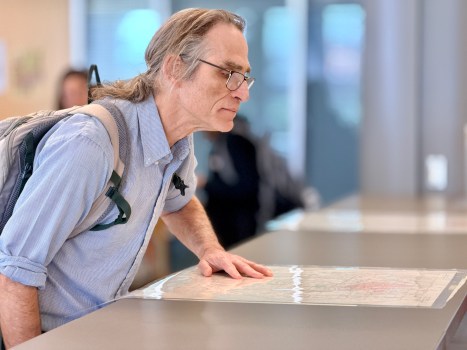
During the event, old maps from the extensive Moellering Collection were on display throughout the library.
Doug Ross is a freelance reporter for the Post-Tribune.