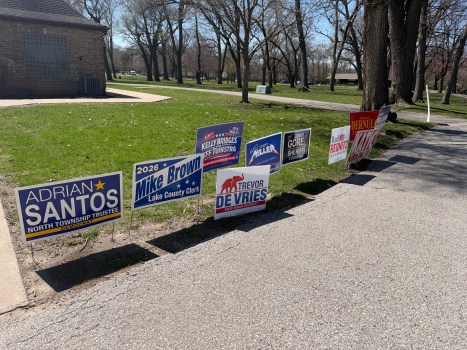

An Indiana law banning the use of university-issued IDs for voting is back in effect after a Monday order from the U.S. Court of Appeals for the Seventh Circuit, as early voting for the state’s May 5 primary continues.
Senate Enrolled Act 10, now known as Public Law 70, removes student IDs from the list of acceptable voter identification. The measure, passed by the Indiana General Assembly in 2025 and signed by Gov. Mike Braun, reverses a previous policy that allowed their use if they met certain requirements.
ACLU of Indiana Advocacy Manager Danielle Drake said the decision adds “confusion for young voters at a time when Indiana should be doing everything it can to encourage participation and strengthen confidence in our elections.”
Drake said that the confusion dates back to the passage of SEA 10 in 2025, when the state ended a two-decade policy allowing eligible students to vote using qualifying university IDs.
“Now, in the middle of early voting, student voters are once again being asked to keep up with changing rules just to know what ID they can use to cast a ballot. That kind of uncertainty discourages participation and makes the process feel less fair and accessible,” Drake said. “In a state that already struggles with turnout, this is exactly the wrong approach.”
State officials say the change is necessary to protect election security.
“Our voter ID law now fully applies again,” a spokesperson for Indiana Attorney General Todd Rokita’s office said in a statement posted to Twitter/X. “Only secure, government-issued IDs like Indiana driver’s licenses are accepted at the polls.”
The appeals court’s decision reverses a federal judge’s earlier ruling that had blocked the law. In that decision, the court found the policy likely placed an unconstitutional burden on student voters.
For nearly two decades, Indiana’s voter ID law allowed public college and university students to vote using school-issued identification, as long as it included a name, photograph, expiration date and was issued by the state or federal government.
According to the Indiana Capital Chronicle, Indiana University student Josh Montagne, one of the plaintiffs in the lawsuit challenging the law, has already cast a ballot using his student ID.
“All ballots voted in which the voter presents with a student ID at the time it was legal will be counted unless/until we receive a Judge’s order explicitly stating that we are not to count the ballot,” Monroe County Election Central Director Kylie Farris said Monday.
Montagne said the change directly impacts students who rely on school-issued identification.
“I have voted in Indiana three times using my student ID, because I don’t have an Indiana driver’s license or other qualifying ID,” Montagne said in a statement. “Senate Bill 10 singles out students like me and makes it harder for us to vote.”
The lawsuit was filed by Count Us In, Women4Change Indiana and Montagne against Indiana Secretary of State Diego Morales, members of the Indiana Election Commission and other state election officials. They argued the law unfairly restricts access to the ballot and disproportionately affects young voters.
“It’s important for student voters and anyone who is eligible to vote to make a plan to vote, whether it is checking their voter registration, planning where and when they may vote during early voting or Election Day, and also asking for help,” said Ami Gandhi, who leads the Midwest voting rights program at the Chicago Lawyers Committee for Civil Rights.
The case is expected to continue through the courts as the state pursues its appeal.
Women4Change Indiana said in a statement that they are “deeply disappointed” by the Seventh Circuit’s decision to stay the injunction blocking Senate Bill 10, calling it a temporary setback but not a final ruling on the law’s constitutionality. The group said student voters are once again unable to use qualifying student IDs in Indiana elections, including the current May primary, and argued the law “moved Indiana in the wrong direction by creating an unnecessary and arbitrary obstacle for tens of thousands of young voters.”
Count Us In Indiana said it “remains firmly committed to this case and will keep fighting to permanently block SB 10 and ensure every Hoosier has a fair opportunity to make their voice heard at the ballot box.”
Vivian Richey is an intern for the Post-Tribune through the Legacy Foundation’s News Internship Program. The Post-Tribune is solely responsible for all content.