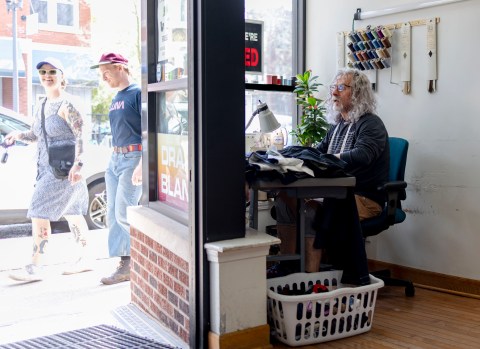

Figo Topal has plenty of room to alter clothes in his Lincoln Square storefront, but he chooses to keep his sewing machine in front of the window.
Most people think he sits there for the good natural light, but for him, being spotted by passersby on the residential Rockwell Street sidewalk is much more important.
“People need to see you work,” he said, his red-framed glasses sliding down to the bridge of his nose as he focused intensely on hemming a pair of beige pants. “That’s the key in this business.”
Topal is considering retiring this year. But the 65-year-old stands as a bastion in a job he believes could become obsolete. Back in the day, he said, when everyone smoked cigarettes in restaurants and no one worked from home, his business flourished. The demand for dry cleaning and alterations was overwhelming.
Now, he said, “the world is different.”
Topal is one of just 250 professional sewers in the Chicago metropolitan area, according to the latest data available from the U.S. Bureau of Labor Statistics in 2024. And as Topal and many other skilled trade workers near the end of their careers, fewer young people are pursuing the jobs they leave behind.

In 2024, the U.S. Bureau of Labor Statistics estimated the number of tailors, dressmakers and custom sewers working in established businesses across the country was down 30% from what it had been a decade earlier.
Including those who are self-employed or running businesses out of their homes, the median age of those working in the industry was 54 last year, 12 years older than the median age of the entire U.S. employed population.
With rising costs and less customer engagement pushing him to retire, he understands fewer young people plan to pick up a needle and thread. He just hopes he can sell his business whenever the time comes.
Carving out space
When he first emigrated from Turkey in 1987, Topal did not expect to spend nearly 40 years working with clothes on Chicago’s North Side. In the late ’80s, he owned a restaurant and drove a cab. Jokingly, he said he once thought he would be a gigolo. That was before he met his wife, Emine, of course.
Once his son, Devrim, was born with muscular dystrophy, he knew he needed stable work. Though he learned to alter clothes through an apprenticeship in Turkey, he worried he would not fit in because most American tailors were Jewish or Italian. Almost every dry cleaner he knew of was Asian.
“Dude, we’re Turks, we don’t know dry cleaning,” he recalled telling a friend back then.
Over time he learned fitting garments to unique specifications was really a business of making customers feel understood.
To this day, when someone enters Devrim Cleaners, named after his son, he invites them to stay for a Turkish coffee or çay tea. A couple of decades ago, it wasn’t unusual for people to stop by the store for happy hour en route to their weekend plans.

When COVID-19 shut down everyday life in 2020, Topal said he lost half his business, forcing him to close his original Lakeview location.
While his machine hummed, pausing occasionally to tuck the fly-away pieces of his long grey hair back into his bun, he speculated that dry cleaning and tailoring have become luxuries many people cannot afford. But he also believes the personal connection he has always strived toward is no longer valued.
“Since the pandemic, people are mean,” he said. “People are less happy.”
A shifting workplace
Veta Caldwell, the 52-year-old owner of Tailorite Complete Clothing Care in Chatham, has not seen her family business suffer the way Topal has.
The daughter of a South Side tailoring legend who handcrafted the Rev. Jesse Jackson’s suits and spent decades washing White Sox uniforms, Caldwell said Tailorite still expands constantly nearly 70 years after it opened.
Her father, Joseph Caldwell Sr., revolutionized the craft he learned in trade school to shorten what took most tailors a week into a three-day turnaround. It’s what made his business, which first opened in 1956, so successful.
Caldwell Sr. grew up as a sharecropper in Arkansas in the 1940s. He moved to the city when he heard about opportunities for Black people up north, his daughter said. A “well-read” man who cared about education more than anything, his career as a tailor lifted him to prominent social circles linking him to former mayors and U.S. presidents alike.
“To come from where he came from and accomplish all that he did … I’m just so proud to be his legacy,” his daughter said.

Even though the family’s business never slowed down, in some ways, it shifted.
As a child growing up in Glenwood, Veta Caldwell remembers coming into her father’s store and seeing a staff of seamstresses who were all born and raised in the U.S. Today, she said, Tailorite employs in its two stores mostly foreign-born men from Africa, Asia and Caribbean nations.
“It’s a problem in that you don’t have the pool that you used to be able to pull from,” she said. “I can’t just post on Indeed anymore. I’ve tried to do that and you just don’t get anything.”
A recent analysis of U.S. census data by the Migration Policy Institute, a nonpartisan Washington think tank, revealed that 41% of all tailors, dressmakers and sewers working in the U.S. were not born here.
According to Julia Gelatt, the director of the institute’s U.S. Immigration Policy Program, this number is even higher in Illinois, where more than half of those employed in the industry are foreign-born.

For Caldwell, changes in who works for Tailorite have not affected quality, but they introduced new challenges such as critical language barriers between counter clerks and tailors.
She wishes more “homegrown” Americans would pursue the craft like her father did, but given that students no longer take high school home economics classes or learn to sew at home as they did in previous generations, their baseline skill levels are not what they used to be, she said.
Paving a path for young sewers
Evelyn Mo, the 24-year-old founder of fashion brand and alterations business Nyleve Nyson, experienced the steep learning curve Caldwell observed. She knows there are few people her age who do what she does.
When Mo left behind a full Columbia College Chicago film scholarship during the pandemic and became the first person in her family to start a business, her relatives worried she should be more pragmatic.
“It was always: ‘Get a good job, get a good job that pays the bills,’” she said. “And whatever dreams we may have had, they just stayed in the back of our minds.”
Mo recognizes she has more resources available to her than her mother and grandparents once did. Having grown up in Marquette Park with a single mom who “busted her butt everyday,” she learned that success only comes through hard work.
So, when she began experimenting with fabric glue and patchwork at home in 2020 and decided she wanted to focus on fashion full-time, it did not take long before she was calling the woman who made her custom prom dress to beg for an apprenticeship.
Soon, customers were asking her the same question she once implored others: “Can you show me how to sew?”

“Back in the day, someone would have a grandma, a mother or someone in the family to teach them how to sew because it was mandatory,” Mo said. “I truly feel like so many people want to learn. They just don’t know who to learn from.”
In Bucktown, Sage Cichock, who opened her own boutique tailoring operation in 2021, experiences the same demand to teach other young people the art of alterations.
Cichock, 35, learned to sew as a child, but perfected the craft in college, making costumes for the theater department. She said working under pressure, rather than just taking sewing classes, gave her a leg up on others when it came to entering the industry after graduation.
At Sophos, her Damen Avenue shop, she now employs 12 people, 11 of whom are women. She estimated that most of her customers and employees fall somewhere between the ages of 25 and 50.
Despite employing tailors younger than the industry’s national age median, Cichock struggles to find fresh talent with the skill level she requires. With more people pursuing fashion degrees from universities rather than attending trade school, she said it takes longer for students to learn to sew at a professional level.
“Young people from this country, it’s difficult for them to have the amount of experience that they need,” she said.
Already working six days a week and parenting an infant, she does not have the bandwidth to teach others her trade, much less even take a vacation, despite their persistent asking.
End of an era
Back in Lincoln Square, Topal has worked longer than Mo and Cichock have been alive. He’s on the verge of retiring, and his life is slower now than it used to be.
Glancing around his storefront, the veteran tailor can name the children of all his longtime customers, who are depicted in holiday cards on his walls. His son died in 2024, but artifacts from his life, like his high school diploma, remain scattered throughout the shop to keep his memory alive.
Most days, business trickles in slowly. Years ago, a constant stream of friends and neighbors joined him for coffee. His two children grew up running around his shops.
“I couldn’t work almost, I had to socialize,” he said. “But, oh, we had such beautiful fun.”

When he first opened his shop, Topal said his customers were “regular people with regular jobs,” who could easily afford to make dry cleaning a frequent errand.
Today, he understands why many young people avoid the added costs of wearing professionally altered clothes as they struggle to afford basic needs like rent and groceries.
“People don’t make a living in this environment,” he said. “We’re not all Donald Trump rich.”
As he prepares to leave the career he loved behind, Topal feels nostalgic for a time when customers were willing to slow down long enough for good conversation. His daughter, who graduated from University of Rochester with a biology degree, once asked if she could take over the family business she cherishes as much as her father does.
He told her the long hours aren’t worth it anymore.
“I’m a master tailor,” Topal said. “I’m not a lawyer or a surgeon general, but I deserve 40 or 50 bucks an hour. If I can’t have that, I can’t keep doing it.”