
Illinois officials plan to award almost $32 million to licensed cannabis companies, in what some business owners said was a significant move, while others questioned whether it was too little too late to save the start-ups.
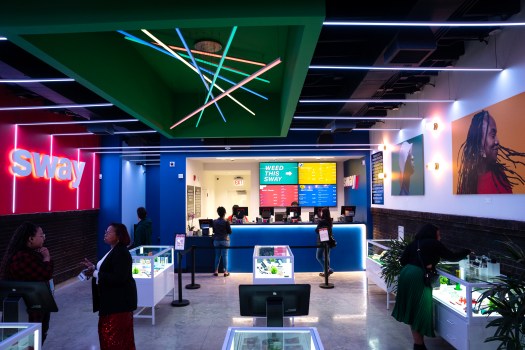
“It’s very exciting,” said Edie Moore, co-founder of Chicago NORML and of SWAY dispensary in Lakeview, which applied for a loan. “I think it’s significant. It’s across all license types, so everybody who’s eligible hopefully will have a piece of that pie.”
The loans to 95 licensees were announced Monday, and “may be up to 100% forgivable upon providing documentation for eligible business expenses.” That means the companies likely won’t have to pay the money back.
Some companies were approved to receive multiple loans. Botavi Wellness, LLC, which operates Nirvana dispensaries, was in line to get five, while Blounts&Moore LLC, operating Market 96, was to get four.
The amounts awarded range from $50,000 per company for transporters, to $245,000 each for dispensaries and infusers, to $750,000 for craft growers. In total, craft growers were in line to receive almost $19 million, followed by dispensaries with $9 million, $3 million for infusers, and $1 million for transporters.
Those amounts are just a fraction of the cost of opening a dispensary or grow operation, which can reach millions of dollars. But the loans are crucial in a business that remains federally illegal, making most federally-insured banks unwilling to participate, resulting in very high interest rates from other lenders, along with more restrictive zoning and higher land costs.
Giving money to private businesses is not typical for Illinois. Usually, state assistance to businesses is in the form of property tax breaks or infrastructure subsidies. In this case, the money is generated entirely by the licensed cannabis industry — from retail taxes of up to 25%, and license fees reaching $60,000 every two years for a dispensary, and $100,000 every two years for a full-size cultivation license.
Only those designated as social equity licenses qualify. A social equity licensee generally is someone who has had a past low-level cannabis charge or conviction, or who has lived in poor neighborhoods disproportionately affected by the war on drugs, or who have hired employees from those groups.
Along those lines, the Illinois Cannabis Equity Coalition is a non-profit which advocates for the state’s legal pot program to reinvest in areas damaged by the war on drugs.
Deputy Director Peter Contos notes that a recent state report showed most arrests for marijuana remain on the mostly Black South and West sides, while very few dispensaries have opened in those areas.
“The majority of our members are just looking for access to affordable cannabis,” Contos said. “So we’re excited about this funding and we welcome it, but this program is working by design to keep some people in and some people out.”
Despite promises that the industry would spread wealth in minority communities, years of problems in licensing and in the industry in general have left new entrepreneurs in the field struggling to open.
First, there were problems with the scoring of license applications, which led to numerous lawsuits and eventually a corrected scoring system and lotteries to award licenses.
Then, the COVID-19 pandemic, disrupted supply chains and rising inflation added new layers of costs. Competition from unlicensed and unregulated hemp companies has led to declining prices and falling revenue. A federal ban on intoxicating hemp is scheduled to take effect in November, though the hemp industry is lobbying to change that.
The loans could help members of the Illinois Independent Craft Growers Association, many of whom have been trying to get up and running for years, founder Scott Redman said.
“It is significant because so few people got loans (previously) and financing has dried up since 2021,” he said. “So for some people this was the linchpin to their development.”
However, he added, “I am already hearing that some people were denied because they didn’t qualify as social equity, even though nothing changed since they were awarded the license.”
The loans follow previous funding rounds totaling $23 million, and a $3.6 million public/private funding round. The money is distributed through the Illinois Department of Commerce and Economic Opportunity.
“Through this investment, we are continuing to break down barriers and expand opportunities for entrepreneurs who have too often been left out of emerging industries,” Lieutenant Governor Juliana Stratton said in a written statement. “The Cannabis Social Equity Loan Program is about more than access to capital — it’s about building generational wealth, strengthening communities, and ensuring that equity remains at the center of Illinois’ cannabis industry.”
Illinois is unusual in providing forgivable loans to cannabis companies. Other states, such as New York, provide loans that typically must be repaid with interest.
The announcement of the Illinois loans came on April 20, or 4/20, an informal holiday celebrating cannabis culture. Many dispensaries with busy were customers taking advantage of special sales and events.
Dispensary operators are still hoping for state lawmakers to lower cannabis taxes and allow all dispensaries to sell tax-exempt medical cannabis.