
Once known as a dry town, Pullman celebrated beer over the weekend with samples of Seipp Beer and a talk about how beer has long been a part of the neighborhood and Chicago.
Several dozen attendees also learned Pullman was not quite as dry as is sometimes thought.
“Pullman was a dry town only in George Pullman’s dreams,” said Ruth Lopez, scholar in residence at the Newberry Library, who has lived in Pullman since 2017.
Pullman, who founded the Pullman Palace Car Company in 1867, and is known to have established the community in 1880, did ban alcohol. But people found a way around it.
“I’m going to keep it really short, but talk long enough so they have time to pour the beer,” Lopez said.
“He kind of forgot his people (workers) with their own traditions and cultures,” said Lopez, referring to the German immigrants who brought their love of beer, as well as the Irish and Italian who followed. “They just went to the other side of the tracks.”
Rebecca Conant, director of programs for the Friends of Pullman National Historic Park, did the beer pouring for the audience and coordinated the event.
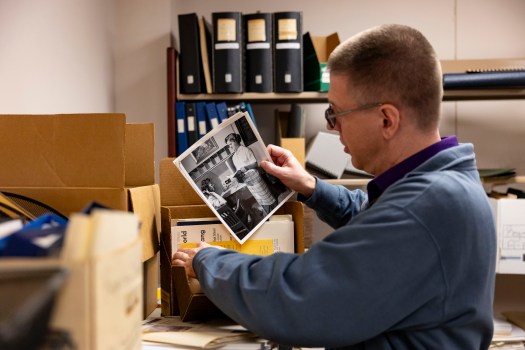
Andrew Bullen, another longtime neighborhood resident and a former librarian with the Illinois State Library, brought a wealth of knowledge about Pullman. He said it was the need for steel railcar workers that drove much of the immigration to the neighborhood, along with their love for beer.

“A major factor in the times in Pullman was a demographic shift due to technology,” said Bullen. “There was a huge building boom throughout car makers to create steel cars.”
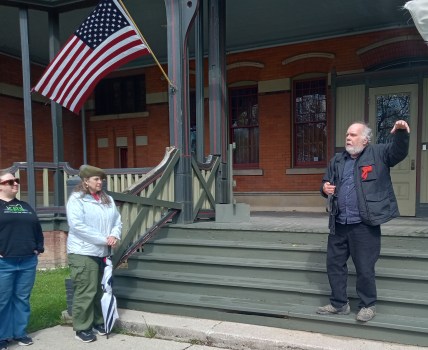
Bullen and resident Rod Lewis led tours of the neighborhood, talking about beer’s influence.
Many bars settled on Kensington Avenue, close enough to attract workers but away from Pullman’s restricted area. But the beer still found its way right into the neighborhood.
“At the (union) foundry in North Pullman, in the summer when it was hot, beer companies would send out a beer wagon and people on their lunch break would come out to have a beer,”said Mike Shymanski, retired architect, founding member and past president of the Bielenberg Historic Pullman House Foundation. “Pullman didn’t object to people drinking but didn’t want to accommodate it.”
Seipp Beer was a big part of the story, too.

“Before we go any further, it’s time to drink a little beer,” said Laurin Mack, the x3 great-granddaughter of Conrad Seipp, who founded the Chicago’s Seipp Brewing Co. in 1854. Mack restarted the Conrad Seipp Brewing Co. in 2020, and talked about breweries burning down during the Chicago Fire.
But the company built back up.
“What did workers need when they were building Chicago again — they needed beer,” said Mack.
Mack said prohibition did a “doozy” on breweries. Seipp closed the Chicago brewery but moved to 27th Street and Cottage Grove Avenue. The beer still found its way to Pullman.
“I love history and I love Chicago,” explained Mack. “I really love beer.”
Many attendees agreed.
“I follow the beer culture but I also like the historical part of it,” said Ron Tabaczynski, of Hammond, who came with his wife, Ruth. He heads the Whiting-Robertsdale Historical Society. “I also have a personal interest in prohibition history, so this brings it all together.”
Tobaczynski also said he’d seen Pullman from the expressway and was intrigued.

Alicia Johnson, who lives in Onarga in Iroquois County, said she was fascinated by the neighborhood.
“I’m just so interested in how everything happened in Pullman from the car porters to how it affected prohibition and the fact that people typically use their own culture to punish labor members,” said Johnson.
She noted there was no alcohol sold on Sundays, but that was workers’ day off.
Liz Garibay, beer historian, discussed German festive culture and beer and how the neighborhood tried to ban it. She also mentioned the anti-immigrant sentiments, which appear to linger nationwide today.
“Mayor Levi Boone in 1855 says we’re going to attack alcohol and the people who sell it and make it,” said Garibay. So saloons were closed Sunday and the cost of a tavern license went from $50 to $300, she said.
Immigrants rebelled, coming together in opposition, she said.
“This is the first time people start to organize,” said Garibay. “It’s all rooted in beer.”