
Among the myriad reimagined versions of Shakespeare’s plays, one question continues to fire up creatives of many stripes: What if (insert name of tragic heroine) didn’t have to die? The jukebox pop musical “& Juliet,” now in its fourth year on Broadway, rewrites the young Capulet’s story as an empowering romantic comedy. Closer to home, Second City went viral in the early 2010s with the “Sassy Gay Friend” web series, in which Brian Gallivan’s character convinces Ophelia, Juliet and Desdemona, as well as other famous women from literature, to choose a healthier way forward.
Drawing on a similar premise but with a more somber tone and otherworldly setting, Caridad Svich envisions an alternate future for Hamlet’s drowned lover in her 2008 work, “12 Ophelias (a play with broken songs),” now onstage by Strawdog Theatre Company in a production directed by Kamille Dawkins. In this retelling, Ophelia (Tierra Matthews) reemerges from the water into a neo-Elizabethan version of Appalachia, where she sets out on a strange journey to recover her reason, memories and autonomy. Interspersed with folk ballads, this fantasia-like play certainly creates a mood, but struggles to tell a cohesive story.
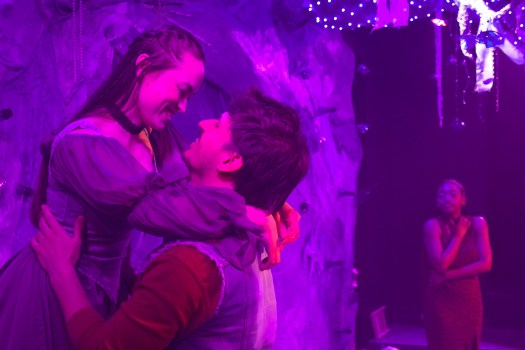
Walking into Strawdog’s venue at the Factory Theater feels like going underwater, thanks to Rose Johnson’s all-blue scenic design and Ellie Humphrys’ cool-toned lighting. Bottles, glass ornaments, scraps of lace and strings of lights hang from branches on the ceiling, while upstage, a cave-like wall frames a round piece of fabric that sometimes evokes a pond and also becomes a scrim for silhouetted scenes. Lines of poetry or lyrics, as well as more lace garments, adorn the walls — perhaps a nod to the tension between Hamlet’s world of “words, words, words,” and the superficial, gendered expectations surrounding Ophelia.
When Ophelia comes out of the pond, gasping for breath, she meets several familiar, though altered, characters from her earlier life. Gertrude (Eileen Dixon) is no longer the queen of Denmark but rather the proprietor of a brothel where Ophelia finds temporary shelter. It’s almost as if Hamlet’s cruel imperative, “Get thee to a nunnery,” fates Ophelia to quite the opposite destination. Dixon strikes an imposing figure in a silver corset, black lace tights and high-heeled boots, waving a long cigarette holder reminiscent of Cruella de Vil (costumes by Emily N. Brink, props by Leo Bassow). However, Gertrude is kinder than she appears, and one of her girls, the street-smart but romantic Mina (Molly Kempfer), makes an even friendlier acquaintance for Ophelia.
As one might expect from a feminist retelling, the men in this play are underwhelming, even annoying, yet still dangerous. Hamlet reappears as a character simply called the Rude Boy (Dryden Zurawski), and his buddy Horatio’s name is abbreviated to “H” (Rafael Gray Lopez). In a weird form of Shakespearean locker-room talk, the two josh each other about women; H is involved with Mina, while the Rude Boy renews his flirtation with Ophelia. The Rude Boy and Ophelia seem to remember something of their previous relationship, but the exact connection between their past and present lives is unclear.
Rounding out the cast are Jillian Leff and Jared Sprowls as R and G (abbreviations of Rosencrantz and Guildenstern), who comment on the action and debate whether or not change is possible for Ophelia. As for Ophelia herself, Matthews’ performance hints at the character’s resilience, vulnerability and optimism, but her arc remains hazy, due to the meandering dialogue and lack of a clear plot. The songs don’t help much with making sense of things, either; they mainly serve to evoke moods rather than develop the characters or move the action along, as in a traditional musical.

For viewers interested in an atmospheric, rather abstract riff on Shakespeare, “12 Ophelias” may appeal. Its dialogue certainly has lyrical moments. But if strong character development and a compelling plot are important to you, this production is likely not the right fit.
Emily McClanathan is a freelance critic.
Review: “12 Ophelias” (2 stars)
When: Through May 24
Where: Strawdog Theatre Company at Factory Theater, 1623 W. Howard St.
Running time: 1 hour, 20 minutes
Tickets: $10-$80 at strawdog.org/12ophelias