
LOS ANGELES — Injuries haven’t been kind to the Chicago Cubs, and they haven’t even gotten through the first month of the season.
The injuries have largely affected the pitching staff, especially a decimated bullpen that already had three high-leverage relievers on the injured list before lefty Caleb Thielbar exited Thursday’s game with left hamstring tightness.
Despite the banged-up pitching staff and a slow offensive start, the Cubs entered Friday’s series opener against the Los Angeles Dodgers riding a nine-game winning streak into their first West Coast trip of the season.
Here are three numbers that help explain how the Cubs climbed out of the National League Central cellar to become the hottest team in the majors.
1. 122 weighted runs created plus (wRC+)

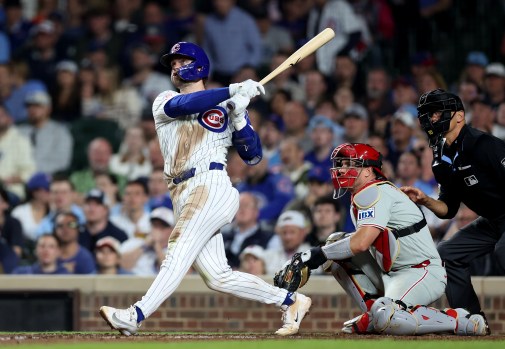
Really, almost any team offensive metric could be chosen to highlight how great the Cubs offense has been recently and the numbers they’ve put up through 25 games.
Although the first 10 days of the season saw rough production, the group has been at a different level lately. The Cubs’ 122 wRC+ through Thursday was tied for second in the majors behind the Dodgers (130), and they’re getting it from everywhere in the lineup.
Eight Cubs have at least a 100 wRC+ (minimum 30 plate appearances), and they’re scoring without Pete Crow-Armstrong (74 wRC+) or Michael Busch (65) getting locked in — though Busch started looking much better at the plate during the last series against the Philadelphia Phillies.
The Cubs rank in the top four among big-league teams in multiple key offensive categories, including on-base percentage (first), fWAR (second), weighted on-base average (third), batting average (third), OPS (third), walk rate (fourth) and slugging percentage (fourth). They have been able to limit strikeouts — only four teams have a lower strikeout rate — and are constantly putting pressure on pitchers.
No team has put more runners on base this season than the Cubs by a wide margin. Their 517 plate appearances with runners on easily eclipses the next-closest team, the Washington Nationals (484). The Cubs haven’t fully capitalized in those situations, highlighted by their 17th-ranked 105 wRC+ with runners on base, but they keep giving themselves chances for multirun innings.
2. Nico Hoerner’s 1.3 wins above replacement, per FanGraphs (fWAR)

Of the 181 qualified big-league hitters through Thursday, only the Houston Astros’ Yordan Álvarez (2.0) has produced a better fWAR than Hoerner’s 1.3, which ties the Cubs second baseman with the Atlanta Braves’ Drake Baldwin and the New York Yankees’ Ben Rice.
Hoerner has done it all between his defense and offensive production. Coming off National League Player of the Week honors for the first time in his career, Hoerner already is more than halfway to his 2025 home-run total with four; he didn’t hit his fourth homer until July 29 last season. And even though he has batted leadoff lately, regardless of whether a right-hander is starting, Hoerner is tied with the Braves’ Matt Olson for fifth in RBIs (22).
Hoerner’s all-around play in the first month is in contention for the best start by an MLB hitter this season.
3. 75.5% left on base percentage (LOB%)

The pitching staff has endured some shaky moments, particularly as it has needed to navigate big outs without its top relievers available.
But when Cubs pitchers have found themselves in a jam, they’ve been among the best in the big leagues at getting out of those situations. Their 75.5% LOB% is third-highest among MLB teams, trailing only the Braves (77.5%) and Texas Rangers (78%). (The Tampa Bay Rays are the worst at 65.6%.)
Limiting opponents’ chances to cash in with runners on base looms large in close games, part of why the Cubs are 4-2 in one-run games. The pitching staff also owns the fifth-best ERA (3.44), and both stats have been aided by stellar team defense.
As long as the Cubs are forced to rely on less proven arms while manager Craig Counsell navigates usage and injuries, preventing big innings by stranding runners is an important piece of the pitching staff’s effectiveness.