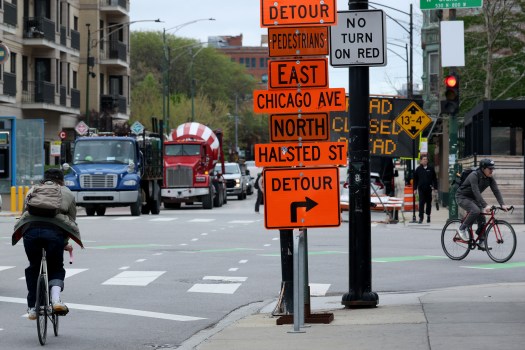

At 8:15 on a Tuesday morning this spring, the intersection of Grand Avenue, Halsted Street and Milwaukee Avenue is an angry beehive. Four CTA bus routes — No. 8, No. 56, No. 65 and No. 66 — funnel through a corridor the Chicago Department of Transportation has reduced to one lane in each direction through May. Drivers detoured from the closed Chicago Avenue bridge pile behind them. Ride-share drivers angle for drop-offs. Scooter riders dangerously thread the gaps. Cyclists choose between a narrow shoulder and a sidewalk where a parent pushing a stroller hesitates at a crosswalk whose signal timing has not caught up to any of it. A ride that used to take 10 minutes can take an hour. People who cannot afford to be chronically late for work are chronically late for work.
This is not a story about Bally’s and its casino project. Progress on old infrastructure is necessary, and the Chicago Avenue bridge and the Halsted viaduct were overdue. A private developer pursuing a redevelopment opportunity is doing what private developers are supposed to do. The question really is why, in a world-class city where hundreds of thousands of people depend on public transit and safe foot and bike routes to get from home to work on time, our leaders did not see this pending challenge coming.
They had four years. The City Council voted 41-7 to approve Bally’s River West casino in May 2022. Bally’s delivered a traffic impact study that December. By last fall, five projects — the closing of the Chicago Avenue bridge; the Halsted viaduct; and the Lake, State and Cortland Street bridges — were underway at the same time. Ald. Brendan Reilly, 42nd, called the result a “cluster—-” on the record. Ald. Bill Conway, 34th, said “the lack of planning is unacceptable.” Ald. Walter Redmond Burnett, 27th, whose ward houses Bally’s, admitted the bridge projects “came out of nowhere.”
How does that happen in a city with as much data, expertise and institutional capacity as Chicago?
The City Council vote in May 2022 approved a casino. It did not approve a coordinated infrastructure plan across the Chicago departments of Transportation, Buildings and Water Management and the CTA — because nothing in Chicago’s process required one.
I have spent a decade leading human-centered redesigns and alignments of public services, and I have a hypothesis. City departments did not center citizens in these decisions. What got centered were the perfunctory tasks government defaults to when everyone is stretched thin — checking the legal and regulatory boxes for approval, designing detour protocols, posting the orange signs in the right places and marking the lane closures clearly. Every agency delivered on its procedural obligations. The Department of Buildings issued the permits. CDOT published the closure notices. The CTA posted the rerouted schedules. Bally’s delivered the traffic impact study. The signs went up.
And the 8:15 rider on the No. 65 is still an hour late.
Every agency did its job. No agency did the job of a citizen.
Imagine if city decision-makers had walked the Grand Avenue bridge at 8:15 on a Tuesday morning in October 2024, stood at Grand and Halsted and Milwaukee, and watched the No. 65 inch forward. Watched the cyclist’s narrow choice. Watched the parent with a stroller. And said: Maybe all of this at once is not a good idea. Let’s go back to the planning table with CDOT, the CTA, the departments of Buildings and Water Management, the Gaming Board and the casino, together, and center our citizens instead of our regulations.

That walk is not sentimental; it is diagnostic. It is the foundational move of human-centered design — a discipline, not an instinct. Observe actual use. Include the affected people. Iterate against lived reality.
Institutions without this kind of rigorous, human-level methodology do not produce the necessary insight, no matter how many community meetings they hold. Nothing in Chicago’s current approval process required anyone to take that walk.
None of this is beyond reach, even now. Public-sector procurement is notoriously siloed and chronically underresourced, and that is not going to change overnight. But the tools to see the whole are more available than they were in 2022. Real-time CTA data, CDOT sensor data, Google Maps traffic data, ride-share drop-off patterns and aggregated 311 complaints can be fused into a living model of what actually happens along the Grand corridor at 8:15 a.m. Every project affecting that corridor can be named on a single public dashboard with an owner, a schedule and a published status.
Commissioners and aldermen can walk the corridor together, monthly, with a standing question: What did we see that the data doesn’t show, and what changes as a result?
A world-class city is not the city that puts up the best orange signs. It is the city where someone’s job is to stand on the bridge at 8:15 a.m., watch the bus not come and have the authority to say: We got this wrong; let’s go back to the table. Chicago approved a casino. Chicago approved the infrastructure the casino requires. Chicago approved the detours. Chicago approved the bus reroutes. Chicago did not approve a process that requires anyone to walk the bridge.
That is the human-level decision paradigm leaders missed, and it is a paradigm we must change.
Andrew Chrismer is founder of Aligned Public Consulting and has spent a decade leading human-centered redesigns of public services, including a $190 million health and human services system serving Franklin County, Ohio.
Submit a letter, of no more than 400 words, to the editor here or email letters@chicagotribune.com.