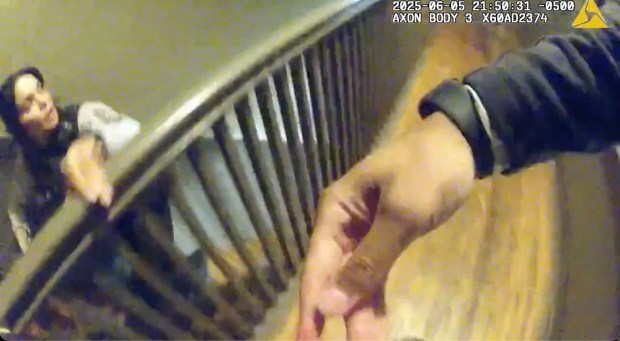

On the night of June 5, 2025, Chicago police Officer Krystal Rivera was fatally shot by her partner Officer Carlos Baker as they pursued a suspect into a Chatham apartment building. Questions about that night have persisted for more than 10 months. The Civilian Office of Police Accountability’s April 17 release of body camera footage partially answers those questions.
This video release marks a telling moment in the city’s long-term project of building a transparency regime worthy of the people’s right to know. On one hand, it demonstrates the strength of the norms and expectations that have taken hold since the city adopted its current video release policy in the wake of the Laquan McDonald scandal. On the other hand, it reveals the limitations of that policy and the need for further reforms.
Under the policy, video evidence in police shooting cases is to be released within 60 days of an incident. In this instance, it took more than 10 months. That was not, however, due to backsliding by the city. Rather, what derailed the process was a secrecy order imposed by Cook County Judge Barbara Dawkins in the criminal case of Adrian Rucker, one of the two men charged with felonies in connection with the sequence of events that led to Rivera’s death. Neither the defense nor the prosecution requested such an order; Dawkins issued it on her own initiative.
Several media organizations intervened to challenge the order. (I was among the intervenors.) On March 27, the Illinois Court of Appeals overruled Dawkins, finding she had exceeded her authority. In doing so, the court made it clear that the city could withhold the videos on other grounds: “Nothing in this decision requires the release of the material named.”
The city did not take the court up on that suggestion and should be commended for adhering to its transparency policies in a case that reflects so poorly on the Chicago Police Department. Arguably, Baker should never have been on the police force, and he certainly should not have been partnered with Rivera. While a probationary officer, Baker accrued a sufficient number of troubling misconduct complaints to warrant terminating him — among them, an allegation that he brandished a gun at an ex-girlfriend in a bar.
Even more disturbing, Rivera and Baker had had an off-and-on intimate relationship. According to a wrongful death lawsuit that Rivera’s family brought against the city of Chicago and Baker, she had ended the relationship and asked her supervisors to assign her another partner because of Baker’s “prior reckless conduct.” Her request initially was granted, but she later was reassigned to Baker.
The family’s lawsuit alleges that Baker had refused to accept the end of his personal relationship with Rivera and had appeared unannounced at her home the night before he shot her.
Two months after the shooting, Baker allegedly attacked another female officer in an off-duty incident at a bar. It is further alleged that he posed as an investigator in an effort to get surveillance video of the incident from a nearby business. Those allegations finally resulted in his being stripped of his police powers.
That was the context in which COPA released two videos — one that is five minutes and 40 seconds long from Baker’s body camera and another that is two minutes and 45 seconds long from Rivera’s body camera. The footage reveals that after Baker shot Rivera, 90 seconds elapsed before he acted to render aid or call for emergency aid. When he eventually called dispatch, he did not provide accurate information about what had happened but instead declared: “Shots fired at the police.”
Although revealing, the footage released by COPA is also seriously incomplete. Immediately after the appellate court decision striking down Dawkins’ secrecy order, I submitted Freedom of Information Act requests to CPD and COPA seeking video footage of the incident. In its April 10 denial of my request on grounds of undue burden, CPD explained that “a minimum of 500 minutes of responsive video” would require at least 41 hours to review before it could be released.
Thus, out of more than eight hours of “responsive video,” COPA released around eight minutes and 30 seconds of footage. The issue here is not whether the city is deliberately hiding anything. The problem resides rather in the language of the ordinance that leaves it to the editorial judgment of COPA staff to determine what footage is “related” to an incident and hence of public interest.
Since the city adopted the video release policy more than a decade ago, experience has repeatedly demonstrated the fallacy of limiting inquiry to the precise moment when a police officer fires their gun. Before that moment, we have repeatedly seen how actions by the police can produce the “split second” in which they chose to use lethal force. And after that moment, we have seen how quickly interactions among officers at the scene can generate self-serving official narratives.
COPA to its credit has been moving by degrees away from the “split second” paradigm of analysis, but that welcome tendency has made apparent the deficiencies of the current transparency policy. Once analysis is no longer limited to a narrow focus on the split second, it is not possible to determine relevance until the full investigation is completed, a process that routinely takes a year and often longer.
The time has come to act on this body of experience and revise the ordinance.
COPA should not make editorial decisions about “relevance.” Rather, all body camera footage of all officers at the scene (not only the officers directly involved in the incident), as well as all video from other sources, should be released in its entirety.
The core principle is simple: Release it all, and let the public determine what is in the public interest.
Jamie Kalven is founding executive director of the Invisible Institute, which was awarded two Pulitzer Prizes in 2024. His reporting first brought the police murder of Laquan McDonald case to public attention.
Submit a letter, of no more than 400 words, to the editor here or email letters@chicagotribune.com.