
For a long time, I struggled to even say it out loud — that my abuela, Elisa Presa, had liver cancer. As if naming it would make it irreversible. As if I could eliminate the possibility of losing her.
When I lost my grandmother on April 22, 2025, about a year ago, I held her hand as she took her last breath. Her pain had ceased, but our family’s pain was just ramping up.
Grief, especially from cancer, is a quiet kind of devastation. You lose your loved one in pieces: to uncertainty, to fatigue, to the slow betrayal of their body.
And when they’re gone, you’re left with questions that don’t have answers: Did I do enough? Did I love them enough?
After her death, I happened to speak with Dolores Castañeda, who carries her own story of caregiving and loss.
For nearly five years, she had cared for her brother, Trinidad Vera Lule, who had colon cancer. He died in December at age 62.
“We need to advocate for them,” she told me. “We have to be strong for them.”
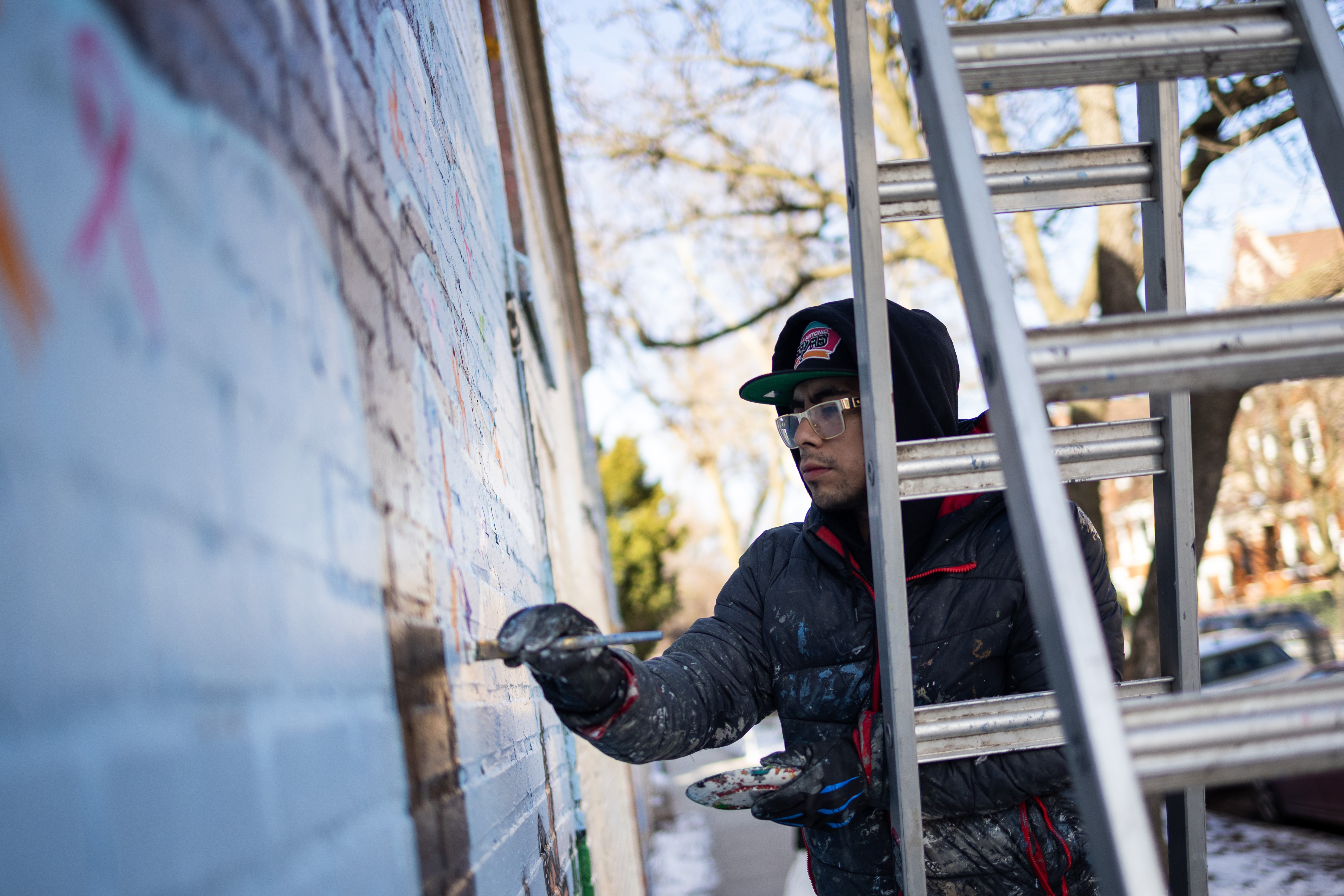
After his death, she found a way to turn her grief into something visible. She raised funds to have a mural painted in Little Village to honor her brother, my abuela and all of those who died of cancer.
At the corner of South Drake Avenue and 26th Street, the mural of Jesus beside a tree whose leaves are ribbons, each one representing a different type of cancer, serves as both art and altar.
Her brother’s name is there. So is my abuela’s, alongside dozens of others.
“It is a reminder that we share this pain, it is a reminder of their resilience and that we must keep on living in their honor,” Castañeda told me.
On a recent Sunday morning, people gathered around the mural, speaking names, telling stories, remembering not just how their loved ones died, but how they lived.
As a society, we don’t talk enough about what it means to care for someone who is dying. The quiet trauma of it. The way that level of intimacy changes you.
People tell you how lucky you are to grow up with a grandparent who loves you deeply — the kind who feeds you until you’re full, who prays over you at night, who holds your hand like it’s the most important thing in the world.

What they don’t tell you is what comes later: the slow unraveling. The way time asks you, gently at first and then all at once, to return that same care.
What no tells you about having such loving Mexican grandparents is the immense pain that comes with watching them get older and weaker. The sleepless nights you’ll spend at the hospital watching over them when they’re sick. The names of all the medications you’ll have to learn to make sure they’re taking them at the right times.
No one tells you that one day you’ll have to braid your grandma’s hair because she can no longer do it herself. You’ll have to hold her by the arm to help her walk, just like she once held yours to teach you how to walk. No one tells you how much greater love becomes.
When she was diagnosed with cancer in November 2024, I knew it was my turn to care for her in the same loving way she had cared for me. It was a privilege to be by her side at the hospital, even as exhaustion settled into my bones.
We still found reasons to smile. Her laugh was loud and heartfelt.
I would hold her warm hand, tracing the lines in her skin, memorizing them without realizing I was doing so.
What do you do with a heartbreak at the holidays? Forgive the father you never had
My abuela was very religious. Catholic, to be exact. Growing up, we would gather outside her bedroom every night to pray: my cousins, my younger uncles, and me. One by one, she would bless us before we went to sleep.
So when we first got the diagnosis, we did what we knew. We prayed.
She believed, with a certainty I envied, that God would have the last word. I had rehearsed how I would speak to her, trying to match the tenderness she had always shown me.
“We have to have faith; everything will be just fine,” I told her. The same words she had uttered countless times.
But cancer does not move at the pace of hope. Soon after the diagnosis, her health began to deteriorate. It was hard to reconcile this fragile version of her with the woman who had seemed unshakable.

Looking back, I wonder if she had been afraid all along, and simply chose to protect us from it.
When we heard the word hospice after less than 6 months, it felt like surrender. But she kept trying: physical therapy, eating on her own, holding onto every small act of independence.
She kept praying. We did too.
Even in the most painful moments, she showed us unconditional love.
“Qué te duele?” What hurts, I would ask her.
“Nada hija. Estoy bien.” Nothing, my dear — I’m OK, she would respond.
And even as her body was failing, she still looked out for me. How lucky I was to have known my abuela. I would spend a thousand more years with her at those hospital appointments if that were the reason she could stay with me for a lifetime.

Castañeda helped me realize that the grief I carry is not mine alone.
It belongs to all of us who loved someone through illness. To all of us who sat in hospital rooms, whispered prayers, memorized the sound of a voice we knew we might lose.
There was a time when it felt impossible to imagine life without my abuela. Now, life moves forward with her presence felt in quieter ways.
I worry that one day I’ll run out of photos of her to post. That it may mean I’ll run out of moments from the life we shared. The fear of forgetting.
“Persígnate hija,” she would say all the time, referring to the motion of making the sign of the cross.
I remember one time walking together in Mexico, holding her hand. I looked up at her and thought: I wish this could last forever. So I promised myself then that I would take as many pictures of her as possible, to preserve her by my side.

I realize now that no picture could ever contain the love we shared or the depth of the grief her absence has left.
I understand now that her spirit is imprinted in my soul. Every time I see beautiful flowers, hear birds chirping or smell café de olla, she’s with me.
She is not just a memory I hold onto, she exists in the way I love, the way I care, the way I move through this world. Maybe one day I will run out of photos to post, but I will never run out of her.
On that corner in Little Village, her name is painted alongside so many others.
Each one carries a story, a family, a loss that reshaped a life. Together, they form something larger than grief. They show the great love we all share.