
Indiana Democratic leaders and voting rights groups have been quick to denounce the recent Supreme Court ruling in a Louisiana case gutting the Voting Rights Act.
While state Republican leadership has remained publicly silent on the issue, a local Republican Party official did not disagree with the decision.

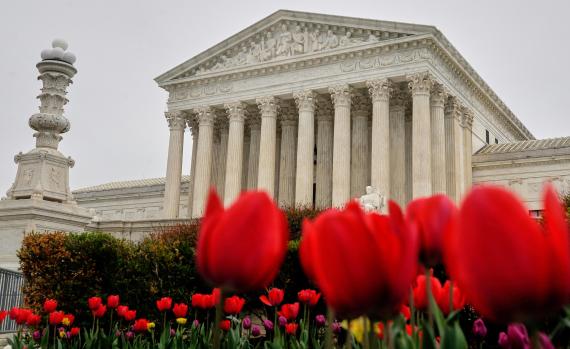
The Supreme Court on Wednesday hollowed out a landmark Civil Rights-era law that has increased minority representation in Congress and elsewhere, striking down a majority Black congressional district in Louisiana and opening the door for more redistricting across the country that could aid in Republican efforts to retain control of the House of Representatives.
In a 6-3 ruling, the court’s conservative majority found that the Louisiana district represented by Democrat Cleo Fields relied too heavily on race. Chief Justice John Roberts had described the 6th Congressional District as a “snake” that stretches more than 200 miles (320 kilometers) to link parts of Shreveport, Alexandria, Lafayette and Baton Rouge.
“That map is an unconstitutional gerrymander,” Justice Samuel Alito wrote for the six conservatives.
Louisiana’s map created two majority-Black districts, in a state where Black residents make up 33% of the state’s population, according to a statement from the Indiana Black Legislative Caucus.

Donald Trump’s administration filed a lawsuit against the map, arguing it created districts based on race and violated the 14th Amendment. The U.S. Supreme Court agreed, issuing a decision “that further guts the Voting Rights Act of 1965,” according to the caucus statement.
“The basis of the Voting Rights Act was to ensure that African Americans had both equal access to the polls and equal representation in governmental bodies. Today’s decision is yet another blow in a decades-long attack on the Voting Rights Act and on minority Americans’ ability to have a voice in their communities and national government,” said State Rep. Earl Harris Jr., D-East Chicago, chair of the Indiana Black Legislative Caucus, in the statement.
Harris said the Supreme Court’s ruling will have greater impacts beyond Louisiana because it will likely “be used to silence minority voices and uphold the violent white supremacy that has marred our nation from its inception.”
“This was an opportunity for the Supreme Court to affirm every American’s right to be fairly represented in their government. Instead, they chose to take our country back decades. The harm that this decision will cause cannot be overstated. This is a sad day for our democracy, but the IBLC is committed to continuing our work to advocate for fair maps that give everyone a voice,” Harris said.

The effect of the ruling may be felt more strongly in 2028 because most filing deadlines for this year’s congressional races have passed. Louisiana, though, may have to change its redistricting plan to comply with the decision.
It is unclear how much of the provision — known as Section 2 of the Voting Rights Act of 1965 — remains.
Indiana Democratic Party Chairwoman Karen Tallian said in a statement the Supreme Court’s decision significantly narrows Section 2 of the Voting Rights Act, a section that ensured minority voters have the right to fair representation and stopped politicians from intentionally discriminating against minority communities.
“This decision is shameful. The architects of the Voting Rights Act clearly meant for it to protect African American voters and communities from having their voices silenced or diluted, like they had been for decades before,” Tallian said. “It was a landmark piece of legislation that sought to guarantee minorities equal representation and protect every citizen’s right to vote.”
With its decision, the Supreme Court has undone decades of precedent that solidified the Voting Rights Act and silenced the voices of minority voters, Tallian said.
“This is yet another decision favoring a Trump-backed lawsuit designed to erode the rights of Americans to have an equal say in our government. Now, more than ever, we reaffirm our commitment to fair maps, strong voting protections and equal representation for every Hoosier and American citizen. The stakes are too high to back down,” Tallian said.
Lake County Republican Party Chairman Randy Niemeyer said he doesn’t see how the ruling guts the Voting Rights Act because congressional districts should be drawn based on census data without regard for race, nationality or creed.
The narrative of the ruling gutting the Voting Rights Act is being pushed by a group with a specific ideology, Niemeyer said.
Overall, Niemeyer said the ruling establishes that no practice of law should be discriminatory for or against one group of people. While the ruling will likely impact states outside of Louisiana, any state that changes its Congressional maps will be challenged in court, he said.
“I don’t see it as a clear path forward because each state is different,” Niemeyer said.
When President Lyndon Johnson signed the bill — the main way to challenge racially discriminatory election practices — into law more than 60 years ago, he called it “a triumph for freedom as huge as any victory on any battlefield.”
In her dissent for the three liberal justices, Justice Elena Kagan wrote that the court’s “gutting of Section 2 puts that achievement in peril.”
Her sentiment was shared by former President Barack Obama, who said the decision showed “how a majority of the current Court seems intent on abandoning its vital role in ensuring equal participation in our democracy.”
In a statement, Fields said the decision’s “practical effect is to make it far harder for minority communities to challenge redistricting maps that dilute their political voice.”
The voting rights law succeeded in opening the ballot box to Black Americans and reducing persistent discrimination in voting. Nearly 70 of the 435 congressional districts are protected by Section 2, election law expert Nicholas Stephanopoulos has estimated.
Alito wrote that “allowing race to play any part in government decisionmaking represents a departure from the constitutional rule that applies in almost every other context.” He said Section 2 is effectively limited to instances of intentional discrimination, a very high standard.
Kagan said the upshot of the decision is that states “can, without legal consequence, systematically dilute minority citizens’ voting power.”
Barring extraordinary action, the broader impact probably will be felt in 2028, when Republicans potentially can replace more than a dozen Democratic-held House districts that were previously protected under the Voting Rights Act.
“The Voting Rights Act as a means to protect minority voters from vote dilution is essentially dead,” said Jonathan Cervas, a political scientist at Carnegie Mellon University who has served as an outside legal expert in multiple Voting Rights Act cases.
Michael Waldman, president and CEO of the Brennan Center for Justice, said in a statement that the Supreme Court “blessed race discrimination and encouraged partisan gerrymandering” in its ruling. Waldman called on Congress to respond by banning gerrymandering in congressional races.
“With this ruling, the Court has completed its decades-long work to effectively demolish the Voting Rights Act. Today’s ruling likely leaves this landmark law a hollow husk. The Court’s majority claims to have left Section 2 of the Voting Rights Act standing, but it, in fact, will encourage less transparent and less representative districts. This ruling allows racial discrimination if it also serves overtly hyper-partisan interests. That’s outrageous,” Waldman said.
Indiana House Democratic Leader Phil GiaQuinta, D-Fort Wayne, said Indiana defeated midcensus redistricting in December, which proposed maps that would have redrawn the districts representing Indianapolis — with a 31% Black population and 16% Hispanic population — and other urban areas and big cities, like in Lake County. But, the Supreme Court made a major ruling that “violates the spirit of the Voting Rights Act,” GiaQuinta said.
“People need to trust that their representatives are truly accountable to them, and map rigging destroys that trust. Indiana House Democrats will keep fighting for fair maps that reflect our communities, not maps drawn to protect one political party,” GiaQuinta said.
Indiana Senate Democratic Leader Shelli Yoder, D-Bloomington, said in a statement that the Supreme Court’s decision “makes it harder to ensure that every American has a fair and equal voice.”
“We cannot afford to treat this as abstract. Fair maps are the foundation of trust in our elections. When that foundation is weakened, everything built on it is at risk,” Yoder said. “We will continue to push for transparency, accountability and redistricting processes that respect communities and protect every Hoosier’s voice.”
The Associated Press contributed.
akukulka@post-trib.com